
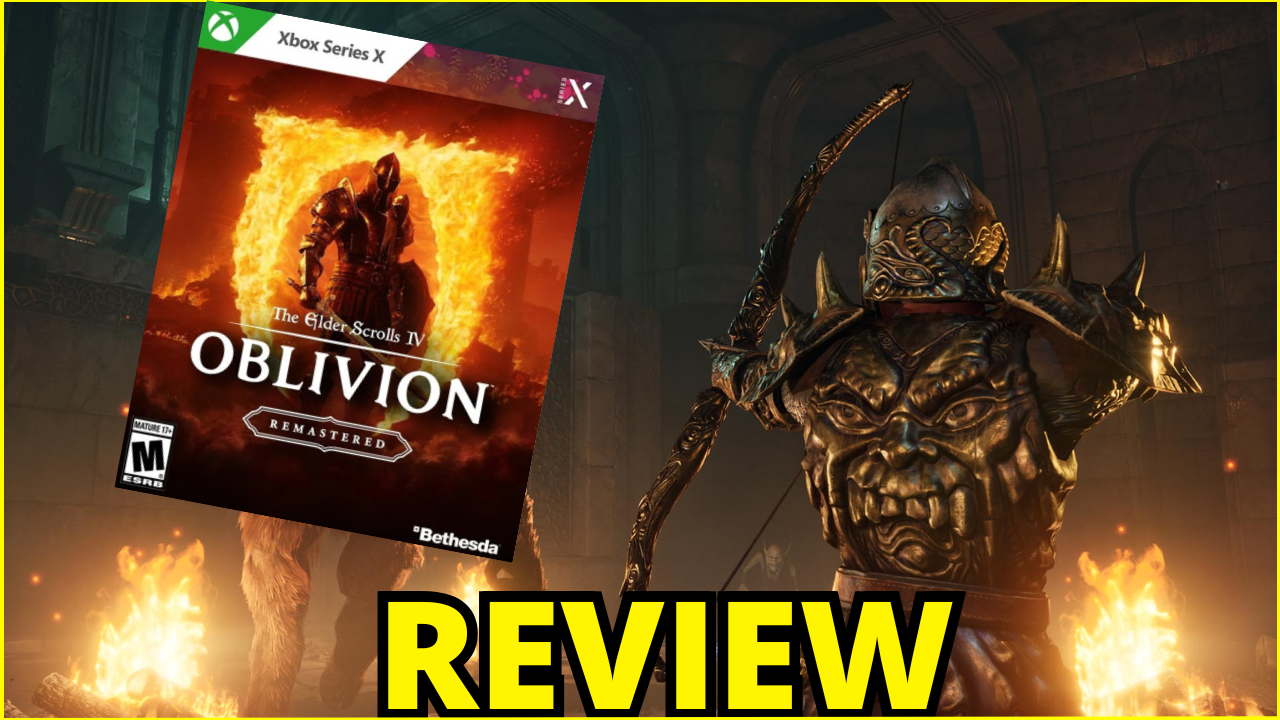
The Elder Scrolls IV: Oblivion Remastered

8
B-Tier
Genre:
Action-Adventure, First-Person, RPG
Platforms:
PC, Ps5, Xbox (Series, One)
Tier Score:
B-Tier
Developer:
Bethesda Game Studios, Virtuos
The Elder Scrolls IV: Oblivion Remastered Review – A Flawed Classic That Still Has Magic in 2025
Introduction
I’m not usually a nostalgia gamer. I don’t often go back and replay older titles, and I generally prefer moving forward—checking out what’s new, what’s evolving, and what’s pushing the medium ahead. But every now and then, a remake or remaster comes along that forces me to stop, look back, and reconnect with who I used to be as a gamer.
The Elder Scrolls IV: Oblivion Remastered did exactly that.
Originally released in 2006, Oblivion sits at a pivotal moment in RPG history. It bridged the gap between old-school, systems-heavy role-playing and the more streamlined open-world design that would later define Skyrim. Nearly two decades later, this remastered version asks an important question: does Oblivion still matter in 2025?
The answer, surprisingly, is yes—warts, jank, potato faces, and all.
Narrative
One of Oblivion’s greatest strengths has always been its storytelling structure. Unlike many RPGs that place the player at the center of a grand prophecy, Oblivion takes a different approach. You aren’t the chosen one—you’re the person tasked with finding and supporting the chosen one. That framing alone gives the narrative a grounded, almost refreshing tone.
The main story revolves around the Oblivion Crisis: demonic gates opening across Cyrodiil, threatening to consume the world. While the act of closing these gates can become repetitive over time, the overarching narrative still carries weight and purpose. There’s a sense that what you’re doing matters, even if the mechanics occasionally wear thin.
Where Oblivion truly shines, however, is in its guild questlines.
The Dark Brotherhood remains one of the best-written questlines Bethesda has ever produced. Its assassinations are creative, its characters memorable, and its twists genuinely engaging even years later. The Thieves Guild excels at forcing players to think on their feet, emphasizing planning, stealth, and improvisation over brute force. The Mages Guild delivers a surprisingly compelling story that explores power, ambition, and responsibility.
Not every faction holds up equally—the Fighters Guild feels dated and overly fetch-quest driven—but when Oblivion is firing on all cylinders narratively, it’s still exceptional. The Shivering Isles expansion, in particular, remains a masterclass in weird fantasy world-building, with Sheogorath standing as one of the most iconic characters Bethesda has ever created.
Gameplay
At its core, Oblivion is built around a skill-based leveling system where abilities improve through use. Swing swords to level Blade, sneak to improve Stealth, cast spells to grow your magical disciplines. On paper, it’s immersive and intuitive. In practice, it can be wildly unbalanced.
If you don’t plan carefully, enemies can outscale you rapidly—leading to absurd situations where roadside bandits are decked out in Daedric armor while you’re still scraping by with iron gear. It’s funny at first, frustrating later, and undeniably part of Oblivion’s identity.
Combat is clunky by modern standards. Melee lacks impact, animations feel stiff, and enemy AI can be unpredictable. That said, magic remains a highlight. Destruction, Restoration, and especially Conjuration offer a sense of freedom and experimentation that still feels powerful today. Summoning bizarre creatures to do your dirty work never stops being entertaining—even when those summons get absolutely demolished early on.
And then there are the glitches.
In 2025, armed with modern guides and community knowledge, Oblivion Remastered practically invites you to break it. Duplication glitches, infinite magicka exploits, and overpowered builds are all still here—and honestly, that chaos is part of the charm. Few games allow you to become a literal god so spectacularly, and sometimes it’s just fun to embrace that power fantasy.
Presentation
Visually, Oblivion Remastered is a massive upgrade. Powered by Unreal Engine 5, Cyrodiil feels far more alive than it ever did in 2006. Forests are lush, lighting adds depth to environments, and load times are nearly instant—dramatically improving the flow of exploration.
The UI overhaul is another standout improvement, modernizing menus without stripping away their identity. However, the infamous NPC faces remain… unsettling. They’re cleaner, sure, but still firmly planted in meme territory.
Radiant AI also returns in all its unpredictable glory. NPCs follow schedules and routines, which sometimes leads to immersive moments—and other times results in villagers stealing food mid-conversation or randomly starting fights. It’s janky, but oddly endearing.
Pros
Oblivion Remastered succeeds because it preserves the soul of the original while smoothing out some of its roughest edges. The world still feels alive, reactive, and full of possibility. The guild questlines—especially the Dark Brotherhood and Thieves Guild—remain among the best Bethesda has ever written. The main story avoids tired “chosen one” tropes and instead grounds the player in a supporting but vital role within a larger crisis.
The visual upgrades, faster load times, and UI improvements make returning to Cyrodiil far more comfortable in 2025. The freedom to approach the world however you choose—whether as a mage, thief, warrior, or glitch-powered demigod—is still unmatched in many modern RPGs.
Cons
Despite the remaster, Oblivion is still very much a Bethesda game. Quest-breaking bugs, strange AI behavior, and awkward voice acting persist. You’ll hear the same voices repeatedly, encounter bizarre NPC behavior, and occasionally need to reload saves to progress.
The combat and leveling systems have not aged gracefully. Grinding skills through repetition can feel tedious, and the Fighters Guild questline lacks the narrative depth found elsewhere. Closing Oblivion Gates becomes repetitive, and players who dislike jank or dated design may bounce off hard.
Overall / Should You Play It?
Yes—if you’re willing to embrace the chaos.
The Elder Scrolls IV: Oblivion Remastered isn’t a perfect remaster, and it certainly isn’t a perfect game. But it’s charming, deep, endlessly replayable, and still filled with a kind of magic that modern RPGs sometimes lack.
If you’re new to The Elder Scrolls and want the smoothest entry point, Skyrim is probably the safer choice. But if you want something stranger, bolder, and more characterful—Oblivion has a soul that still shines through its flaws.
I put another 60 hours into Oblivion Remastered in 2025, and I didn’t expect to. The world pulled me back in. The guilds hooked me all over again. The jank made me laugh instead of quit.
On the Single Player Experience review scale, The Elder Scrolls IV: Oblivion Remastered earns an: