
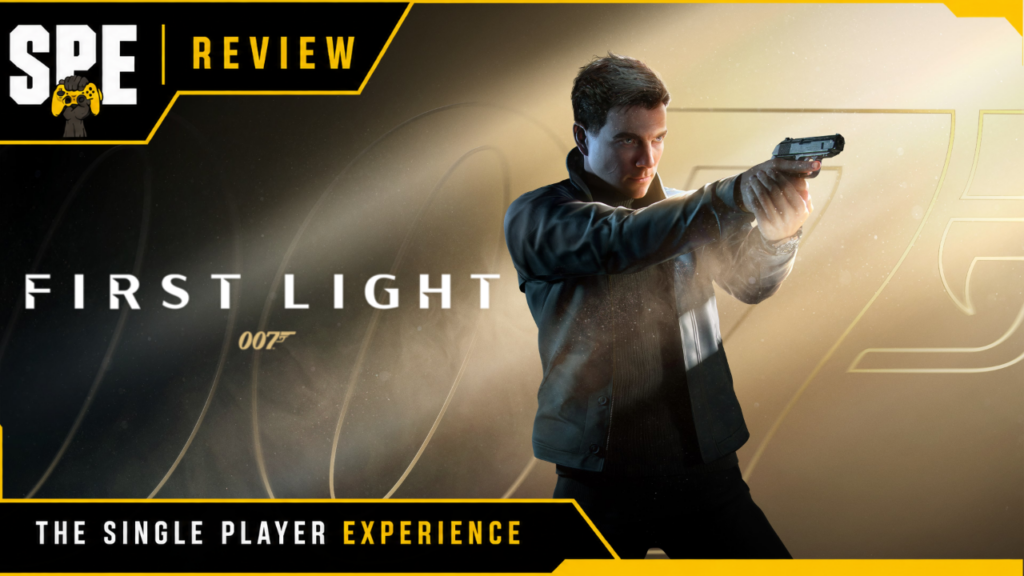

007 First Light Review: The New Standard 007 Game Experience?
Intro: The Name's Bond
I’ve been waiting for a game like 007 First Light for a long time, and not necessarily because I’m some lifelong James Bond superfan. I’m a 90s kid who grew up playing GoldenEye, Nightfire, Everything or Nothing, Agent Under Fire, and From Russia with Love, so Bond games have always been somewhere in my gaming history. But my real connection to the character came much later through the Daniel Craig movies, particularly Casino Royale and Skyfall. What I’ve been missing, though, is something a little more specific: that big-budget, over-the-shoulder action-adventure game that makes you feel like you’re stepping directly into the shoes of an iconic character.
That is my favorite kind of AAA game. I love Uncharted. I love God of War. I love the modern Spider-Man games. I love anything that makes me feel like I’m playing through a ridiculously expensive action movie where the character I’m controlling actually feels like the character I’m supposed to be. That combination of cinematic presentation, explosive set pieces, hand-to-hand combat, gunplay, exploration, and spectacle is basically catnip for me.
007 First Light understands that fantasy almost immediately.
This feels like the long-lost child of the Uncharted series and IO Interactive’s own Hitman: World of Assassination trilogy, with a little bit of Arkham-style melee combat thrown into the mix. It isn’t perfect, and its roughly 15-to-20-hour runtime occasionally works against it, but when First Light is firing on all cylinders, it delivers exactly what I’ve wanted from a modern James Bond game.
More importantly, by the time the credits rolled, I had a realization that I don’t think many licensed games manage to achieve: this is now the James Bond game I’m going to think about whenever I want to play a James Bond game.
Set the Scene
007 First Light starts with a fucking bang, and I mean that literally.
The game wastes very little time establishing that this isn’t going to be some quiet, grounded spy thriller. Bond’s story begins with him serving in the Royal Navy as an aircrewman during a training mission in Iceland. Naturally, things go horribly wrong, and what initially appears to be a routine exercise quickly turns into something much more dangerous. It is the kind of opening that immediately tells you what kind of ride you’re in for.
From there, First Light does something I genuinely haven’t seen another game execute quite like this: it turns Bond’s training into one giant tutorial.
Instead of dumping a series of disconnected gameplay tutorials on you, the game puts you through a training montage where each sequence introduces another part of the game’s mechanics, world, characters, gadgets, and level design. You’re learning how to fight, sneak, use gadgets, navigate environments, and approach situations while simultaneously watching James Bond develop into the operative he’s eventually going to become.
It is an inspired way to begin the game because the tutorial never feels like a tutorial. You’re watching Bond train while you’re learning how to play as Bond. The game gets you acquainted with the people around him, establishes his personality, introduces the world of MI6, and gives you a taste of the tools you’ll eventually have at your disposal. By the time the training sequence is over, you’ve learned the fundamentals of First Light without ever feeling like you’ve been pulled out of the experience to study a control scheme.
It also immediately establishes the game’s biggest strength: 007 First Light knows how to make you feel like James Bond.
The opening hours are particularly strong. The game moves from the Arctic Circle to Vietnam, London, deserts, museums, and other memorable locations, with each setting giving IO Interactive another opportunity to create the kind of lavish set pieces that have become synonymous with Bond. There is a sense throughout the game that you’re constantly moving from one movie location to another, and the presentation does a great job selling that fantasy.
The problem is that the pacing doesn’t remain quite as sharp throughout the entire adventure. Around the six- or seven-hour mark, the game begins to feel a little slower and more padded. It doesn’t completely lose momentum, but there is a noticeable middle stretch where I started to feel the runtime more than I did during the opening hours.
Fortunately, First Light knows how to finish.
The final stretch kicks the door back open and throws you into some of the game’s biggest explosions, most elaborate action sequences, and strongest cinematic moments. By the time the credits rolled, I had absolutely gotten my fill, but I also found myself immediately wanting another Bond adventure. That’s a pretty good sign.
Narrative: A Strong Beginning
007 First Light is fundamentally an origin story. This is James Bond before he’s the fully formed 007 we know, and the game follows his journey from a talented but inexperienced young operative toward earning his place within the Double-O program.
That setup works surprisingly well because this Bond is very different from the version we’ve become accustomed to seeing on screen.
Patrick Gibson gives Bond a fantastic performance, portraying him as cocky, witty, arrogant, capable, and occasionally reckless. He’s confident because he knows he’s talented, but he’s still inexperienced enough that you can see why the people around him don’t necessarily trust him with everything. He’s not the weary, morally compromised Bond that Daniel Craig played so brilliantly across his films. He’s younger, more energetic, and much more willing to run headfirst into danger. And honestly, I really liked that.
Daniel Craig’s Bond is still my favorite version of the character, but First Light’s Bond feels like a refreshing change of pace. There’s something entertaining about watching a younger Bond who hasn’t completely figured himself out yet. His competence constantly clashes with his inexperience, and that gives the character somewhere to go over the course of the story.
The supporting cast is also one of the game’s strongest elements. Kiara Lester’s Penny provides a great balance of professionalism and sarcastic humor, while Lennie James’ John Greenway is exactly the kind of hard-ass mentor figure you’d expect to see in a Bond origin story. Greenway initially feels like an obstacle Bond has to overcome, but there’s enough humanity underneath the drill-sergeant exterior to make his relationship with Bond work.
The performances across the board are convincing, and that goes a long way toward selling the more cinematic moments. First Light has a cast that understands the tone of the material, and the result is a game that frequently feels more like a Bond movie than a licensed video game.
The story itself is considerably more predictable. The game’s themes surrounding artificial intelligence are timely and provide some interesting ideas to chew on, but I didn’t find the primary villains nearly as compelling as the heroes surrounding them. They occasionally feel like they were pulled straight out of an older Bond movie, which isn’t necessarily a bad thing, but I wanted more depth from the antagonists beyond their relationship with Isola and their broader ambitions.
Bawma, played by Lenny Kravitz, was another character I struggled to connect with. He’s a black-market arms dealer and crime lord who clearly has a larger role to play in the future of this version of Bond, but within the core campaign, his inclusion felt somewhat forced. There were moments where the game seemed determined to remind me that Bawma was important without giving me enough reason to understand why he needed to be such a prominent part of this particular story.
That may ultimately pay off in future content, but within First Light’s main campaign, I couldn’t shake the feeling that his character was being positioned for something that hasn’t arrived yet.
Even with those problems, the narrative succeeds where it matters most: it gives you a Bond worth spending 18 hours with. The story is predictable in places, but the characters, performances, presentation, and sense of progression make the journey enjoyable.
Gameplay
This is where 007 First Light really #ucking shines. IO Interactive has taken several different flavors of modern action games and blended them together into something that feels surprisingly cohesive. There is a little bit of Uncharted’s cinematic action-adventure structure, a little bit of Hitman’s environmental problem-solving, and a healthy dose of Arkham’s melee combat. Somehow, it works.
Bond is more than capable of throwing hands, and the melee system is one of my favorite parts of the game. Enemies telegraph attacks, allowing you to parry or dodge, and once you’ve softened an enemy up enough, Bond can perform some wonderfully animated finishing moves. You can also use the environment to your advantage, throwing enemies over railings or finding other contextual ways to take them down. It feels good. There is a satisfying crunch behind the melee combat that makes every punch feel impactful, and I love that IO Interactive didn’t simply make Bond another character who shoots everyone in sight. The game gives you the opportunity to fight intelligently and creatively.
That philosophy carries over into stealth. First Light frequently gives you multiple ways to approach an objective. You can sneak through environments, hide behind cover or vegetation, listen in on conversations, pickpocket people for useful items, and use gadgets to manipulate situations. Paying attention to your surroundings is usually rewarded, and there are enough alternative paths and solutions that I rarely felt like the game was forcing me down one exact route.
The Q-Watch is particularly useful. It functions as a Swiss Army knife for Bond, allowing you to locate objectives, scan through walls, identify people carrying items that can be pickpocketed, and generally gather information about your surroundings. It is one of those gadgets that feels genuinely useful rather than simply existing because Bond is supposed to have cool gadgets.
And then there are the gadgets themselves.
You can blind enemies with lasers, disarm them, use smoke grenades to obscure your position, deploy proximity explosives, fire micro-missiles from seemingly innocuous objects, and use other tools to manipulate encounters. The game encourages you to think about your loadout before entering certain situations, and different equipment choices can open or close different approaches.
I do wish the gadgets were incorporated into level design a little more aggressively. There are moments where I wanted the tools at Bond’s disposal to create completely new pathways through an environment rather than primarily being used to open a lock, disable something, or gain an advantage during combat. The creative toolbox is there, but I think IO Interactive could have pushed the environmental applications even further.
The gunplay is a little less impressive.
When you’re moving quickly between weapons, gadgets, melee attacks, and enemies, First Light can feel fantastic. I genuinely felt like a badass during some of the game’s larger firefights, especially when I was combining gadgets with melee attacks and gunplay. There is something incredibly satisfying about disarming an enemy, picking up their weapon, throwing your empty gun into somebody else’s face, and continuing the fight.
The problem is that some firefights simply go on too long.
The longer the game forces you into extended shooting sequences, the more repetitive the combat begins to feel. The game is at its best when you’re constantly switching between different approaches, rather than sitting behind cover and mowing down wave after wave of enemies.
The enemy AI also isn’t particularly impressive. Enemies can sometimes investigate bodies in a way that makes them ridiculously easy to manipulate, and there were moments where I could take down an enemy almost directly beside another guard without getting the reaction I expected. Considering how loud some of Bond’s melee takedowns sound, there were definitely moments where I wondered how someone three feet away didn’t hear the giant cinematic crunch happening behind them.
It doesn’t ruin the stealth, but it does occasionally expose the machinery underneath the fantasy.
Fortunately, the game’s set pieces do an excellent job of reminding you why you’re here.
The Pearl Hotel sequence in Vietnam, the museum sequence, the opening in Iceland, and the game’s later action sequences are exactly the kind of bombastic spectacle I wanted from this game. There are explosions, vehicle sequences, shootouts, chases, environmental destruction, and moments where the game basically grabs you by the collar and says, “You’re James Bond. Try to keep up.”
The balance between slower infiltration and explosive action is generally excellent. Some of the game’s best moments are actually the quieter ones where you’re navigating a crowded social environment, gathering information, or trying to figure out how to infiltrate an area without drawing attention.
Then the game eventually blows everything up. That’s Bond.
The soundtrack deserves special mention as well. Whenever the classic Bond musical themes begin to swell during a major moment, First Light suddenly feels enormous. The opening title sequence set to Lana Del Rey’s “First Light” is particularly effective, giving the game that unmistakable Bond identity right from the beginning. The music, cinematography, sound design, and action work together incredibly well to create the feeling of playing through a Bond movie.
Pros
The biggest strength of 007 First Light is its identity. This doesn’t feel like a generic third-person shooter that happens to have James Bond’s name attached to it. IO Interactive clearly understands what makes Bond appealing and builds the entire game around that fantasy. From the gadgets and stealth to the melee combat, exotic locations, dramatic musical cues, and ridiculous action sequences, First Light consistently makes you feel like you’re controlling James Bond.
The presentation is another major success. The performances are excellent, the cinematography is strong, and the soundtrack knows exactly when to lean into that classic Bond sound. Patrick Gibson’s performance gives this younger version of Bond a personality that separates him from previous portrayals, while the supporting cast provides enough charm and personality to carry the quieter moments between the explosions.
I also love the game’s willingness to borrow from other successful action games without simply copying them. The melee combat has clear Arkham and Uncharted DNA, while the environmental options and gadgets carry some of IO Interactive’s Hitman philosophy. First Light feels like an amalgamation of some of my favorite AAA design philosophies, but it still manages to feel like its own thing.
Most importantly, the game made me want to replay it immediately after finishing it. That’s something I can’t say about every cinematic single-player game I play. First Light scratched a very specific itch that I’ve had for years, and it did so well enough that I can already see myself coming back to it whenever I get the urge to play a James Bond game.
Cons
The biggest strength of 007 First Light is its identity. This doesn’t feel like a generic third-person shooter that happens to have James Bond’s name attached to it. IO Interactive clearly understands what makes Bond appealing and builds the entire game around that fantasy. From the gadgets and stealth to the melee combat, exotic locations, dramatic musical cues, and ridiculous action sequences, First Light consistently makes you feel like you’re controlling James Bond.
The presentation is another major success. The performances are excellent, the cinematography is strong, and the soundtrack knows exactly when to lean into that classic Bond sound. Patrick Gibson’s performance gives this younger version of Bond a personality that separates him from previous portrayals, while the supporting cast provides enough charm and personality to carry the quieter moments between the explosions.
I also love the game’s willingness to borrow from other successful action games without simply copying them. The melee combat has clear Arkham and Uncharted DNA, while the environmental options and gadgets carry some of IO Interactive’s Hitman philosophy. First Light feels like an amalgamation of some of my favorite AAA design philosophies, but it still manages to feel like its own thing.
Most importantly, the game made me want to replay it immediately after finishing it. That’s something I can’t say about every cinematic single-player game I play. First Light scratched a very specific itch that I’ve had for years, and it did so well enough that I can already see myself coming back to it whenever I get the urge to play a James Bond game.


