
Romeo Is a Dead Man Review (PC) - A Wild Hack-and-Slash Throwback That Never Quite Comes Together
Set the Scene
I first became interested in Romeo is a Dead Man during a showcase in June 2025, when the game appeared with exactly the kind of trailer that makes you stop and wonder what the hell you’re looking at. On paper, it seemed to combine several things that I already knew I liked while avoiding one of the biggest trends in modern action games that has increasingly turned me away from the genre. It looked like an anime-inspired action game with a completely unhinged science-fiction premise, but underneath all of that was something that reminded me of the action-adventure games I grew up playing during the PS2 through Xbox 360 era. More importantly, it didn’t look like another Souls-like. As someone who has never really connected with the Souls formula outside of Star Wars Jedi: Fallen Order and Jedi: Survivor, the prospect of getting a straightforward hack-and-slash action game in 2026 was incredibly appealing.
That initial impression is probably why I had such high expectations for Romeo is a Dead Man. The game looked nostalgic without appearing completely stuck in the past, and its visual presentation had enough modern polish to make the whole thing feel like a revival of a genre that has largely disappeared from the mainstream. There was a time when we regularly received action games that were happy to simply let you run into a room, fight a ridiculous number of enemies and feel like an absolute badass. Games like the original God of War trilogy, Devil May Cry and Dante’s Inferno understood that there was value in making an action game primarily about the joy of fighting your way through increasingly ridiculous situations. Romeo is a Dead Man seemed like it wanted to bring some of that energy back, and as someone who has always had a soft spot for that era of games, I was ready for it.
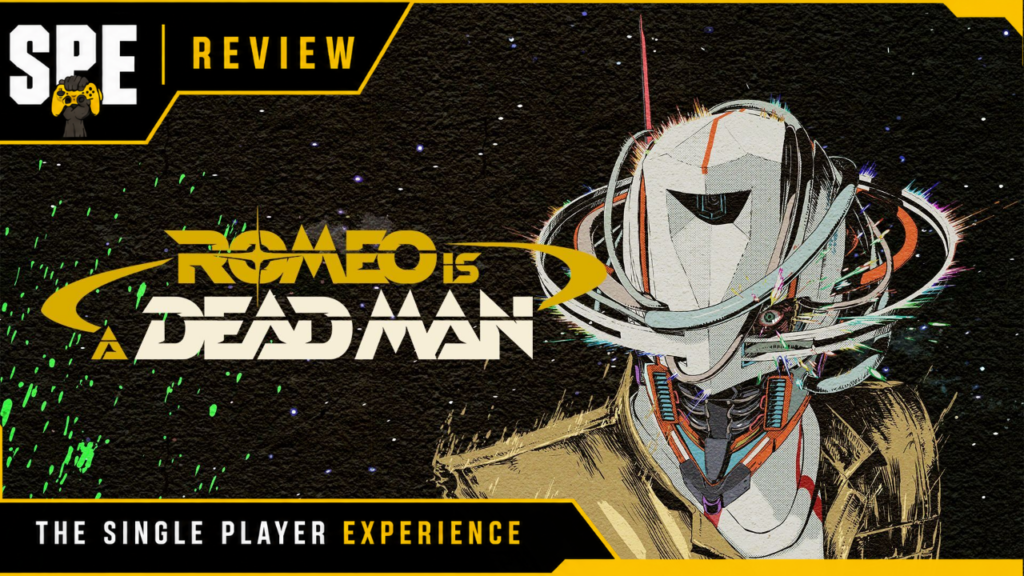
The actual game is even stranger than the trailer suggested. You play as Romeo, an ordinary police officer whose attempt to help a woman in distress turns into the beginning of a zombie apocalypse. Romeo ends up dead, only for his grandfather to appear with a time-traveling device called the Dead Gear that essentially brings him back as a half-human, half-dead version of himself. His grandfather then becomes a talking, stitched-on patch attached to the back of Romeo’s jacket, providing guidance while Romeo travels through a bizarre science-fiction world filled with zombies, strange creatures and situations that routinely made me stop playing just long enough to ask myself what I had actually just witnessed.
That absurdity is not an accident. Romeo is a Dead Man was written and directed by Suda51, and while I haven’t played enough of his previous work to speak confidently about how this compares with the rest of his catalog, it doesn’t take long to understand that the game’s bizarre personality is very much part of its identity. The opening menu alone is a perfect example. A fish is repeatedly disintegrated and rematerialized inside a fish tank while a solar system moves around it, and nearby there’s a ballet dancer statue fused with a coral reef. None of that prepares you for the actual game, but somehow it feels like the perfect introduction to the kind of chaotic experience Grasshopper Manufacture has created here.
Narrative
The problem for me is that while I could appreciate how intentionally strange Romeo is a Dead Man is, I struggled to become invested in the actual story. There were plenty of moments when I would pause and genuinely ask myself, “What the fuck is actually happening?” The game throws so many concepts, characters and bizarre plot developments at you that I often felt like I was watching an anime that had started halfway through its second season. I could recognize that something interesting was happening, and I could appreciate the style of the presentation, but I rarely felt like I had a firm grasp on why any of it mattered.
That was particularly disappointing because I’m someone who tends to connect with games through their narratives. The concept of Romeo being transformed into a dead man through a time-traveling device, traveling through a bizarre science-fiction world and dealing with zombies and other supernatural threats sounds like something that should have been right up my alley. The problem is that the story never gave me enough of a foundation to become emotionally invested in those ideas. By the time I was several hours into the game, I could describe the general madness surrounding Romeo, but if someone asked me to explain the actual plot and the major conflicts taking place, I would probably give them a terrible answer.
I don’t necessarily think Romeo is a Dead Man needs to become a straightforward narrative adventure, because the game’s weirdness is clearly part of its appeal. There is something entertaining about never quite knowing what ridiculous thing is going to happen next, and the game’s cutscenes are visually stylish enough that I enjoyed watching them even when I wasn’t completely sure what they were trying to communicate. The problem is that eventually the novelty of being confused starts to wear thin. Weirdness works best when there is something underneath it to become invested in, and I never quite found that foundation here.
Gameplay
The core of Romeo is a Dead Man is much easier to understand than its story. This is an old-school hack-and-slash action game, and for the most part, it knows exactly what it wants you to do. You have standard and strong attacks that can be combined into different strings, and successful attacks build a meter that allows you to unleash a powerful ability capable of damaging multiple enemies while also restoring some of your health. There is also a gun that becomes particularly useful against stronger enemies because many of them have vulnerable spots that can be targeted for significant damage. Finding those weak points can be difficult in the middle of a chaotic encounter, especially when you’re surrounded by multiple enemies, but landing those shots adds a nice bit of variety to what could otherwise become a purely melee-focused combat system.
When the combat works, it delivers exactly the kind of cathartic action I was hoping for when I first saw the game. Cutting through a crowd of zombies with a combination of quick and strong sword attacks can be genuinely satisfying, particularly when you build up enough blood to activate your ultimate ability. The soundtrack helps considerably during these moments, because the game knows when to throw a loud rock track into the mix while Romeo is slicing through enemies with his katana. There are other moments where the music shifts into surprisingly relaxed jazz while you’re exploring, and that contrast fits the game’s strange personality better than you might expect.
The game also has a fun approach to death. Whenever Romeo dies, you’re taken to a game-show-style wheel that you can spin to determine what kind of benefit you’ll receive when you restart. Depending on where the wheel lands, you can receive bonuses such as increased attack power, increased defense or a revival that lets you continue from the point where you died. The revival option became particularly valuable during boss fights because it allowed me to return to the encounter without having to completely restart the battle, and the enemy would still have the same amount of health I had managed to remove before dying. During some of the more difficult encounters, I found myself ignoring the offensive and defensive bonuses altogether because I would rather take the guaranteed revival and continue chipping away at the boss.
Unfortunately, the combat has a major issue that kept me from enjoying it as much as I wanted to. There are times when you’re attacking an enemy while that enemy is simultaneously attacking you, and the game doesn’t necessarily communicate the impact of those exchanges very well. You can continue swinging your weapon while an enemy is hitting you, which creates a strange situation where both characters appear to be simply trading blows without much physical reaction. Your health bar is dropping, so you know you’re being damaged, but you don’t always feel the individual hits in the way you would in a game where every successful attack creates a noticeable reaction.
That distinction matters more than it might sound because good hack-and-slash combat should make you feel the difference between landing a devastating attack and getting hit by one. I like combat systems that can create the sensation of a heavyweight boxing match, where two opponents are trading blows and you can clearly tell who is winning each exchange. Romeo is a Dead Man occasionally feels more like two characters standing in a room and rapidly subtracting health from each other. The actual mechanics are functional, but the physical feedback isn’t always strong enough to make the combat feel as impactful as it looks.
The game also occasionally throws you into groups of enemies that can overwhelm you before you have much opportunity to react. There were several moments where I moved into a crowd and suddenly found myself surrounded while multiple enemies attacked simultaneously. It could feel like getting jumped by a pack of hyenas when you’re the only gazelle in sight, and because the game doesn’t always provide strong feedback when you’re being hit, those encounters could end with me looking at my health bar and realizing that I had somehow lost most of it without fully understanding what had happened.
The level design created another problem for me. One of the earliest major areas takes place inside a massive shopping mall filled with zombies, which immediately reminded me of Dead Rising and seemed like exactly the kind of ridiculous environment where this game should thrive. The objective is to activate several generators throughout the mall, and while most of them were relatively easy to locate, I spent roughly 45 minutes trying to find the last one. The map didn’t do much to help me identify where I needed to go, and eventually the experience became less about exploring the environment and more about wandering around hoping I would accidentally stumble across the objective.
That issue became a recurring frustration because I wanted Romeo is a Dead Man to feel more focused. Instead, I occasionally found myself spending more time trying to figure out where the game wanted me to go than actually enjoying the combat. It’s especially frustrating because the game’s strongest qualities are so obvious when it gets out of your way and lets you fight.
There is also a significant shift in gameplay whenever you return to your spaceship between missions. The main game is presented as a modern 3D action-adventure experience, but the spaceship hub transforms into something resembling a top-down 32-bit RPG. You can talk to your crewmates, upgrade equipment, take on side quests and move around the ship before eventually returning to the larger 3D world. The ship itself can also be navigated through space, although your movement is fairly restricted.
I can appreciate what Grasshopper Manufacture was trying to do with this structure, particularly because it reinforces the game’s willingness to constantly change genres and presentation styles. The problem is that I wasn’t particularly interested in the detour. I went into Romeo is a Dead Man because I wanted a strange, linear hack-and-slash action game, so every time the experience shifted into its pixelated hub world, it felt like the game was taking me away from the part I actually wanted to play. The side content may be valuable to players who enjoy exploring every system the game offers, but personally, I would have preferred a more focused experience.
One thing I will give the game credit for is its technical performance on PC. I played Romeo is a Dead Man on my Radeon 9060 XT, and the game ran very well throughout my playthrough. I didn’t encounter noticeable stuttering, major bugs or performance problems that distracted from the experience, which is particularly welcome in a game built using Unreal Engine 5.
Pros
The biggest strength of Romeo is a Dead Man is its personality. There is almost nothing about this game that feels like it was designed by committee, and that makes it refreshing in an industry where many major releases increasingly seem to be built around familiar formulas. From the bizarre story to the visual presentation, strange characters, unpredictable tonal shifts and completely ridiculous premise, the game has a distinct identity that is difficult to confuse with anything else.
The return to a traditional hack-and-slash structure is also something I appreciated. Modern action games have increasingly adopted Souls-like mechanics, and while there are plenty of excellent games within that formula, I have personally grown tired of seeing every challenging action game incorporate the same systems. Romeo is a Dead Man instead feels like something from the PS2 through Xbox 360 era, when games could simply give you a weapon and a room full of enemies and trust that the act of beating the hell out of them would be enough to carry the experience.
The soundtrack and presentation complement that identity particularly well. The game can jump from aggressive rock music during a chaotic battle to mellow jazz while you’re exploring, and its cutscenes have a stylized quality that makes them enjoyable even when the narrative itself isn’t particularly clear. The game’s bizarre presentation is not something I ever wanted to see removed; if anything, I wish the underlying story had been strong enough to match the creativity of everything surrounding it.
Cons
The biggest problem is that the game’s narrative never gave me enough of a reason to care about what was happening. Romeo is a Dead Man has no shortage of ideas, but I struggled to connect those ideas into a coherent story that I could follow or become invested in. Being confused can be entertaining for a while, especially when the confusion is intentional, but eventually I needed something more substantial underneath the chaos.
The combat also suffers from inconsistent impact feedback. Fighting enemies can be satisfying when you’re able to get into a rhythm and chain together attacks, but large groups can make the system feel messy because enemies can continue attacking you while you’re attacking them. Seeing your health disappear without always feeling the individual hits makes some encounters less satisfying than they should be, particularly when the game is clearly aiming for the exaggerated, visceral energy of an old-school action game.
Finally, the game’s tendency to interrupt its strongest gameplay with navigation problems and hub-world distractions worked against it for me. I didn’t mind the spaceship itself, but I wanted more of the focused action experience that initially attracted me to the game. When I was wandering around looking for a generator or completing activities in the top-down hub, I often found myself wishing the game would simply send me back into the next fight.