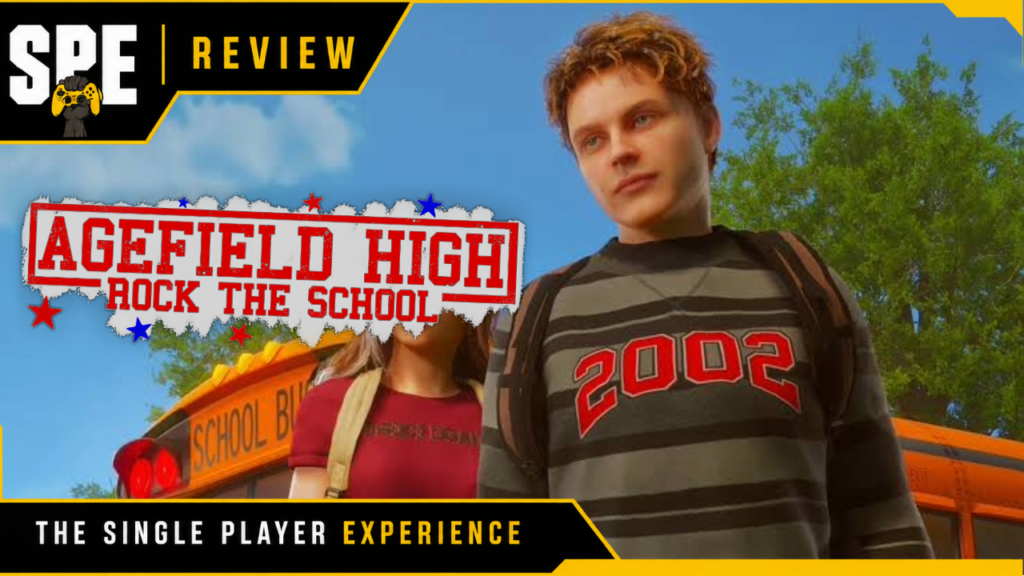

Agefield High: Rock the School Review - Left me In disbelief
Set the Scene
There are some games that I go into expecting to be great, some that I expect to be terrible, and then there are games that I desperately want to be good because the idea behind them appeals to me so much. Agefield High: Rock the School falls firmly into that last category. I wasn’t expecting Refugium Games’ take on the high school open-world adventure to be an Indie Game of the Year contender, but I did think there was a chance it could be a really fun throwback to a type of game that we simply don’t get very often anymore.
The premise immediately caught my attention because it is essentially built around a combination of things I already enjoy. I grew up playing games like Bully and Grand Theft Auto, and I have always enjoyed that particular type of open-world or open-area game where the main story gives you something to work toward while the world itself gives you plenty of opportunities to screw around in between missions. The market has been missing that kind of experience for a while. Grand Theft Auto V has been around for more than a decade, Bully 2 remains something that doesn’t exist, and the Saints Row series is effectively a thing of the past after its 2022 reboot failed to reignite the franchise.
That makes Agefield High an interesting proposition. It is set in the early 2000s and takes inspiration from the raunchy teen comedies that dominated that era, while attempting to recreate the kind of mischievous school-life gameplay that made Bully so memorable. I also happen to enjoy that particular brand of stupid, over-the-top early-2000s comedy. American Pie, Accepted, Superbad, EuroTrip and plenty of other movies from that era were guilty pleasures for me growing up. I never considered them cinematic masterpieces, but they knew what they were trying to be and could be a hell of a lot of fun.
So when I saw the trailers for Agefield High: Rock the School, I was intrigued. At the same time, I had some concerns. The trailers made the game look like it could be a fun throwback, but they also had an undeniable layer of cringe hanging over them. I went into the game hoping that some of that awkwardness was simply the result of a trailer not presenting the game properly. Unfortunately, that wasn’t really the case.
What I got instead was a game with an appealing concept that struggles with almost every aspect of its execution.
Narrative
You play as Sam Tatum, a teenager who has recently moved to Agefield with his mother. She wants him to take school seriously, go to college, get a good job and eventually settle down with a family. Sam, naturally, has little interest in following that particular life plan. He arrives at his new school and quickly meets Axel and Kale, two students who have their own ambitions of becoming school legends before graduation.
From there, the three decide to cause some chaos, deal with the school’s bullies, impress girls and ultimately make their mark before they graduate. The story is intentionally built around the kind of exaggerated teenage rebellion and raunchy humor that defined a lot of early-2000s comedy.
That isn’t inherently a problem. In fact, I think the premise is one of the stronger aspects of the game. I didn’t need Agefield High to suddenly become The Last of Us or deliver some deeply emotional coming-of-age story. If anything, trying to turn this into something overly serious would have defeated the purpose. I wanted a dumb, funny, chaotic teenage adventure that understood exactly what kind of movie and game it was trying to emulate.
The problem is that the characters and writing never give that premise enough personality to carry the experience. The dialogue is frequently awkward, the performances are incredibly stiff, and the characters rarely feel like actual teenagers with believable personalities. Instead, they often feel like characters reading lines from a script while waiting for the next animation to finish.
The facial animation makes this even worse. The character models have very little emotional expression, and their eyes frequently look completely lifeless. There were moments when the eyes would move independently of the rest of the face in a way that reminded me more of a mannequin or ventriloquist doll than an actual human being. It becomes particularly distracting during conversations because the characters are supposed to be conveying emotions that simply aren’t present in their faces.
There are moments where the game gets the intended tone right. One early side mission involves tracking down a stolen book, and the man who lost it clearly doesn’t want to explain what kind of book it is. His awkward “you know” response makes it obvious that we’re dealing with some sort of dirty book without the game needing to spell it out. That kind of stupid teenage humor fits what Agefield High is trying to accomplish.
Unfortunately, those moments are surrounded by missions that feel incredibly generic. One mission has you retrieving a purse from someone who supposedly stole it from an old woman. Another has you mowing someone’s lawn so you can earn money to buy supplies for a prank. The missions aren’t necessarily offensive in their simplicity, but they rarely feel inspired. They often come across as errands that exist simply because the game needs something for you to do.
That is especially disappointing because the setup has so much potential. A game about being a rebellious teenager in an early-2000s high school should be overflowing with memorable characters, ridiculous situations and stories that make you want to see what happens next. Instead, I repeatedly found myself wondering what the hell was actually going on and, more importantly, why I should care.
Gameplay
At its core, Agefield High: Rock the School is trying to recreate the gameplay loop of an older open-world action game. You have a map filled with different activities and objectives, main missions represented by red icons, side missions, your house, the school, vendors and other points of interest. You move from objective to objective while trying to keep up with your school schedule and occasionally causing trouble along the way.
The school schedule is actually one of the more interesting ideas in the game. You have a weekly timetable that tells you when and where you are supposed to be. My schedule included English, geometry, music and German classes, with different classes occurring at different times throughout the week. The idea of having to balance your school responsibilities with the game’s mischievous activities is exactly the sort of system that could have helped Agefield High develop its own identity.
Skipping class apparently has consequences for your pocket money, although I never found the connection between attending high school and getting paid particularly convincing. Still, it is a system that fits the fantasy of the game, and I appreciated having a schedule that made the school itself feel like something I was supposed to participate in rather than just another location on the map.
The actual moment-to-moment gameplay is where things begin to fall apart.
Combat is incredibly stiff. You have punches, kicks, a push and a block, but the fighting feels more like two characters awkwardly exchanging animations than two people actually fighting. There is very little weight behind the attacks, and the lack of a reliable lock-on system makes some encounters more frustrating than they need to be. The result is a combat system that never develops into the kind of satisfying brawler that I was hoping to see.
That stiffness extends to practically every other interaction. At one point, I had to mow someone’s lawn to earn enough money to buy supplies for a prank. On paper, that sounds like exactly the kind of ridiculous side activity that could make a game like this charming. In practice, mowing the lawn became one of the most frustrating minigames I’ve played in a while. The mower was difficult to control, turning felt awkward, and trying to cut the grass in a straight line often felt like fighting the controls rather than mowing a lawn.
I eventually reached roughly 49 percent completion and was already ready to throw my controller across the room. I know you’re technically doing chores, but controlling the character shouldn’t feel like a chore in its own right.
The navigation doesn’t help either. The game frequently sends you long distances across the map, and if you don’t have a bicycle available, you can spend several real-world minutes simply walking toward your next objective. The bicycle should alleviate that problem, but even riding it is more awkward than it should be. The game gives you some basic controls, but I had to figure out parts of the system through trial and error.
The distance wouldn’t necessarily be a problem if there were enough interesting things happening along the way, but there usually aren’t. Instead, you’re frequently traveling several minutes to reach an objective only to discover that the mission itself is another fairly generic errand.
There are also stealth sections, although I wouldn’t call stealth one of the game’s strengths. You crouch and avoid enemy lines of sight, but getting caught doesn’t carry much consequence. The enemies themselves move so stiffly that avoiding them isn’t particularly difficult, and failing generally just puts you back at a checkpoint. It feels more like a box the game needed to check than a fully developed gameplay system.
The same problem applies to the game’s attempt at giving you a GTA-style consequence system. You can get into fights and cause trouble, but there isn’t really a wanted system that lets you become the menace that the premise seems to promise. Teachers or police may come after you, but the punishment usually amounts to being sent to the principal’s office and paying a relatively small fine.
That could have been a funny part of the game if the NPCs actually reacted to your behavior in entertaining ways. Instead, the world often feels strangely indifferent to whatever you’re doing.
Performance and Presentation
I also need to separate the game’s actual design problems from its technical problems because Agefield High: Rock the School gave me serious performance issues on PC.
I played the game on a system equipped with an AMD Radeon RX 9060 XT 16GB, a Ryzen 5 7500X3D and 16GB of DDR5 memory. This isn’t some ancient machine struggling to run modern games. Nevertheless, from the opening cutscene, the game felt choppy and blurry in a way that reminded me of watching a DVD that was skipping in an old DVD player.
I tried practically everything I could think of. I changed the graphical settings, dropped the quality to low, adjusted FSR, experimented with motion blur and moved between different quality presets. Nothing seemed to eliminate the underlying problem. The image remained blurry, movement remained choppy, and after spending enough time playing, I legitimately started feeling nauseous.
That distinction is important because I’m not saying the game made me nauseous because of its story or subject matter. The game was making me physically uncomfortable because of how it was rendering and moving on screen.
I eventually reached out to the development team and received some suggestions about settings that might improve performance. After reinstalling the game and making the recommended adjustments, the performance improved somewhat. It wasn’t making me nearly as motion sick anymore, which was obviously a substantial improvement, but the game still didn’t look particularly good.
The character models remain rough, the facial animations are poor, and the overall presentation often feels like something from the Xbox 360 and PlayStation 3 era without the charm that can sometimes make older-looking games appealing. The school and surrounding environments aren’t necessarily ugly, but they don’t do much to make the world feel alive.
There were also smaller technical problems throughout my time with the game. Doors would sometimes open too quickly, characters could become stuck, characters and objects would clip through things, sound effects could trigger at strange times, and I even managed to get my character stuck in the sidewalk after crashing the bicycle. None of these bugs completely destroyed my save, but they accumulated to create an experience that constantly felt unfinished.
The sound design has similar problems. There were moments when sound effects appeared noticeably after the action they were supposed to accompany, which only added to the sense that the game wasn’t quite keeping everything synchronized.
Pros
The strongest thing about Agefield High: Rock the School is the concept. There is something genuinely appealing about a modern single-player game trying to capture the spirit of Bully, Grand Theft Auto and the raunchy teen comedies of the early 2000s. The school schedule, open-area structure and emphasis on teenage mischief are all ideas that could have worked extremely well with stronger execution.
The game also deserves credit for attempting something that isn’t another Souls-like action game. There is value in seeing an indie developer try to recreate a specific kind of early-2000s action-adventure experience, particularly when the larger industry doesn’t seem particularly interested in making games like this anymore.
Unfortunately, those strengths exist almost entirely at the conceptual level.
Cons
Almost everything that should make Agefield High enjoyable is undermined by its execution. The combat is stiff, the movement is awkward, the missions are generic, the navigation frequently becomes a chore, the character animations are lifeless, and the voice performances rarely feel convincing. Even the game’s attempts at humor struggle because the characters delivering the jokes don’t feel like believable people.
The technical problems make matters worse. The PC version initially ran so poorly for me that I found it difficult to play for extended periods without feeling physically uncomfortable. While the performance improved after working with the developers and adjusting my setup, the game still had noticeable visual and technical issues throughout my time with it.
Perhaps the biggest problem, though, is that none of these systems come together to create a satisfying gameplay loop. I kept waiting for the moment when the game would finally click, but instead I repeatedly found myself thinking about how much more fun I could be having with another game.