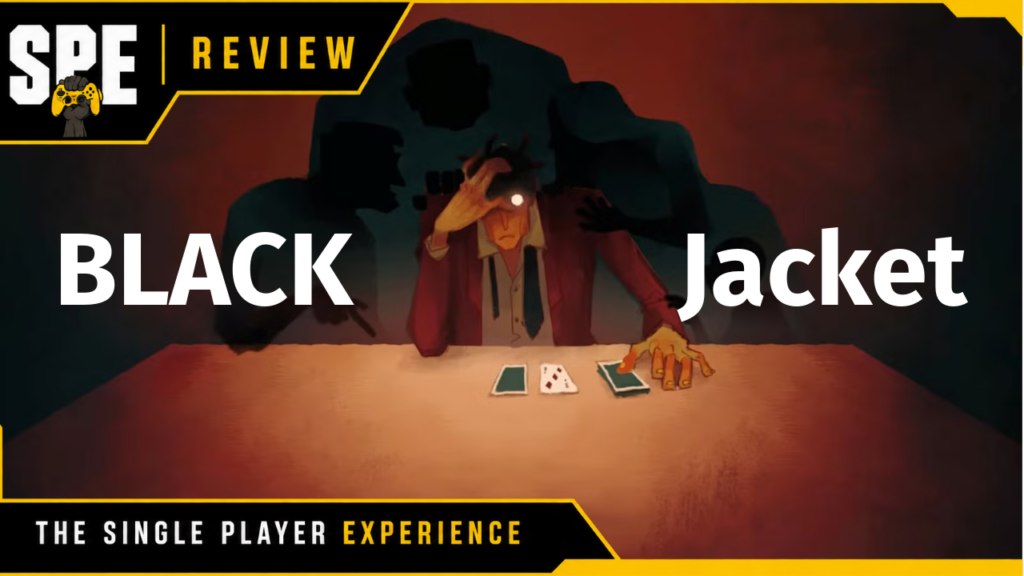

Black Jacket Review: More than Black Jack Balatro?
Set the Scene
I am, by all accounts, a roguelike sicko. Games like Hades, Cult of the Lamb, Rogue Legacy 2, Slay the Spire, and Balatro have become some of my favorite games over the years because I love what happens when developers take a familiar idea and build an entirely new system around it. There is something incredibly satisfying about a game that looks simple enough to understand in a few minutes but slowly reveals layers of strategy the longer you play. That was exactly what caught my attention with Black Jacket.
On the surface, Black Jacket sounds like an obvious attempt to capitalize on the same appeal that made Balatro such a phenomenon. Instead of poker, however, Mi’pu’mi Games takes blackjack and builds a roguelite deckbuilder around it. Your goal is still to get as close to 21 as possible without going over, but the similarities to traditional blackjack only go so far. Once cards begin gaining unique abilities, bosses start manipulating the table, suits introduce different mechanics, and you begin building a deck around specific strategies, the familiar card game becomes something considerably more complicated.
That is what makes Black Jacket so impressive. It understands that blackjack is already a simple and accessible foundation, so rather than burying that foundation beneath dozens of unnecessary mechanics, it keeps the rules recognizable while gradually introducing systems that completely change how you think about every hand. You can pick up the game and understand what you’re supposed to do almost immediately, but understanding how all of its systems interact is something that takes considerably longer.
The premise helps give all of this mechanical experimentation some personality. You find yourself in an eerie underworld where the Ferryman can potentially return you to the life you lost, but getting back isn’t free. You need coins, and lots of them. Your journey takes you through this strange realm where you gamble against other souls, bosses, and eventually the forces standing between you and whatever life you are trying to reclaim.
It is a wonderfully strange premise for a deckbuilder, and it gives Black Jacket an identity that goes beyond simply being “the blackjack version of Balatro.”
Narrative
One of the biggest surprises for me was just how much I cared about the story. Roguelites can sometimes treat their narratives as something that exists around the gameplay rather than something that genuinely drives you forward. Black Jacket does not make that mistake. The more you play, the more you learn about your character, the other souls trapped in this world, and the circumstances that brought everyone to the table in the first place.
The story isn’t delivered exclusively through traditional cutscenes, either. A significant amount of the narrative comes from the conversations that happen while you’re sitting across the table from your opponents. Every boss has their own personality, history, abilities, and relationship with the protagonist, and defeating them multiple times gradually reveals more about who they are and why they’re here. Morgan, for example, eventually begins recognizing something familiar about you and even calls you Kris, suggesting that there is considerably more history between these characters than you initially understand.
That structure reminded me of Hades in the best possible way. You’re not simply beating a boss because the game tells you that you need to beat them. You become interested in what they have to say because every victory potentially reveals another piece of their history. Defeating Morgan eventually unlocked the Vice deck for me after reaching relationship level two with her, while repeated encounters with Ivel began revealing more about his own past and hinted at my character’s search for family and responsibility.
The game’s bosses are especially effective because their mechanics often reflect who they are. Niv, for example, is a child whose “Child’s Play” ability introduces train cards that can move cards around the table. I initially had no idea what the hell I was looking at, but once I understood how his cards could rearrange the board and disrupt my carefully constructed hand, the character suddenly became mechanically memorable as well as narratively interesting. His story also carries a much darker undertone, with his dialogue revealing a child surrounded by the souls of the lost and afraid of becoming like them.
That combination of mechanics and character is one of Black Jacket’s strongest qualities. The people sitting across from you don’t feel like interchangeable opponents. Their decks, abilities, personalities, and stories all contribute to the feeling that you’re gambling against actual characters rather than simply fighting another set of numbers.
The voice acting helps considerably. I wasn’t expecting Black Jacket to have fully voiced boss encounters, but each character’s performance gives them an additional layer of personality. The cast isn’t enormous, but that actually works in the game’s favor because the characters you do encounter get enough time to establish their own presence. Their performances fit the game’s Gothic, occult atmosphere extremely well, and the combination of eerie music, moody environments, and subdued character performances creates a distinctive tone that I wasn’t expecting from a $15 blackjack deckbuilder.
More importantly, the story gave me another reason to start another run. I wasn’t always jumping back into the game because I wanted to build a better deck. Sometimes I simply wanted to see what Morgan, Ivel, Niv, or another character was going to reveal next.
Gameplay
The core rules of Black Jacket are wonderfully approachable. Your objective is still to get as close to 21 as possible without going over, with an Ace functioning as either one or eleven. A blackjack, made up of an Ace and a ten-value card, beats a normal 21, while ties can be broken by the highest card played in the hand. The basic concept is simple enough that anyone familiar with blackjack can understand what is happening almost immediately.
Then the game starts throwing everything else at you.
Every opponent has a collection of coins, and the objective isn’t simply to win a certain number of hands. You are gambling away their coins until they have nothing left, and bosses also possess a gold coin that has to be won before you can finish the encounter. Every round therefore carries real consequences because losing your own coins can bring an entire run to an end.
The table itself is where Black Jacket begins separating itself from traditional blackjack. Cards can be placed into different slots, some slots have special effects, and certain cards can be stacked in ways that fundamentally change their value or abilities. A card might drain the value of another card, manipulate your deck, move cards around the table, break another card and turn its positive value negative, or alter the opponent’s side of the board.
One of the most memorable examples I encountered was a negative ten of hearts that could break cards positioned diagonally from it. Instead of simply being a card with a negative value, it could completely change the mathematical situation on the table by turning another card’s positive value into its negative counterpart. Suddenly a card that would normally be helping you reach 21 could become a liability.
That is where the deckbuilding starts to become genuinely interesting. You’re not simply collecting cards because they have higher values. You’re building combinations and trying to understand how their abilities interact with the physical layout of the table.
The four starting suits reinforce that philosophy. Clubs can drain the value of other cards and potentially discard them, Spades can introduce destructive cards into the opponent’s deck and manipulate their cards, Diamonds can rearrange your deck and allow multiple cards to occupy the same slot, and Hearts introduce negative values and breaking mechanics. Later, you unlock additional suits with their own mechanics, including Flames, Greed, Tumor, and Teeth.
It is a lot to take in, but that’s also part of what kept me playing. The shop system gives you plenty of ways to manipulate your deck between encounters. You can buy new cards, remove cards from your deck, awaken blank cards to unlock their effects, or purchase booster packs focused on specific suits. Removing cards becomes increasingly expensive, and the cost of awakening cards is shared with other upgrades, meaning you have to think about how you want to spend your limited resources rather than simply buying everything that looks interesting.
Then there is the sleeve system, which might be my favorite mechanic in the entire game. Because you’re trying to escape hell, cheating a little feels appropriate. You can hide cards up your sleeve and save them for the right moment, allowing you to essentially keep a trick in reserve. I found myself using this constantly whenever I could reduce the cost of doing so to zero. If I had a card that could push me toward 21 or completely wreck an opponent’s total, I could hide it away and wait until the right moment to spring it on them. It creates a wonderful tension because you always have the feeling that you might have one more trick available than your opponent expects.
The Roguelite Loop
The actual structure of each run is also more flexible than I expected. You begin by facing the narrator, Reed, before branching out into a map where you choose your next destination. You might find a shop, an awakening event, a battle against another soul, an artifact, or another special encounter.
The route selection gives you some agency over how you want to approach a run. If you see a shop on one path and an awakening opportunity on another, you have to decide which one is more valuable for the deck you’re currently building. You can’t simply experience everything in a single run, which gives the map another strategic layer.
Artifacts can provide additional card options, while Solitude locations can awaken cards. There are also rewards that expand your options between runs, and after finally completing a run, the game opens up additional difficulty modifiers that can dramatically increase the challenge. The difficulty system eventually climbs all the way to 21, with each level introducing another modifier and keeping previously activated modifiers in place.
That gives Black Jacket an impressive amount of longevity. Even after finishing a run, there are still challenges, discoveries, relationships, cards, suits, difficulty modifiers, and other systems to uncover. At one point I had discovered only 31 of 124 possible discoveries, which gave me a pretty good indication of just how much more there was left to see.
The game also does a good job balancing luck and strategy. Obviously, you’re still playing a card game, so sometimes the deck simply doesn’t give you what you need. But your decisions throughout a run matter. The cards you buy, the ones you remove, the ones you awaken, the route you choose, the suit you start with, and the way you use your sleeve can all influence how well a run develops.
That balance is important because it prevents losing from feeling completely arbitrary. There were plenty of times when I got my ass kicked, sometimes only four minutes into a run, but I usually understood enough about what happened to want to immediately try again.
That is the exact kind of failure a roguelite should produce.
Final Verdict
Black Jacket is one of those games that looks incredibly simple until you actually start playing it. Blackjack is the foundation, but the game builds an impressive tower on top of it with deckbuilding, unique card powers, suit-specific mechanics, branching paths, boss encounters, relationship systems, and an unexpectedly compelling story about people trying to escape the consequences of their past.
The comparison to Balatro is unavoidable, but I don’t think it is entirely fair to reduce Black Jacket to “Balatro with blackjack.” The two games share an obvious philosophy, but they ultimately pursue different things. Balatro is an almost endlessly replayable mechanical sandbox, while Black Jacket combines its card-game experimentation with a character-driven narrative and a distinct Gothic atmosphere.
There are still some rough edges. The game doesn’t always explain its more complicated card effects as clearly as it should, and the core run structure can become familiar after enough hours. But those issues are outweighed by just how much the game gets right. I started playing because I wanted to see if somebody could do for blackjack what Balatro did for poker, and I ended up with a game that has its own identity, its own story, and more mechanical depth than I expected.
For $15, Black Jacket is punching way above its weight class.
Pros
Black Jacket’s greatest strength is how much complexity it manages to build on top of such a familiar foundation. Blackjack is a game that almost anyone can understand, but Mi’pu’mi Games uses that familiarity as an entry point rather than a limitation. Once the card abilities, suits, bosses, table effects, deckbuilding, and sleeve mechanics start interacting, every hand can become a completely different puzzle.
The narrative is another major strength, particularly because I wasn’t expecting it to be this compelling. The game’s story about grief, regret, shared history, personal mistakes, and the desire to escape the consequences of your past gives the roguelite structure an emotional reason to keep going. Every victory against a boss can reveal another piece of that character’s history or your own, and that made me genuinely interested in continuing beyond the mechanical loop.
The presentation ties everything together. The Gothic art direction, eerie soundtrack, strong voice performances, and smooth controller support make Black Jacket feel much more polished and complete than its $15 price tag would suggest.
Black Jacket has a fantastic aesthetic that fits its premise. The Gothic and occult imagery gives the game a dark underworld atmosphere without making it feel like another generic dark fantasy game. The table, characters, cards, and environments all contribute to the feeling that you’ve entered some strange supernatural gambling den where everyone has a story they’re desperate to escape.
The soundtrack complements that atmosphere extremely well. It has an eerie quality that reinforces the feeling of wandering through an underworld, but it never becomes so oppressive that it gets in the way of the gameplay. Combined with the voice acting, the music gives the game considerably more personality than I expected from its premise.
It is also an exceptionally good controller game. I played on PC with an Xbox-style controller, and the controls were smooth enough that I never felt like I was sacrificing anything by playing with a controller. Passing is mapped to Y, quick-drawing is mapped to X, the deck can be inspected with LB, and movement can be handled with either the analog stick or D-pad. It makes the game feel like something that was practically designed to live on a Steam Deck.
And honestly, I could see Black Jacket living on my Steam Deck forever.
The game is perfectly suited to the “I’ll just play one run” mentality. You can sit down, play for a few minutes, lose horribly, and go back to whatever you were doing. Or you can accidentally look up at the clock after several runs and realize you’ve been playing for far longer than you intended.
Cons
The biggest issue is that the game sometimes struggles to communicate the depth of its own systems. Card descriptions are available, but some of the more complicated effects require trial and error before their practical use becomes obvious. That isn’t necessarily a deal breaker for a game built around experimentation, but better tutorials or demonstrations could have made the learning curve considerably smoother. The other limitation is that the basic run structure can eventually become familiar. Once you’ve spent enough time with the game, you’re repeatedly navigating the same general loop of encounters, shops, deckbuilding, and bosses. Fortunately, the sheer number of cards, abilities, suits, characters, discoveries, challenges, and difficulty modifiers gives you plenty of reasons to keep experimenting.
My biggest criticism of Black Jacket is also something that becomes more noticeable the deeper you get into it. The game has an incredible number of systems, but it doesn’t always do a great job of explaining exactly how those systems work.
The card descriptions technically tell you what each effect does, but understanding the practical application of some abilities often requires experimentation. I frequently understood the individual words in a card’s description without immediately understanding how that effect was supposed to function during an actual hand.
That became particularly noticeable once the game started introducing more complicated powers, exploits, different card types, and special encounter rules. I could explain the basic concept of Black Jacket to somebody fairly easily. Explaining every interaction between its card systems, suits, exploits, bosses, and match-specific rules would be considerably harder.
I actually think some of that discovery is part of the fun, but there were definitely moments when I wished the game would stop telling me what a card technically does and instead show me how the damn thing is supposed to work.
There is also a point where the basic structure of a run can start feeling somewhat familiar. You’re still moving through the map, fighting opponents, visiting shops, building your deck, and eventually confronting a boss. The variety comes primarily from the cards, suits, bosses, and modifiers, so players who aren’t interested in experimenting with those systems may eventually find the loop repetitive.
For me, however, the depth of the systems kept that repetition from becoming a major problem.