Laysara: Summit Kingdom

6
Mid-Tier
Genre:
City Builder, Strategy
Platforms:
PC
Tier Score:
Mid-Tier
Developer:
Quite OK Games
Laysara: Summit Kingdom Review – A Mountain City Builder That Feels Like a Strategic Puzzle
Introduction
Ever since I played Cities: Skylines years ago, I’ve had a deep appreciation for city builder games. There’s something uniquely satisfying about watching your carefully planned infrastructure come to life—seeing production chains run smoothly, citizens thrive, and your city grow into something impressive.
But the flip side is just as compelling. Watching your economy collapse because of poor planning or mismanagement can be equally dramatic.
So when I heard about Laysara: Summit Kingdom, an indie city builder that challenges players to construct thriving settlements on the sides of avalanche-prone mountains, I knew I had to check it out.
It turns out building a city on a mountain isn’t just difficult—it fundamentally changes how you approach the genre.
Narrative
Unlike many city builders that drop you straight into sandbox mode, Laysara: Summit Kingdom features a structured campaign.
The story introduces you to three advisors who guide your civilization as it attempts to settle the harsh mountain environment. Each advisor represents a different philosophy and personality: one focused on faith and tradition, one more optimistic and supportive, and another who is constantly worried about profit and looming dangers.
The campaign opens with a fully voiced intro cutscene, which was a pleasant surprise. The voice acting is solid and helps set the tone for the game’s narrative ambitions.
That said, while the advisors have distinct personalities, I never found myself particularly invested in them. They function more as tutorial guides and objective givers rather than characters I connected with on a deeper level.
The story serves its purpose in moving the campaign forward, but it’s not something that will stick with you long after the credits roll.
Gameplay
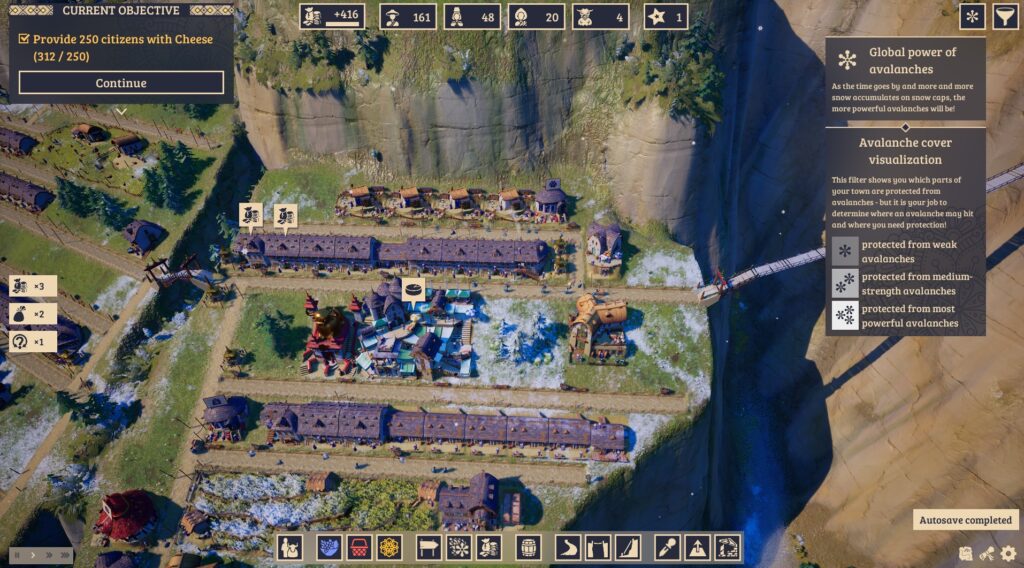
The core gameplay of Laysara revolves around building and maintaining settlements across narrow mountain plateaus.
Instead of the wide open landscapes typical of most city builders, this game forces you to work within extremely tight, vertical environments. Your city ends up spread across multiple mountain sections connected by bridges and lift systems, allowing goods and citizens to travel between different plateaus.
This vertical city design is one of the game’s most interesting ideas.
At first glance, many systems feel familiar to fans of the genre. There’s a bottom menu where you can quickly access categories like housing, food production, infrastructure, and special buildings such as temples or enlightenment centers.
However, Laysara introduces an important twist to the usual resource flow.
In many city builders, production buildings automatically deliver their goods to storage facilities. Here, you must manually assign where each building sends its output. If you forget to set a destination, the building simply produces goods that go nowhere.
It’s a small but meaningful change that forces players to pay closer attention to supply chains.
One tool that makes building significantly easier is the duplication tool, which allows you to instantly copy an existing structure and place it elsewhere without digging through menus. It’s incredibly convenient and honestly feels like something every city builder should adopt.
The Three-Caste System
Another major gameplay mechanic is the game’s three-caste population system.
Your settlement is made up of:
- Lowlanders, who handle farming and basic labor
- Artisans, who perform skilled jobs like blacksmithing
- Monks, who prefer higher altitudes and spiritual buildings
Each class thrives in different environments and requires specific housing and workplaces.
Initially, this system feels fresh and interesting. But over time it begins to feel less like a cohesive city and more like three separate towns loosely connected together.
Instead of blending into a unified society, the castes often feel isolated from each other, which can make the settlement feel disjointed rather than holistic.
Avalanche Management
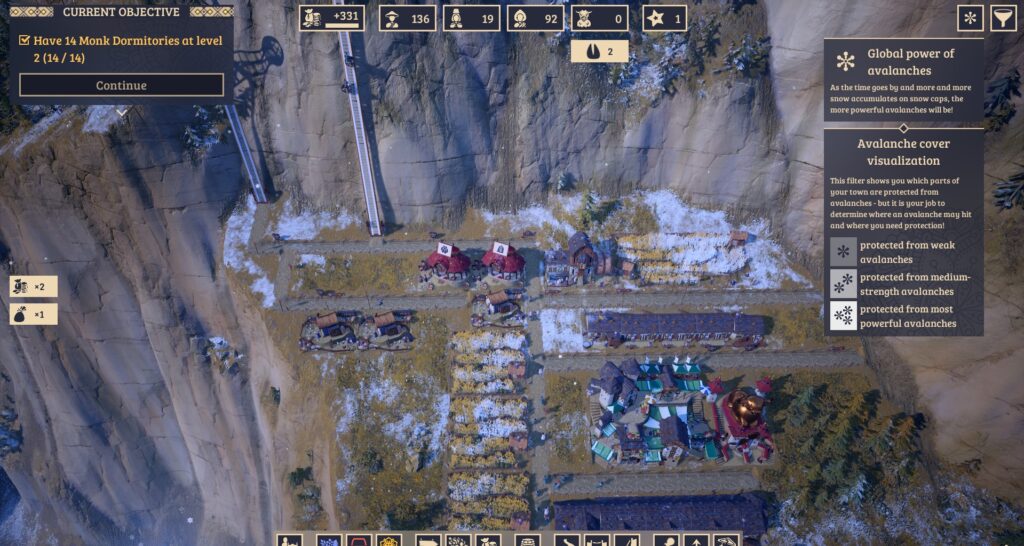
Your primary enemy in Laysara isn’t an invading army or rival civilization—it’s the mountain itself.
Avalanches pose a constant threat to your settlements. If you fail to plan ahead, a single avalanche can wipe out large sections of your city.
To defend against them, players can:
- Plant forests to weaken smaller avalanches
- Construct avalanche walls to block stronger ones
Interestingly, avalanches feel terrifying early in the campaign but become much easier to manage once you understand how forest barriers work.
After that point, the threat level drops significantly.
Puzzle-Like City Building
As the campaign progresses, the game’s biggest challenge becomes space management.
The available land becomes so limited that building your city often feels more like solving a puzzle than running a sprawling metropolis.
While this constraint adds a unique twist to the genre, it also shifts the experience away from traditional city building. Later missions feel more about perfectly fitting buildings into limited spaces than about organically growing a city.
For players who enjoy puzzle-style strategy games, this may be a huge plus. But if you prefer the more open-ended freedom of games like Cities: Skylines, the restrictions might feel a bit limiting.
Campaign Structure
The campaign itself is solid and offers a wide range of difficulty options.
Players can choose from:
- Novice – Very forgiving for newcomers
- Adept – Balanced difficulty
- Professional – Challenging and strategic
- Veteran – Extremely demanding optimization
- Custom – Fully customizable settings
One interesting design choice is that the campaign sometimes returns you to previously built cities with new objectives.
While this idea is meant to show the evolution of your settlement, it can also create frustrating situations. If you rushed through a previous mission with a messy layout, you may later be forced to revisit that same town and reorganize everything.
Personally, I would have preferred starting fresh with new cities instead.
Presentation
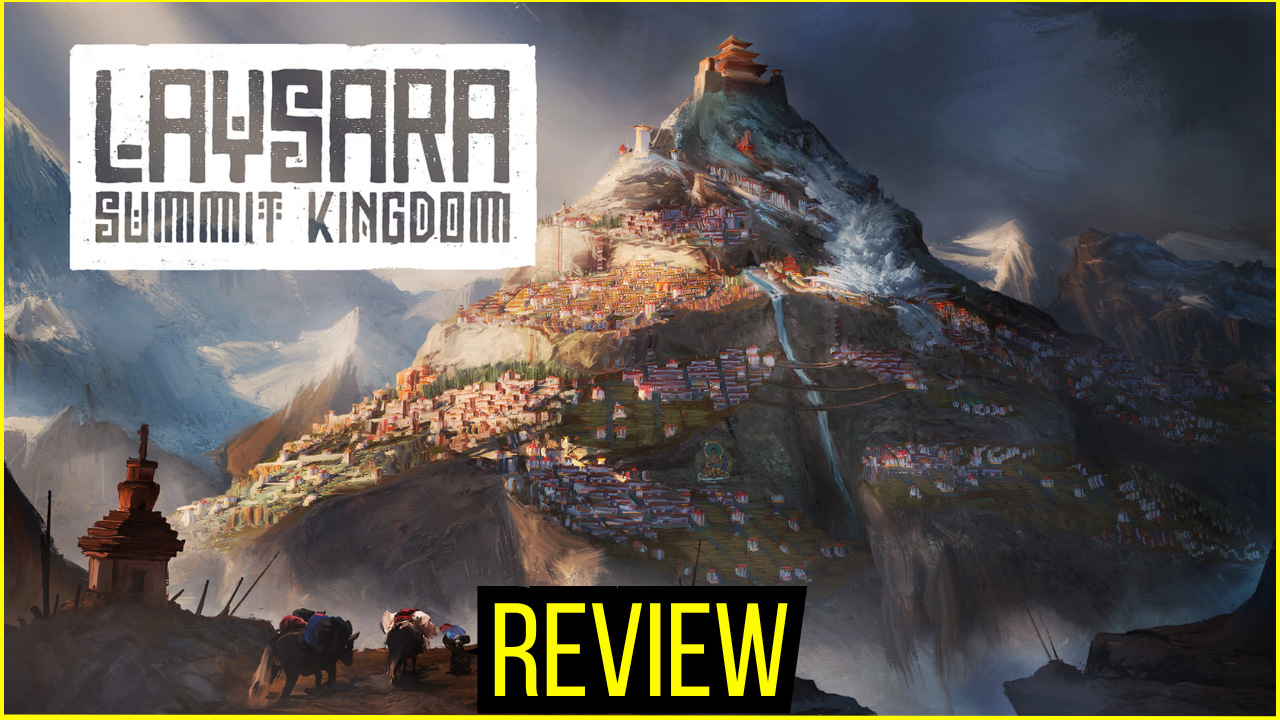
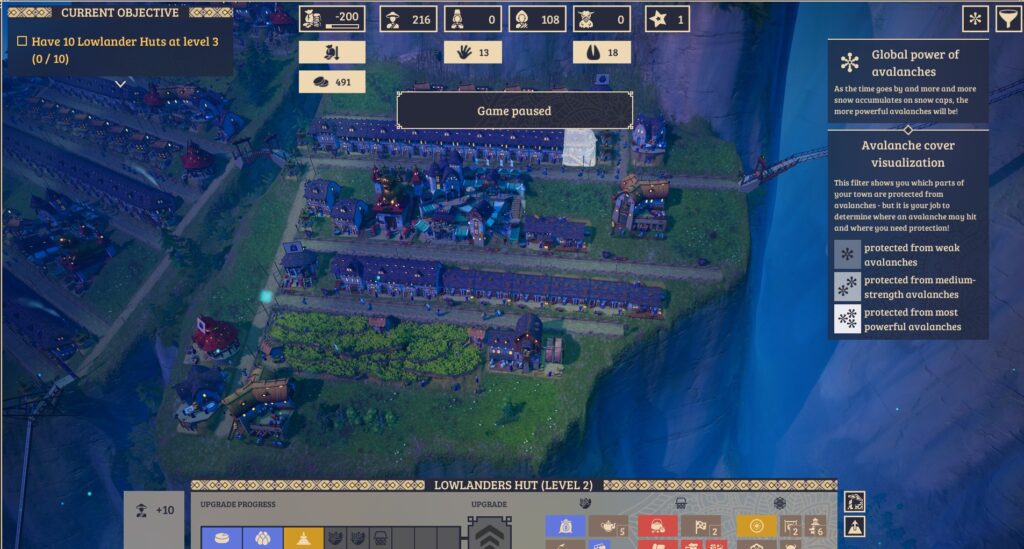
Visually, Laysara is quite impressive.
Watching settlements slowly expand across snowy mountain slopes looks fantastic, and the bridges and lift systems connecting different plateaus create a unique skyline for your city.
The soundtrack is another highlight. While there may not be a huge number of tracks, the ones included are excellent and fit the game’s atmosphere beautifully.
Pros
One of Laysara’s biggest strengths is its unique concept. Building a functioning city across narrow mountain plateaus forces players to rethink traditional city-building strategies and adds a refreshing twist to the genre.
The duplication tool is another standout feature. Being able to quickly copy buildings without navigating menus makes constructing your settlement significantly smoother and more efficient.
The game also does a good job offering multiple difficulty options, allowing players to tailor the experience to be either relaxing and cozy or brutally challenging.
Finally, the presentation is strong. The mountain environments look great, and the soundtrack complements the serene yet dangerous setting perfectly.
Cons
While the three-caste system initially feels interesting, it eventually becomes somewhat tedious. Instead of feeling like a unified society, the system often makes it feel like you’re managing three disconnected settlements.
Avalanches, which initially appear to be a major threat, become much less intimidating once you understand how easily forests can neutralize them.
The campaign’s decision to revisit previous cities can also be frustrating. If you built something inefficient earlier, you may later be forced to return and fix it rather than starting with a clean slate.
Lastly, the extreme space constraints can make the game feel more like a puzzle than a traditional city builder, which may not appeal to everyone.
Overall – Should You Play Laysara: Summit Kingdom?
Laysara: Summit Kingdom is a solid indie city builder with a clever mountain-setting twist.
Its vertical city design, avalanche mechanics, and constrained building spaces create a unique challenge that separates it from many other games in the genre.
However, it doesn’t quite reach the same level of depth or emotional engagement as some of the genre’s heavy hitters. The caste system feels somewhat disjointed, the avalanche threat loses impact over time, and the puzzle-like building restrictions may not appeal to all players.
Still, if you enjoy city builders and want something that forces you to think differently about space, logistics, and terrain, Laysara is absolutely worth checking out.
It may not dethrone your favorite city builder, but it’s a creative and enjoyable entry in the genre.