Set the Scene
I went into Aerial_Knight’s DropShot completely blind, which is becoming an increasingly rare way for me to experience a game. No trailers, no gameplay previews, and no expectations beyond whatever vibes I picked up along the way. What I didn’t anticipate was stumbling into one of the most absolutely batshit concepts I’ve encountered in an indie game this year. We’re still early enough in the year that another developer could theoretically top it, but they’re going to have to get pretty creative to beat this one.
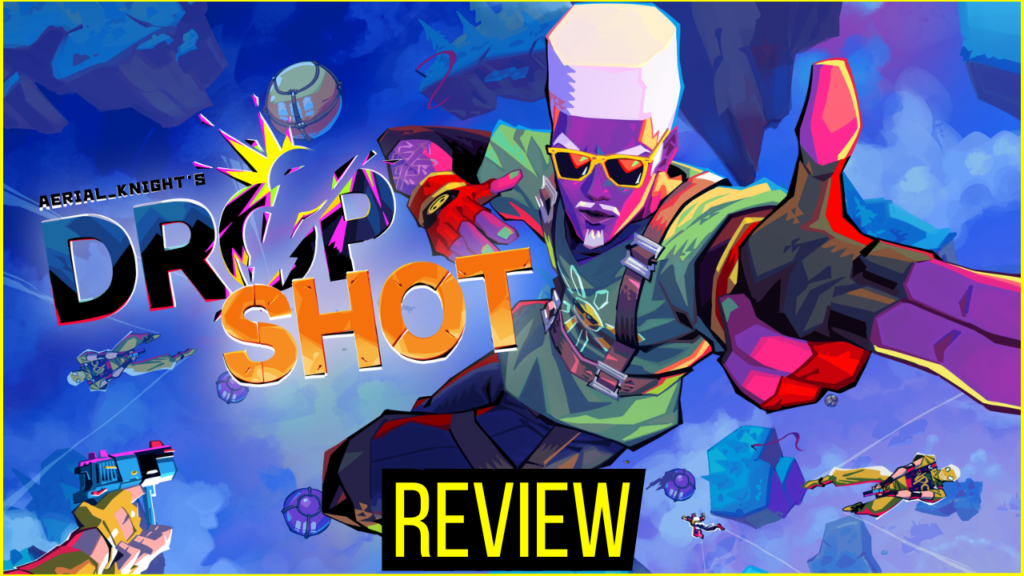
Here’s the setup: You play as Smoke Wallace, a purple-skinned man who was bitten by a radioactive dragon and cursed with the ability to shoot bullets from his fingertips. Yes, we’re talking about a literal Spirit Gun from Yu Yu Hakusho. After the dragon murders his family, Smoke sets out on a revenge-fueled mission to kill dragons and the murderous military forces that seem determined to get in his way. Along the journey, he even allies himself with an anthropomorphic, demonic-looking cow, because apparently a radioactive dragon and finger guns weren’t enough to make this story weird.
That introduction should give you a pretty good idea of what you’re getting into with Aerial_Knight’s DropShot. The game doesn’t seem particularly interested in explaining its absurdity or asking you to take its story seriously. Instead, it takes a ridiculous premise, cranks the intensity up to eleven, and drops you out of an airplane to shoot as many enemies as possible before you hit the ground. It’s the kind of idea that sounds like it should run out of steam almost immediately, yet I found myself playing through the entire campaign. I wasn’t expecting much when I started, but I was pleasantly surprised by how much fun I had with the ride.
Finger Guns and Freefall
The central idea behind Aerial_Knight’s DropShot is remarkably straightforward. Each level throws Smoke into a freefall alongside a swarm of enemies, and your job is to eliminate as many of them as possible before reaching the ground. You’re armed with your trusty finger guns, a limited supply of ammunition, and a melee punch for enemies who get close enough. You can move left, right, forward, and backward within the boundaries of each level, allowing you to line up shots, avoid incoming fire, and collect helpful items as you plummet toward the finish.
The ammunition system gives the otherwise simple shooting a little more personality. You can’t fire endlessly, so you’ll need to shoot floating barrels that are also falling through the sky to replenish your bullets. Meanwhile, obstacles such as floating islands and laser traps can quickly drain your health if you aren’t paying attention. Enemy soldiers are shooting back, your ammunition is limited, and you’ve only got two lives to work with during a run. There’s a surprising amount to keep track of for a game that boils its entire premise down to falling out of the sky and shooting people with your fingers.
What makes the concept work is how quickly everything comes together. The controls are easy to understand, the objective is immediately clear, and the frantic pace gives each encounter a natural sense of urgency. You’re constantly scanning the screen for enemies, ammunition, hazards, and anything else that might help you survive. There’s no elaborate progression system you need to understand before the fun begins, and the game doesn’t waste much time getting you into the action. It knows what its central gimmick is and gets right to it.
The simplicity is both a strength and a limitation, but there’s no denying that the first few encounters have a certain appeal. Shooting enemies while hurtling toward the ground is an unusual twist on the first-person shooter, and the combination of dodging obstacles and trying to maintain an efficient kill streak gives the action an arcade-like quality. It’s easy to see why someone might get hooked on improving their performance, even if I eventually found myself more interested in seeing what came next than perfecting the levels I’d already completed.
A Score-Attack Game That Doesn't Quite Hook Me
If you’ve played I Am Your Beast, you’ll recognize some of the design philosophy behind Aerial_Knight’s DropShot. The game is divided into discrete levels, each with its own score and performance grade, ranging from a dismal D all the way up to an S rank. The intention is to encourage repeated playthroughs, giving you an opportunity to learn the layout, improve your efficiency, and squeeze a little more performance out of each run. Levels are organized into groups of five, with the fifth encounter serving as a boss battle.
Standard levels have you freefalling alongside enemy soldiers as you try to rack up kills, dodge incoming attacks, and survive long enough to reach the ground. Boss encounters take that same basic idea and apply it to much larger opponents, asking you to deal as much damage as possible while avoiding their attacks and the hazards surrounding you. The soundtrack keeps the energy high, and the exaggerated scale of these encounters gives the game some welcome variety without abandoning the core mechanics that define it.
The problem is that DropShot never quite gave me a compelling reason to chase perfection. The ranking system is perfectly functional, and I understand why players who enjoy score-attack games might spend hours replaying levels to earn that elusive S rank. But while I appreciated the structure, I didn’t find myself particularly motivated to return to a completed stage just to improve my grade. Once I had made it through a level, I was generally happy to move on and see what the next one had waiting for me.
That’s where the game’s limited mechanical depth starts to show. The premise is so ridiculous and the presentation so energetic that I expected the experience to evolve in more substantial ways as I progressed. Instead, the core loop remains largely the same throughout the campaign. You’re still falling, shooting, dodging, and trying to survive, with the different encounters offering variations on that basic formula rather than fundamentally changing how you play. It’s an enjoyable formula, but it doesn’t develop enough to make replaying the same levels feel essential.
Still, I have to give DropShot credit for keeping me engaged long enough to finish every level. Based on the concept alone, I expected to bounce off this game pretty quickly. Instead, I found myself wanting to see the whole thing through, even though I had little interest in chasing perfect scores afterward. There’s a difference between a game that makes you want to master it and one that makes you curious enough to see it through to the end, and DropShot turned out to be the latter for me.
When the Chaos Gets in Its Own Way
For all its absurdity, Aerial_Knight’s DropShot has a few practical problems that can interfere with the fun, and visibility is the biggest one. You’re plummeting through the sky while trying to identify enemies, line up shots, avoid hazards, and keep track of your limited ammunition. In the middle of all that action, some enemies can appear as little more than tiny dots in the distance, making them surprisingly difficult to spot before they disappear from view.
I understand the logic behind this. You’re falling from the sky at high speed, so enemies shouldn’t necessarily be sitting conveniently in front of your face waiting to be shot. The problem is that realism isn’t always the best friend of an arcade shooter, especially when the game is asking you to rack up kills and earn higher grades. Missing an enemy because you weren’t quick enough is one thing; missing one because you could barely make it out against the background is another. When your performance depends on eliminating as many targets as possible, that lack of clarity can make the pursuit of a better score feel more frustrating than rewarding.
The game’s repetitive structure is another limitation, although this one will depend heavily on what you’re looking for. If you enjoy replaying short levels, memorizing enemy placements, and gradually improving your performance, there’s a decent amount of entertainment to be found here. The game also has a secret level and an additional mode for players willing to dig deeper. But if you’re more interested in experiencing a campaign once and moving on, the limited evolution of the mechanics means there isn’t necessarily a wealth of new ideas waiting to be uncovered after the initial novelty wears off.
Price is worth considering, too. At $19.99, DropShot asks players to weigh its short campaign against the replayability offered by its ranking system and additional content. I don’t think a short game is automatically a bad value, particularly when the experience has a distinct identity and doesn’t overstay its welcome. However, the value proposition becomes harder to justify if you’re not interested in repeating levels for better grades. I finished the campaign and had a good time doing it, but I wasn’t compelled to go back and squeeze every last point out of the experience.
The Soundtrack and Style Keep the Energy High
One of Aerial_Knight’s DropShot‘s biggest strengths is its presentation. The entire experience is built around exaggerated action and a completely unhinged premise, and the game commits to that identity rather than trying to temper it with unnecessary seriousness. Smoke’s backstory is ridiculous, his finger guns are ridiculous, and the sight of him falling through the sky while exchanging fire with soldiers and battling enormous bosses is ridiculous. Thankfully, the game understands that the absurdity is part of the appeal.
The soundtrack deserves particular credit for keeping the action moving. The music hits hard, complementing the rapid pace of the gameplay and giving each encounter an extra shot of adrenaline. When you’re dodging lasers, shooting enemies, and desperately trying to reload before the next wave gets the better of you, the soundtrack helps make the experience feel like a chaotic action sequence rather than a repetitive shooting gallery. It gives the game an energy that its relatively straightforward mechanics might otherwise struggle to sustain.
The presentation also helps distinguish DropShot from the many indie games competing for attention. There are plenty of games that can offer short levels and score-chasing mechanics, but the combination of skydiving combat, finger guns, radioactive dragons, and demonic livestock gives this one an identity that’s difficult to confuse with anything else. The novelty won’t sustain the entire experience on its own, but it provides a strong first impression and helps make the campaign memorable enough to finish.
Is This a Good Single Player Experience?
Yes, particularly if you’re looking for something short, uncomplicated, and a little strange. Aerial_Knight’s DropShot doesn’t require a major time investment to understand its systems, and it gets you into the action almost immediately. Its freefall shooting is a genuinely unusual hook, the controls are approachable, and the soundtrack helps turn each level into a concentrated burst of arcade chaos. It’s the kind of game you can pick up, play for a while, and enjoy without needing to commit to dozens of hours of progression.
However, this is also a game whose long-term appeal depends heavily on how much you enjoy its core loop. The score-attack structure is designed to encourage repeated runs, but I wasn’t interested enough in improving my grades to keep returning after completing a level. Visibility issues can also make it harder to achieve the high scores the game encourages you to pursue. If you’re someone who loves mastering short stages and squeezing every possible point out of a run, you’ll likely get more out of DropShot than I did.
Ultimately, I enjoyed my time with the game because I was curious to see where its bizarre premise would take me, and that curiosity carried me through the campaign. I wasn’t left wanting to spend another dozen hours perfecting my performance, but I was glad I’d experienced it. For a single-player game built around such a strange idea, that’s a worthwhile accomplishment.
Aerial_Knight’s DropShot is a strange, fast-paced indie shooter that makes a memorable first impression and delivers a fun, if somewhat repetitive, campaign. Its freefall combat is an inventive hook, its finger-gun mechanics are easy to understand, and its energetic soundtrack helps keep the action exciting. Smoke Wallace’s bizarre revenge story gives the game plenty of personality, while the score-attack structure offers an incentive for players who enjoy perfecting short levels.
Unfortunately, the novelty does more work than the mechanics themselves. The core gameplay doesn’t develop enough to keep me interested in replaying completed stages, and visibility issues can make it frustrating to track enemies when trying to earn higher grades. At $19.99, its value will depend largely on whether you’re willing to return for better scores and additional content. I had a good time playing through the campaign, but I didn’t feel the need to stick around after finishing it. Still, I can’t deny that Aerial_Knight’s DropShot gave me exactly the kind of unexpected experience I hope to find when I dive into an indie game without knowing what to expect. It’s ridiculous, it’s energetic, and it’s a lot more fun than its premise has any right to be. I just wish the gameplay had a little more staying power to match the wild imagination behind it.
Why This Passion Score?
My 54/100 Passion Score reflects a game I enjoyed more than I expected, even if I never developed a particularly strong attachment to it. Going in blind made the introduction especially memorable, and Smoke Wallace’s absurd backstory immediately gave me something to laugh about. The Spirit Gun comparison, the radioactive dragon, the revenge mission, and the demonic cow are the kind of wonderfully strange ingredients that make indie games exciting to discover. I love seeing developers take a concept that sounds completely ridiculous on paper and commit to it with this much confidence.
The gameplay was also fun enough to carry me through the entire campaign, which surprised me because I assumed the novelty would wear off much sooner. The fast pace, energetic soundtrack, and straightforward shooting gave the experience a satisfying arcade rhythm, and I enjoyed seeing what each new level had to offer. However, my interest was driven more by the desire to complete the journey than by a need to master the mechanics. Once the credits were in sight, I was happy to call it a day rather than chase S ranks across every stage.
That’s ultimately why my enthusiasm lands in the middle rather than leaning toward a stronger personal recommendation. DropShot has a great hook, but the mechanics don’t evolve enough to make the experience feel substantially different as it progresses. Visibility issues occasionally make the action harder to read, and the short runtime means players who aren’t interested in replaying levels may struggle to justify the price. I had fun, I appreciated the game’s weirdness, and I’m glad I played it, but it didn’t leave me with a particularly strong desire to return. Sometimes a game can deliver a good time without becoming something you want to revisit, and that’s where Aerial_Knight’s DropShot lands for me.