Set the Scene
I’ve had my eye on Duskfade for quite some time, and it wasn’t necessarily because I knew anything about its story or had seen much of its gameplay. What initially caught my attention was its presentation, which immediately reminded me of the kind of colorful, adventurous 3D games I grew up playing. The character designs, floating animations, combat, and overall user interface all brought Kingdom Hearts to mind, particularly the first two games, which remain some of my favorite gaming experiences from my younger years. My relationship with that series has changed over time, and while I still appreciate what those original games accomplished, the franchise as a whole hasn’t held onto the same magic for me. Even so, I was intrigued by the idea of another game capturing some of that early Kingdom Hearts charm while building an identity of its own.
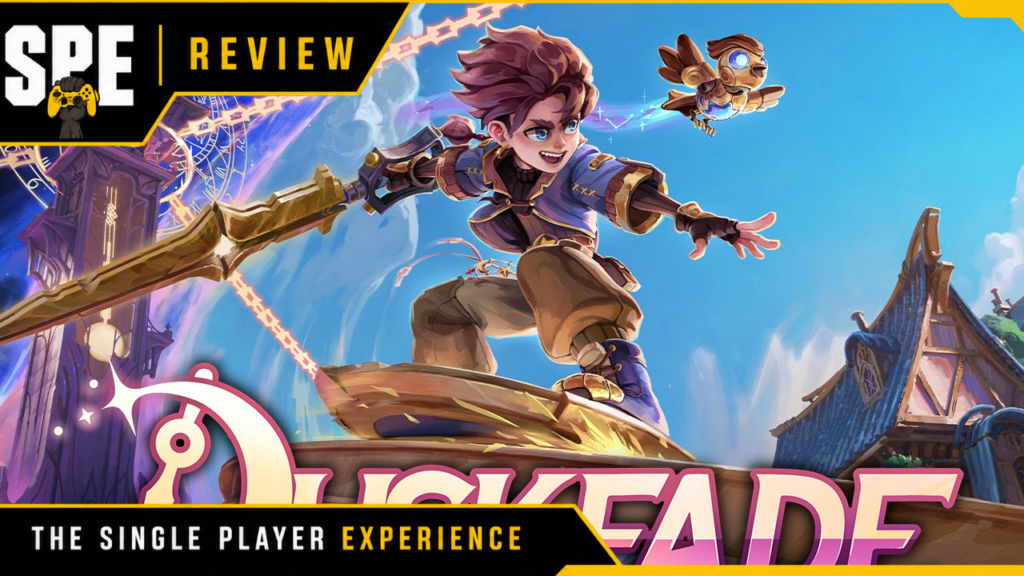
Developed by Weird Beluga and published by Fireshine Games, Duskfade is a 3D action-platformer that wears its influences proudly. Its promise of jumping, swinging, slashing, and exploring a fantastic world in the spirit of classic 3D platformers immediately appealed to me, especially with its apparent combination of Jak and Daxter, Ratchet & Clank, and Kingdom Hearts. The Steam description introduces Zirian, a young adventurer accompanied by a mechanical Cuckoo, who must rescue his sister Allira from a mysterious Clock Tower that has plunged the land into eternal night. It’s a familiar setup for an adventure of this kind, but one that gives the game a clear direction and a reason to explore its world.
After spending approximately 11 hours with the finished release on PC, I came away feeling that Duskfade is a good game that understands what makes this particular style of adventure appealing. It has colorful environments, satisfying combat, a strong musical identity, and plenty of opportunities to explore. However, while I enjoyed my time with it, I also found myself wishing that more of its ideas had come together in a way that made the adventure feel genuinely special. Duskfade delivers a worthwhile throwback, but being reminded of the classics isn’t quite the same as standing alongside them.
A Beautifully Stylized Adventure
The first thing that stands out about Duskfade is its art direction, which gives the game a distinct personality without trying to imitate the visual realism that dominates so many modern releases. Its environments are colorful, its character designs are expressive, and its three-dimensional world feels deliberately stylized rather than like a technically limited attempt at realism. There’s a cartoon quality to the presentation that makes the adventure immediately inviting, but the game doesn’t come across as something designed exclusively for young children. Instead, it captures the approachable, imaginative atmosphere that made so many older platformers appealing to players of different ages.
The user interface is another major part of that identity, and it’s one of the clearest examples of the game’s Kingdom Hearts inspiration. Zirian’s health display features his character portrait, and even his expression changes as he takes damage or approaches low health. His movement also evokes Sora, from the slightly floaty quality of his jumps to the way he lands with his legs spread apart. His sword is another recognizable point of comparison: although it isn’t a direct Keyblade copy, it functions as a key for opening treasure chests, which reinforces the similarities without preventing the weapon from having its own design.
I don’t think there’s anything inherently wrong with a game wearing its influences so openly. Some of the most enjoyable games are built around ideas that players already love, and Duskfade clearly understands why those older adventures made such an impression. The challenge is establishing enough of an identity that players eventually stop thinking about the inspiration and become invested in the new experience. Duskfade succeeds in creating its own atmosphere and has several mechanics worth appreciating on their own merits, but its similarities to Kingdom Hearts are so apparent that they remain a constant part of the experience. For me, that’s both one of its biggest selling points and a reminder of the creative heights it doesn’t quite reach.
A Familiar Adventure With Its Own World to Explore
The adventure begins in Tick Town, Zirian’s hometown and the central hub from which he’ll travel into the surrounding regions. His primary objective is to rescue his sister Allira, who is trapped inside a mysterious tower, and accomplishing that goal requires him to travel through several major areas and destroy the chains holding the tower’s entrance in place. Each region offers a mixture of open environments, enemy encounters, platforming challenges, and a dungeon that leads toward a climactic confrontation. It gives the adventure a satisfying rhythm, with each new destination providing another collection of obstacles to overcome before Zirian can move closer to his sister.
The structure is familiar, but it works well for the type of game Weird Beluga is making. Rather than funneling players through one continuous sequence of levels, Duskfade gives them room to explore its environments, discover hidden collectibles, and return to previously visited locations once they’ve acquired new abilities. The areas gradually become more accessible as Zirian gains additional traversal options, including zip lines and glider wings, which open up new routes and make reaching previously inaccessible locations possible. That sense of returning to a place with a fresh set of tools is a welcome part of the experience, particularly for anyone who enjoys exploring every corner of a platformer’s world.
There are also plenty of collectibles to hunt down, including coins, sparkle dust, colored dyes, and equipment used to improve Zirian’s abilities. Coins can be spent on new combat upgrades, while dyes unlock additional outfits and color schemes. The game also gives you reasons to revisit completed areas, since some of their secrets are inaccessible until you acquire the appropriate movement abilities later in the adventure. These systems provide a steady stream of small rewards for exploration, even if none of them fundamentally changes the overall structure of the game.
I particularly appreciated the ability to warp between previously discovered locations. When you reach a teleportation pad, the game provides a breakdown of the collectibles you’ve found and the ones you still need to locate in that region. It doesn’t reveal the precise location of every missing item, so there’s still a reason to search, but the overview helps you understand how much of an area remains unfinished. That sort of information is useful in a game that encourages backtracking, and I wish the navigation systems had been more consistent about providing that same level of assistance elsewhere.
Combat Has More Bite Than Its Art Style Suggests
One of the pleasant surprises in Duskfade is that its combat is more demanding than its colorful presentation initially led me to expect. This isn’t a Soulslike, and it doesn’t attempt to turn every enemy encounter into a punishing test of patience. Instead, the challenge feels closer to that of an old-school action game, where understanding enemy behavior, managing your health, and using your abilities effectively are important parts of making progress. I didn’t encounter many situations where I felt completely overwhelmed, but I still needed to heal throughout the adventure, and the combat kept me engaged rather than allowing me to mindlessly swing my sword through every encounter.
Zirian’s sword is the foundation of the combat system, but one of the abilities I enjoyed most was Chrono Blast. Activated with the appropriate controller input, this move unleashes a powerful burst of energy that hits enemies at range, giving Zirian something resembling a shotgun blast in the middle of his otherwise melee-focused arsenal. The ability has a limitation that prevents you from relying on it constantly, since you need to hit additional enemies to recharge it after use. That restriction encourages you to weave the blast into your regular attacks rather than treating it as a convenient way to eliminate every threat from a distance.
The result is a combat system that feels approachable without being completely toothless. The game understands that an appealing art style doesn’t require every encounter to be effortless, and that balance helps it appeal to players who grew up with action-platformers as well as younger players discovering the genre for the first time. There are four difficulty options, ranging from Story Mode to Master Clockmaker, with Clockmaker recommended by the developers as the balanced experience. That flexibility makes it easier for players to find a challenge that suits them without fundamentally changing what the game is trying to accomplish.
Unfortunately, the combat isn’t always as smooth as it should be. The camera can become awkward during encounters, occasionally making it harder to follow the action than necessary, and Zirian’s movement doesn’t always feel as responsive as I’d like. These problems become more noticeable during longer boss fights, when the camera has more opportunities to interfere with your view of the arena. I also found that Zirian’s upgrade progression felt somewhat lethargic, making improvements feel less exciting than they could have been. The combat remains one of the game’s stronger elements, but a little more polish could have made it considerably better.
Narrative: A Story That Never Quite Pulls You In
At the center of Duskfade is Zirian’s effort to rescue his sister Allira from the mysterious Clock Tower, with the villain Despair standing among the forces threatening the world. It’s a straightforward premise that fits the game’s classic adventure structure, giving Zirian a personal objective and providing a reason to travel through its different regions. There’s nothing inherently wrong with keeping a platformer’s story accessible, particularly when the game is more concerned with movement, combat, and exploration than complicated narrative twists.
The problem is that I never became as invested in the story as I wanted to be. The adventure provides enough motivation to keep moving forward, and I was interested in seeing how Zirian’s journey would conclude, but the narrative never developed into the kind of compelling experience that could elevate the rest of the game. Its characters and conflicts serve their purpose, yet I rarely found myself thinking about them once I stepped away from the screen. The story provides a framework for the gameplay rather than becoming a reason to love the experience in its own right.
The voice acting is another mixed element. There are performances I appreciated, but others felt a little one-note or stale compared with the energy and personality of the game’s presentation. I wouldn’t describe the entire cast as bad, because that would be unfair to the moments that do work, but the unevenness makes it harder for the characters to leave a lasting impression. A more consistently engaging vocal performance could have helped give the story some of the emotional weight it lacks.
Ultimately, the narrative doesn’t ruin Duskfade, but it also doesn’t provide the spark that might have made the adventure more memorable. The colorful world, satisfying combat, and excellent soundtrack kept me interested enough to finish the game, yet the story never made me feel particularly attached to the outcome. I wanted the journey to leave a stronger impression, especially given how much the game borrows from adventures that made me care about their characters and worlds when I was younger.
Pros
If there’s one aspect of Duskfade that consistently elevated my experience, it’s the music and sound design. The soundtrack has a sweeping orchestral quality that feels right at home in an adventure built around exploring fantastical locations, overcoming dangerous enemies, and venturing into mysterious dungeons. At its best, the score evokes the kind of cinematic excitement you’d associate with an old Star Wars or Indiana Jones adventure, giving even routine moments of exploration a sense of forward momentum.
The music also adapts well to the environments and encounters. Caves introduce slightly eerie orchestral tones, while combat brings a more whimsical rhythm that adds personality to the action. Some of the melodies reminded me of the atmosphere surrounding Traverse Town in the original Kingdom Hearts, but the soundtrack doesn’t feel like a simple imitation of that game’s music. Instead, it uses a similar sense of wonder and adventure to establish a sound that feels appropriate for Zirian’s journey.
The sound effects deserve just as much credit. Sword swings have a satisfying sense of movement, and the audio accompanying Zirian’s jumps and airborne traversal reinforces how much time you’ll spend moving through the environment. Those details may seem small, but they contribute to the physicality of controlling the character, making the constant jumping and swinging feel more engaging. Even when the platforming itself became frustrating, the sound design helped maintain the sense that I was playing a colorful, adventurous action game.
For me, the music and sound effects are the game’s biggest highlights because they consistently make the experience feel more exciting than its individual mechanics sometimes manage on their own. The rest of Duskfade is generally solid, but its audio presentation feels like something genuinely special. It’s the part of the game I would most readily praise to someone considering picking it up, and it does an excellent job of supporting the adventurous atmosphere Weird Beluga is trying to create.
Cons
Platforming Is Part of the Problem
As much as I enjoyed fighting enemies and exploring the world, the platforming was more of a mixed bag. Jumping, navigating obstacles, and using Zirian’s expanding collection of movement abilities are essential parts of the experience, and there are moments when the game captures the satisfying rhythm of classic 3D platformers. Reaching a difficult platform after several attempts or figuring out how to use an ability to access a previously unreachable location can be rewarding, especially when the game gives you a clear understanding of what it’s asking you to do.
The trouble is that not every challenge reaches that point. Some platforming sequences rely heavily on precise timing, and environmental obstacles can turn otherwise straightforward traversal into an exercise in trial and error. There are also occasions when the game’s stylized, slightly busy environments make it difficult to distinguish background scenery from objects Zirian can actually interact with. That visual ambiguity is especially frustrating when you’re trying to identify a fixture to climb or determine which surface will support your next jump. The issue isn’t that platforming should be easy, but that difficulty feels more satisfying when the game communicates its rules clearly enough for you to learn from your mistakes.
I also found that some of the platforming sections felt more like things I had to get through than challenges I was excited to tackle. The game has the basic ingredients for enjoyable traversal, and the later movement upgrades add welcome variety, but not every sequence makes the most of them. Because the platforming occupies such a substantial part of the adventure, those weaker sections have a noticeable effect on the overall pacing. I wanted to enjoy these moments as much as the combat, but too often I found myself simply trying to get through them so I could return to the parts of the game I liked more.
A World That Needs Better Navigation
Exploration is one of the defining features of Duskfade, but it’s also the area where I found myself running into some of the most unnecessary frustrations. The game sends Zirian through several large regions, encourages him to uncover secrets, and expects players to return to earlier locations as new abilities become available. That approach can work extremely well in a 3D action-platformer, provided the game gives players the tools to understand where they’ve been and where they should go next. Unfortunately, Duskfade doesn’t always provide enough information to make that process comfortable.
My problems with navigation began in Tick Town, where I spent time looking for the vendor who sells Zirian’s upgrades. I knew the shop existed, but without a useful map or a clear way to locate the vendor, I found myself wandering around the hub until I eventually stumbled across him. It’s a relatively minor inconvenience in isolation, but it highlights a larger issue with the game’s approach to exploration. If a game expects me to move freely through an environment, I want some way to understand its layout without having to rely entirely on memory.
That problem becomes more significant when traveling through the game’s major regions. The ability to teleport back to Tick Town is convenient, but moving between locations can make it difficult to remember where you’ve explored, which paths you’ve already taken, and where you might need to return once you’ve unlocked another ability. The collectible tracker helps with completion, but knowing that you’re missing an item isn’t the same as knowing where to look for it. A proper map showing explored areas, important landmarks, and previously visited routes would have made a meaningful difference.
I’m not asking the game to place an objective marker on every secret or remove the satisfaction of discovering something for myself. Exploration should still involve curiosity, and I appreciate that Duskfade doesn’t simply hand over every collectible’s location. However, there’s a difference between allowing players to discover a world and making them struggle to remember its layout. Better navigation would have allowed me to spend more time enjoying the environments and less time trying to figure out where I’d already been.
Is This a Good Single Player Experience?
Yes, Duskfade is a good single-player experience for anyone who enjoys classic 3D action-platformers and doesn’t mind seeing some familiar influences in a newer adventure. Its stylized art direction gives it an inviting personality, its combat offers more challenge than the presentation might suggest, and the combination of exploration, upgrades, and traversal abilities provides a solid foundation for an approximately 11-hour campaign. The excellent soundtrack is the icing on the cake, consistently reinforcing the sense of adventure that makes this genre so appealing.
However, I would temper expectations for players looking for something that will stay with them long after the credits roll. The camera can make combat awkward, platforming occasionally becomes frustrating, and the lack of useful navigation tools makes revisiting the game’s larger regions more cumbersome than it should be. Most importantly, the story never develops into something compelling enough to give the adventure a stronger emotional core. These aren’t problems that make Duskfade a bad game, but together they prevent it from reaching the heights its presentation initially suggests are possible.
What makes the experience difficult to evaluate is that I genuinely enjoyed playing it. Once I was in the middle of a session, I wanted to keep going, explore another area, defeat another boss, and see how the story ended. Yet when I wasn’t playing, Duskfade rarely crossed my mind. That disconnect is important because it separates a game that is consistently enjoyable in the moment from one that leaves you eager to return to its world. Duskfade does the former well enough, but it never quite managed the latter for me.
Duskfade is a charming throwback to the 3D action-platformers of an earlier era, combining beautiful stylized environments, satisfying combat, and an excellent orchestral soundtrack with a healthy dose of Kingdom Hearts inspiration. Its willingness to embrace familiar design ideas gives it an appealing identity, and the campaign offers enough exploration, upgrades, and boss encounters to make its 11-hour runtime worthwhile. Unfortunately, awkward camera behavior, uneven platforming, frustrating navigation, and a story that never quite captures the imagination prevent it from becoming something truly memorable.
I recommend Duskfade to players who want a modern take on the kind of colorful, character-driven adventures that defined an era of console gaming, provided they understand that nostalgia and good execution don’t automatically produce greatness. I enjoyed my time with Zirian, and I’m glad I saw the adventure through to its conclusion, but I came away feeling that the game was good rather than great. Sometimes a game can do enough things right to be worth playing without giving you a reason to fall in love with it, and that’s ultimately where Duskfade landed for me.
Why This Passion Score?
My Passion Score of 65/100 reflects a game that I enjoyed and respected more than I truly loved. I can appreciate what Weird Beluga has accomplished with Duskfade, especially its beautiful art direction, its excellent orchestral soundtrack, and a combat system that offers a satisfying amount of challenge without becoming punishing. I also appreciate the game’s willingness to embrace an older style of 3D platforming instead of trying to reinvent the genre. There is a clear audience for this kind of adventure, and I think players who share my affection for classic PlayStation-era games will find plenty to enjoy here.
The lower Passion Score comes down to the difference between appreciating a game and feeling personally invested in it. The story didn’t give me a compelling reason to care about Zirian’s journey, the platforming could become tedious, and the navigation issues made exploration more frustrating than necessary. Although I wanted to keep playing whenever I sat down with it, I never reached the point where the game felt exceptional or where I found myself thinking about its world outside of my sessions. It was an enjoyable experience, but it lacked the memorable moments and emotional connection that would have pushed my enthusiasm higher.
That’s why I land at 65 rather than treating Duskfade as a disappointment. I don’t regret the time I spent with it, and I would still recommend it to the right player, particularly someone looking for a colorful action-platformer with a nostalgic sensibility. My enjoyment simply never caught up with my appreciation for its strengths. Duskfade is a solid game that I had a good time finishing, but it never became the remarkable adventure I hoped it might be.