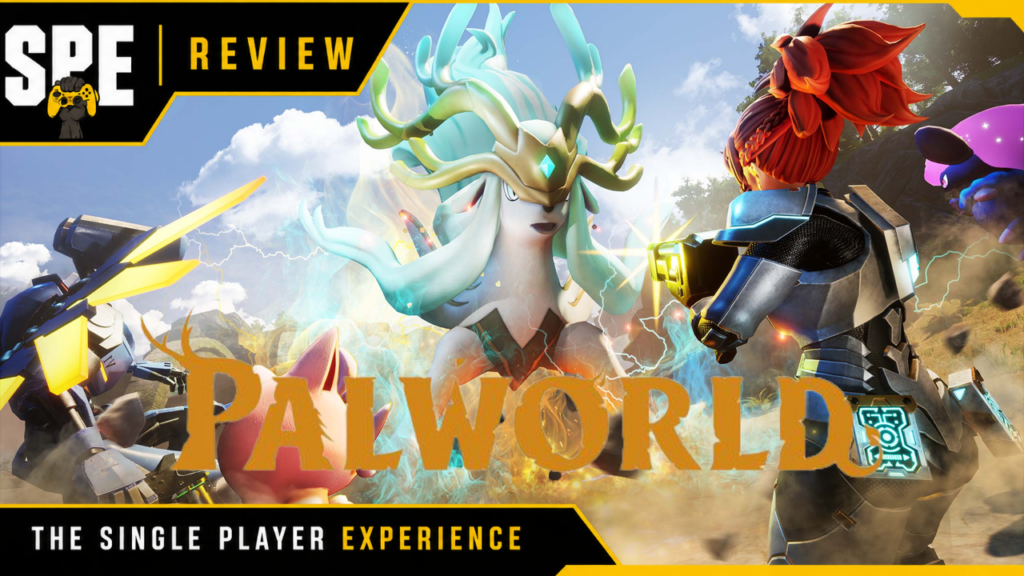

Palworld Review: More than A Pokemon Clone?
Set the Scene
I remember checking out Palworld when it first hit Game Pass a couple of years ago. I only played for a few hours, but I came away with a surprisingly positive first impression. At the time, I was tired of what felt like the increasingly predictable formula of Pokémon, and I had been waiting for someone to take the creature-collection genre in a different direction. Palworld immediately looked like it might be that game.
The premise was ridiculous enough to grab my attention but familiar enough to understand immediately. Here was a game that appeared to take the basic idea of collecting mysterious creatures and then throw that concept into an open-world survival game where those creatures could fight, build, farm, mine, craft and, apparently, get into gunfights. I played a little, enjoyed what I saw, and then decided to wait. I wanted to experience Palworld when it was finally finished rather than judge it while it was still evolving.
That time has finally come. With Palworld reaching its 1.0 release, I decided it was time to return to the Palpagos Islands and see whether the game had become the experience I thought it could be.
After spending hours with it, I can say that Palworld is absolutely more than a Pokémon knockoff. It is also a game that I think I like more in concept than I actually like playing. That might sound contradictory, especially because I couldn’t stop playing it.
Gameplay/Pokémon, But Make It Survival
Let’s get the obvious comparison out of the way: it is nearly impossible to play Palworld without thinking about Pokémon. The similarities are simply too obvious. You explore a world populated by strange creatures, weaken them, capture them, level them up and use them in combat. If someone walked into my house while I was playing Palworld without knowing what it was, I would not blame them for assuming they were looking at some kind of open-world Pokémon game. The two concepts are intrinsically linked whether you want them to be or not.
But playing Palworld for any significant amount of time makes it clear that Pocketpair was not simply trying to make a Pokémon game with different creatures. The survival mechanics, crafting, base building, automation, resource management, open-world exploration and shooter elements fundamentally change how the game works.
In fact, one of the games I kept thinking about while playing Palworld was V Rising. The two games are obviously very different, but structurally there are some interesting similarities. Both ask you to establish a base, gather resources, become stronger and use the systems around you to progressively expand what you’re capable of doing. V Rising has its own version of servants and minions, while Palworld gives you Pals who can fight alongside you or become workers around your base.
The more I played Palworld, the more I found myself comparing the two. And that’s where things got interesting for me, because while I think Palworld is a fun enough survival game, I repeatedly found myself thinking about how much more I enjoyed V Rising‘s overall experience.
That’s the strange thing about Palworld. It borrows from a lot of games, but it doesn’t necessarily feel like a cheap imitation of any one of them. It feels like Pocketpair looked at some of the biggest ideas in modern games and asked, “What if we put all of these things together?” And for the most part, that works.
Everything Is Crafting
If you don’t like crafting systems, I have some bad news for you: Palworld is basically Crafting: The Game.
You craft your Pal Spheres. You craft your pickaxe when you want to mine. You craft an axe when you want to chop wood. You craft weapons to defend yourself, including everything from basic spears and bows to much more powerful firearms. You craft your glider, your shield and various accessories, and nearly everything you use around your base requires some degree of crafting.
The game is constantly asking you to gather something so you can turn it into something else that allows you to gather something even better.
There is a satisfaction to that progression because the systems feed into one another. You gather resources so you can build better equipment. Better equipment lets you explore further. Exploring further introduces you to stronger Pals and more valuable resources. Those Pals can then become combat partners or workers who help automate your base, which allows you to produce even more resources and continue the cycle.
It is a very effective loop.
The problem is that the game can sometimes feel like it is running on that loop without giving me enough reason to care about where the loop is actually taking me.
That distinction became increasingly important the longer I played.
The Pals Are the Best Part of the System
One of the smartest things Palworld does is give the Pals actual jobs. Some Pals are good at farming. Others can mine, chop trees, tend crops, generate electricity, keep things cold or work at furnaces. Even creatures you encounter early in the game can have useful abilities that make them worth keeping around.
Catching a new Pal, checking its skills and assigning it to a station is immediately satisfying. I could catch a creature, bring it back to my base and suddenly have another little worker helping me produce whatever resources I needed. There is something genuinely satisfying about watching the whole operation start to run itself.
The problem is that this also exposed one of my biggest issues with Palworld: I never became particularly attached to my Pals. That surprised me. I have played plenty of Pokémon games, and one of the smartest things that series does is get you emotionally invested in your team almost immediately. Picking one of three starters seems like a small decision, but it gives you a companion. That Pokémon becomes part of your adventure. You watch it grow, evolve and become stronger alongside you, and eventually you develop an attachment to it.
I never really experienced that with Palworld. After dozens of hours, I still found myself looking at my Pals primarily as tools. This one mines. This one waters. This one fights. This one is better at this particular job. This one has better stats. This one can learn a useful ability. They were workers before they were companions. And I think that’s a major reason the game never completely clicked with me.
Pros
The movement and exploration also borrow heavily from some of the biggest open-world games of the last decade. You can climb surfaces as long as your stamina allows it, glide across large sections of the map and use the environment to reach areas that would otherwise be difficult to access. There are even areas where currents of air can carry you upward, allowing you to ascend cliffs and reach higher sections of the world.
If you’ve played Breath of the Wild, Tears of the Kingdom or Elden Ring, you’ll recognize pieces of this design immediately. I have to admit that I never loved this style of exploration in Breath of the Wild, and Palworld didn’t completely change my mind. At the same time, I actually enjoyed it more here because exploration is tied directly into the creature-collection and survival systems.
Finding a new fast-travel point gives you experience and technology points. Discovering new Pals gives you experience. Capturing multiple Pals of the same species rewards you as well. The game constantly encourages you to interact with its systems rather than simply run from objective to objective. That part of the design is smart. I just wish there were more interesting things waiting for me when I got there.
The world is large, but it often feels empty. There are plenty of Pals wandering around, but outside of them, resources and occasional points of interest, I frequently found myself moving through large stretches of land without seeing much that made me want to stop and investigate. The exploration system works. The world itself just doesn’t always give me enough reason to care about exploring it.
The Game Has a Weird Grip on Me
Here’s the part that makes my 6/10 score difficult to explain.
I kept playing. Even when I was bored, I wanted to do the next thing. Even when I was frustrated with the base building, I wanted to upgrade it. Even when I questioned whether the story was going anywhere, I wanted to defeat the next tower. Even when I found myself thinking about V Rising, Pokémon or some completely different game I could be playing instead, I still found myself saying, “Okay, let’s just do this next task.”
It reminded me of the way roguelikes grab me. With a roguelike, I might lose a run and immediately say, “Okay, one more.” With Palworld, I found myself saying, “Okay, I’ll just finish this task.” Then another task appeared. Then another. Then another. There is something about the constant progression that keeps pulling you forward even when the individual activities aren’t particularly exciting. You’re always getting a little stronger, unlocking something new, catching another Pal or improving your base.
That loop is legitimately effective. I just don’t think the individual pieces are consistently compelling enough to make the whole experience exceptional.
Some Quality-of-Life Choices Are Hard to Defend
There are also a handful of design decisions that consistently irritated me. For starters, enemies can attack you while you’re talking to NPCs. Your character is essentially locked into the conversation while enemies are perfectly capable of beating the shit out of you.
I was also attacked while using a fast-travel point and died while trying to select where I wanted to go. Those aren’t game-breaking problems, but they’re the kind of small frustrations that accumulate over a long playthrough.
The bigger problem for me is that Palworld doesn’t properly pause during single-player play. That is a huge issue for someone like me. I’m playing alone. I’m not in a multiplayer session. If I need to step away from the game, I should be able to pause it. Instead, the game requires you to return to the title screen or use other workarounds to safely stop playing.
For a game that can already be demanding about survival, inventory management and exploration, not having a traditional pause function in a single-player experience is an incredibly strange choice.
Cons
For the first 20 or so levels, I was having a pretty good time. I was constantly unlocking something new, discovering another Pal, improving my equipment or finding another system to interact with. The progression felt tangible because every few hours I was getting something that changed what I could do.
Eventually, though, the grind started to catch up with me. The higher I climbed, the more the game began to feel like I had already seen most of what it had to offer. I was still becoming stronger, but the progression wasn’t consistently surprising me anymore. Instead, I found myself completing tasks because they were the next tasks on the list. That isn’t inherently a bad thing. There are plenty of players who love checklist-driven progression, and Palworld is actually pretty good at giving those players something to work toward. I’m just not naturally motivated by checking boxes unless the game gives me a compelling reason to care about the box I’m checking. And that’s where Palworld’s lack of narrative started to hurt.
The Adventure Needs a Story
Palworld does have lore. It has environmental storytelling, scattered journal entries, factions, tower bosses and pieces of information that allow you to gradually understand the Palpagos Islands. But it does not have the kind of narrative structure that I personally need to stay emotionally invested. The main progression is essentially about getting stronger, improving your base, catching better Pals and eventually taking down the various Tower Bosses. The game gives you clear indicators for where you should go next, including the golden objective marker on your compass, and I actually appreciate that enormously.
I’m somebody who likes direction. I understand why some players love being dropped into a world and told to figure everything out for themselves, but I enjoy knowing that there is a deliberate path the developers want me to follow. Give me a destination and let me see what you’ve built along the way.
The problem is that I never felt like I was on a grand adventure. I felt like I was completing increasingly difficult tasks. There is a difference. I would defeat a tower boss and think, “Well, I guess I need to get stronger now.” I’d improve my base, gather resources, catch stronger Pals and eventually go after the next boss. The progression worked mechanically, but it rarely felt meaningful.
I kept thinking about how much better this foundation could be with a story-driven structure similar to something like Persona or Like a Dragon. Imagine taking these incredibly deep systems and putting a compelling cast of characters, relationships and narrative stakes around them. That is the version of Palworld I kept wishing I was playing.
The Systems Are Deep, But the Game Doesn’t Teach Them Well
There is a surprising amount going on underneath Palworld’s relatively straightforward presentation. The problem is that the game isn’t always very good at explaining all of it.
One example is ammunition. You unlock different types of arrows, including elemental and status-based variants, but figuring out how to actually switch between those ammunition types isn’t explained particularly well. There are similar problems with the morale and hunger systems surrounding your Pals. Storage is another example. You can create storage containers and even establish rules for what types of items can be stored in them, which is incredibly useful when you’re dealing with a mountain of resources. If I want one crate to contain weapons and another to contain materials, I can organize my base that way.
But the game doesn’t always do a great job of making those options obvious. Instead, you learn some of these systems through experimentation. You press a button and discover that it does something. You stumble across a menu option and realize you’ve been making your life harder than necessary.
There is a difference between giving players freedom to discover systems and failing to explain them. Palworld occasionally falls on the wrong side of that line.
The Base Building Is Not for Me
Unfortunately, the base-building system is one of the areas where I never really found the appeal. I understand why people love it. There is something satisfying about building a home, organizing your resources and creating an efficient operation where your Pals handle the work for you. But the actual building tools never felt particularly intuitive to me.
Moving something around can be unnecessarily frustrating because instead of simply picking up an object and relocating it, you often have to dismantle it and rebuild it somewhere else. The placement system itself can also be finicky.
I found myself spending more time thinking about how much I didn’t enjoy building than thinking about what I wanted my base to look like.
The Pal management, on the other hand, is exactly what I wanted from this part of the game. Assigning creatures to specific jobs and watching the base operate efficiently is great. Building the physical structure around them is where things fall apart for me. And then there is the overencumbrance system.
I understand why it exists. Survival games need ways to force players to make decisions about what they carry. But I will never enjoy picking up a few too many resources and suddenly becoming a slow-moving lumbering son of a bitch because I’m carrying 716 pounds of material when my limit is 400. Being overencumbered is one of those mechanics that always makes me think, “I get why you did this. I still don’t like it.”
Guns, Pals and Absolute Nonsense
For all of my complaints, Palworld does have an undeniable sense of personality. There is something inherently funny about sending a creature into battle against a human carrying an assault rifle. At one point, I was using a frog dressed like he was ready to teach a karate class while fighting a guy with a gun.
I cannot make that shit up. The game also goes much further than simply giving your Pals weapons. You can teach them new abilities using Skill Fruits, allowing creatures to learn moves they otherwise wouldn’t have. You can encounter different species interacting with one another, watch groups of the same creatures behave almost like little tribes and stumble across surprisingly funny situations throughout the world.
And yes, you can literally butcher your Pals for meat. This is not Pokémon. That absurdity is part of what makes Palworld work. Pocketpair took a concept that many of us grew up with and asked what would happen if you removed some of the traditional boundaries surrounding it. The result is a game where adorable creatures can become farmhands, miners, combat companions, factory workers or dinner. It is bizarre, but it is also distinct.