Introduction
I’ve been a Gears of War fan for a long time. I’ve played every game in the franchise, and while each entry has its own strengths and weaknesses, I’ve always enjoyed what this series does best: delivering a gore-soaked action movie wrapped around one hell of a shooter campaign. The stories have never needed to be the most riveting narratives in gaming for me to enjoy them, because the combination of explosive set pieces, memorable characters, and satisfying gunplay has consistently made Gears one of my favorite shooter franchises. There’s something uniquely satisfying about cutting a Locust in half with the Lancer, knocking another enemy into the dirt with a shotgun, or getting that perfect active reload to squeeze a little extra damage out of your weapon. It’s a formula that has worked for years, and I keep coming back for more.
I was a little conflicted when Gears of War: E-Day was announced. I had invested in the newer storyline introduced in Gears 4 and continued in Gears 5, and I was genuinely interested in seeing where Kait’s story would go next. A prequel wasn’t necessarily what I wanted, and part of me would still rather be playing Gears 6. But let’s be honest: the moment another Gears campaign became available, I was going to play it. I wanted another opportunity to kick some Locust ass, experience the franchise’s signature combat, and see what The Coalition could do with the series’ most important historical event.
What I didn’t expect was for E-Day to become my favorite Gears game of all time. This is still the brutal, bombastic shooter I’ve loved for years, but it also delivers the most emotionally compelling story I’ve experienced in the franchise. By taking us back to the beginning of the Locust invasion, The Coalition has found a way to make these familiar characters feel more human, transforming a prequel I wasn’t particularly asking for into the Gears experience I’ll remember for years to come.
Set the Scene
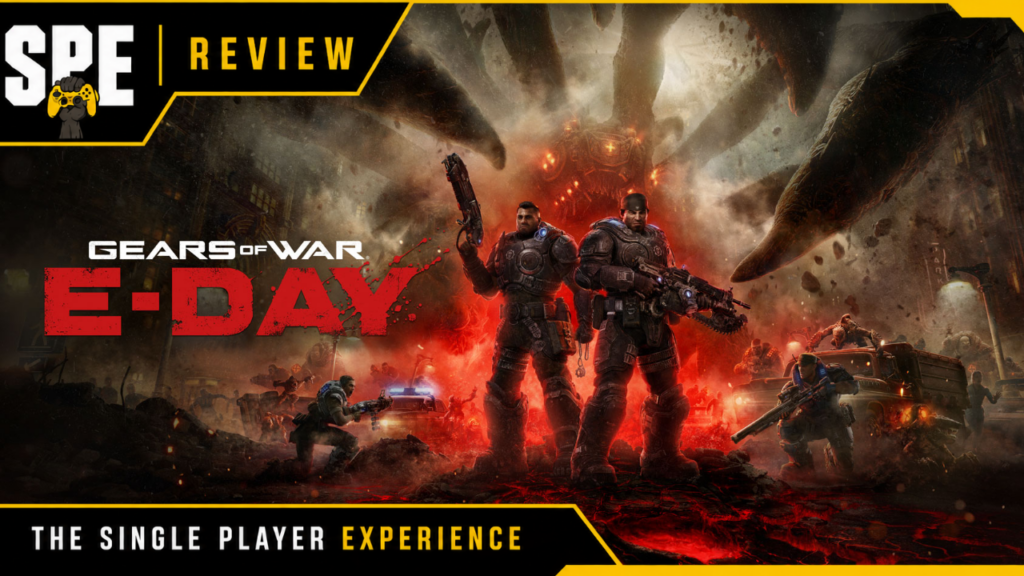
Gears of War: E-Day takes place 14 years before the original game, following Marcus Fenix and Dominic Santiago during the initial emergence of the Locust Horde on the planet Sera. Rather than dropping us into another chapter of an ongoing war, the game takes us back to the moment everything changed, when an entire civilization suddenly found itself facing an enemy it barely understood. This is the beginning of the nightmare that would define Marcus, Dom, and the world they inhabit, and experiencing that moment through characters we’ve known for so long gives the prequel an immediate sense of significance.
After playing for only an hour or so, I was already struck by how different the familiar Gears universe felt through this perspective. Marcus and Dom have always been portrayed as hardened soldiers, practically walking tanks capable of mowing down entire hordes of enemies without blinking. Here, we’re seeing the world when the invasion is still new, when the people around them are trying to comprehend what is happening and the soldiers themselves are being forced to confront an enemy unlike anything they’ve faced before. The atmosphere reminded me of experiencing the first day of a zombie apocalypse, with the familiar world suddenly becoming terrifying and unpredictable.
That change in perspective makes the characters feel more grounded without sacrificing the larger-than-life action that defines the series. Marcus is still Marcus, and the game doesn’t need to reinvent him to make this story worthwhile. Instead, it shows us another side of a character whose history we already know, giving us a better understanding of the experiences that helped shape him. Returning to this world also provides a great introduction for newcomers, who can jump into E-Day without needing to know the events of the original trilogy or the newer games. The prequel establishes the Locust threat, the scale of the disaster, and the people caught in its path in a way that feels accessible while still rewarding longtime fans.
The world itself looks phenomenal. E-Day is one of the best-looking Xbox-associated releases I’ve played, with impressive environments, detailed character models, and cutscenes that do an excellent job conveying the destruction unfolding around the cast. The sound design is just as strong. The weapons have the weight and punch you’d expect from Gears, and the audio presentation makes every firefight feel appropriately vicious. Even the collectibles help flesh out the setting, offering glimpses into the culture, history, and everyday life that existed before Emergence Day changed everything. I also appreciated the way the game uses television broadcasts and radio chatter to reference the wider Gears universe. Little details like these make the world feel lived in, and they show that The Coalition understands how much longtime fans enjoy seeing the series’ history woven into the experience.
Narrative
The biggest surprise of Gears of War: E-Day is just how much I connected with its story. I went into this expecting a solid prequel that would provide some additional context for Marcus and Dom before the original trilogy. Instead, I got what I believe is the most gripping narrative the franchise has delivered to date.
Previous Gears games have certainly had their emotional moments, but their stories have generally served as the framework for the action. These are games about hardened soldiers fighting impossible odds, cutting enemies apart with chainsaw guns, and surviving increasingly ridiculous battles against overwhelming forces. That bombastic action is part of the franchise’s identity, and I wouldn’t want to lose it. What makes E-Day so effective is that it retains all of that while putting considerably more emphasis on the people underneath the armor. This isn’t simply a story about fighting monsters. It’s about the emotional toll of surviving a catastrophe, the grief that comes with losing people, the guilt that can follow survival, and the determination required to keep going when the world around you is falling apart.
That focus extends beyond Marcus and Dom, with the new additions to the cast becoming some of the most rewarding parts of the experience. Lucas and Mags bring personalities and perspectives that distinguish them from the familiar Gears squadmates, and their stories give the larger conflict a more personal dimension. I initially expected Lucas to be little more than a tagalong character, but he became one of my favorite parts of the game. His backstory, in particular, helped me understand the person beneath the soldier, and I found myself far more invested in his journey than I anticipated. These characters aren’t just there to fill out a squad and contribute another gun to the firefight. Their experiences give the war a human cost, making the destruction around them feel more meaningful.
The writing and performances are a significant step forward for The Coalition. The facial animations are sensational, and the characters communicate an extraordinary amount through their expressions and body language. You can see the grief in Marcus and Dom’s eyes, feel the tension building as the squad confronts seemingly insurmountable odds, and recognize the mixture of fear, frustration, and determination that comes with watching an entire world descend into chaos. These moments make the characters feel vulnerable in ways that complement the series’ traditionally imposing image of its soldiers. They’re capable fighters, but they’re also human beings trying to survive something they don’t fully understand.
That’s what makes the story so effective. The action still delivers the familiar spectacle, but it now carries more emotional weight because I care about the people experiencing it. The Coalition has taken the established Gears formula and given it a more intimate, character-driven foundation. I wasn’t expecting to become so invested in the personal journeys of this new group of characters, and I certainly wasn’t expecting a prequel to make me want another prequel. Yet, when the credits rolled, I wanted more. I wanted to know what happened next to Marcus, Dom, Lucas, and Mags, and I wanted to see the experiences that would eventually lead Marcus to the events of the original game.
I went into E-Day wishing The Coalition had continued Kait’s story in Gears 6. I came out of it wondering whether I’d rather see an entire prequel trilogy instead. That’s a remarkable turnaround, and it speaks to how effectively this story won me over. For a franchise I’ve enjoyed for years primarily because of its gameplay, E-Day gave me a narrative experience that elevated everything around it.
Gameplay
Fortunately, Gears of War: E-Day doesn’t need to reinvent the series’ combat to deliver one of its best campaigns. The core gameplay remains as satisfying as ever, built around the familiar rhythm of moving between cover, suppressing enemies, flanking opponents, and finding the right moment to leave safety and get aggressive. There’s a particular satisfaction to the way Gears handles combat that few other shooters have managed to replicate. The weight of the weapons, the brutality of the executions, and the constant push and pull between defensive positioning and aggressive movement make every encounter feel physical. The Lancer remains a joy to use, and there’s still nothing quite like getting up close with the Gnasher or tearing through a Locust with a perfectly timed chainsaw execution.
The active reload mechanic remains another one of the franchise’s best ideas. Hitting the timing window rewards you with a more effective reload, giving even a familiar firefight a little extra tension and making weapon management feel more involved than simply emptying a magazine and pressing a button. The gunplay sounds fantastic, too. Each weapon has the kind of punch and mechanical character that makes it immediately satisfying to fire, and the sound design reinforces the sheer brutality of the combat.
Movement also benefits from some welcome additions. Sliding into cover and navigating between low and particularly low barriers gives encounters a little more fluidity, allowing you to move around the battlefield with greater flexibility. These changes build on the existing cover-based system rather than replacing it, and they help the combat feel fresh without losing the identity that makes Gears so distinctive. The Locust also have a few new tricks of their own. One addition I particularly enjoyed was their use of smoke grenades to obscure your vision before rushing in close. Shotgun-wielding enemies using smoke to close the distance can turn a seemingly manageable firefight into a scramble for survival, forcing you to react instead of comfortably picking enemies off from cover. It’s a simple addition, but one that makes encounters more dynamic.
The arsenal offers plenty of options, including the Lancer Mk. 1 with its bayonet, the prototype chainsaw Lancer, the Hammerburst, the Gnasher, the Boomshot, the Snub pistol, frag grenades, the Reach Shot sniper rifle, and the Gut Puncher grenade launcher. Finding supply caches scattered throughout the city lets you select your loadout, adding a useful layer of preparation to the campaign. The game also encourages you to explore beyond the main objective, with open areas offering secondary missions, collectibles, and weapon upgrades that reward players who take their time.
Weapon and armor modifications are among the more substantial additions. Weapon mods can improve accuracy, critical damage, range, recoil, and stability, while other options let you change a weapon’s firing mode. Armor mods can strengthen your defensive abilities or better support your preferred approach to combat, and completing secondary objectives can reward you with additional upgrades. Whether you want to improve accuracy while firing from cover, reduce sway while aiming, or build a setup that better suits your playstyle, there’s a satisfying amount of customization available. These systems give exploration a practical purpose beyond collecting items for the sake of completion, and they make the optional activities feel worthwhile when you’re rewarded with an upgrade that meaningfully changes how you approach the next encounter.
The collectibles themselves are also worth mentioning. Alongside the usual discoveries scattered throughout the environment, you can find items connected to the wars that preceded Emergence Day and pieces of everyday life from the world before the invasion. As someone who enjoys seeing developers pay attention to the history and culture surrounding a fictional universe, I appreciated the way these items help flesh out the setting. They give you another reason to explore while reinforcing the tragedy at the center of the story: this was a world with its own history, traditions, and ordinary lives before the Locust turned everything upside down.
Not every gameplay sequence is equally successful, however. During Act II, Chapter 5, I encountered one of the game’s weaker moments while manning the gunner seat of a Raven helicopter. The sequence largely involves shooting wave after wave of airborne enemies, and it quickly becomes monotonous. It’s the kind of stationary shooting-gallery section that feels as though it belongs to an older era of action games, and it doesn’t do much to advance the story while you’re stuck repeating the same basic action. It isn’t a campaign-breaking problem, but it stands out in a game whose ground combat is otherwise so consistently engaging.
The campaign also has a few technical and AI issues that detract from the experience. On multiple occasions, I noticed human soldiers and Locust enemies standing near one another without engaging in combat, which was a little immersion-breaking. I also encountered some obvious animation and collision problems during cutscenes, including a character clipping through a fully assembled helicopter as though the vehicle weren’t there. These moments can be amusing in isolation, but they undermine the polish of an otherwise gorgeous game. More frustratingly, I ran into a bug during the optional Trap Locust mission that prevented me from interacting with the control panel needed to start the objective. The train wouldn’t emerge, and no amount of trying would get the mission to load properly. I also had a moment when Dom blocked a doorway and left me completely unable to exit an apartment I’d entered to fight enemies and collect an item. My only solution was to restart from the previous checkpoint.
These issues weren’t constant enough to ruin the campaign, but they were noticeable. The checkpoint system also adds some pressure to individual encounters, as playing on Normal gives you four downs before you’re sent back to the latest checkpoint. That generally works well with the game’s action-focused design, although the occasional technical hiccup makes it more frustrating when something goes wrong.
My biggest reservation is a little more philosophical. Prequels have a difficult job when it comes to continuity, especially when they introduce new weapons, enemies, technology, and mechanics that apparently disappear by the time the original story begins. E-Day includes systems and equipment such as weapon and armor modifications, additional defensive options, and enemy types that aren’t part of the original trilogy in the same way. These additions help make this the most mechanically feature-rich Gears game I’ve played, but they also create some questions about why these technologies and tactics don’t play a larger role in the later games. I understand the temptation to make a new entry feel more substantial and modern, and I would rather have an enjoyable game than one that rigidly limits itself to the mechanics of an older release. Still, the trade-off is worth acknowledging. E-Day might be the most fun Gears game yet, but some of that fun comes at the expense of perfect continuity.
Pros
Gears of War: E-Day delivers the most compelling story the franchise has ever had, pairing the series’ signature spectacle with a genuinely moving exploration of grief, perseverance, and survival. Marcus and Dom feel more human in this setting, while Lucas and Mags provide new personalities and emotional journeys that made me far more invested in the squad than I expected. The excellent performances, expressive facial animations, gorgeous presentation, and outstanding sound design help bring that story to life. Meanwhile, the core combat remains wonderfully satisfying, with weighty weapons, brutal executions, active reloads, improved movement, clever enemy tactics, and a substantial weapon and armor modification system that makes exploration worthwhile. It’s a fantastic single-player campaign that left me wanting more.
Cons
The campaign’s technical issues occasionally undermine its otherwise excellent presentation, with enemy AI inconsistencies, character clipping, and a frustrating bug that prevented me from completing an optional mission. The Raven gunner sequence is another low point, feeling repetitive and outdated compared with the more engaging ground combat. The additional mechanics and enemy types also raise some continuity questions when viewed alongside the original trilogy, even if they make the campaign more enjoyable in the moment. None of these shortcomings outweigh the game’s strengths, but they prevent an already excellent experience from feeling completely polished.
Is This a Good Single Player Experience?
Absolutely. Gears of War: E-Day is a damn fine shooter campaign and one of the strongest single-player experiences I’ve played this year. The combat is immediately satisfying, the presentation is excellent, and the story gives the franchise’s familiar action a level of emotional depth I wasn’t expecting. You don’t need to be a longtime Gears fan to appreciate the campaign, either. The prequel provides an accessible entry point into the series while offering longtime players a fresh perspective on characters and events they’ve known for years. Whether you’re here for the gunplay, the spectacle, or the story, there’s a hell of a lot to enjoy.
Gears of War: E-Day is the best Gears of War game I’ve played, combining the franchise’s signature brutal gunplay with its most emotionally compelling story yet. Despite some technical hiccups, a handful of repetitive sequences, and a few continuity concerns, The Coalition has delivered an outstanding single-player campaign that made me fall in love with this world all over again. I came in wanting Gears 6, but I left hoping this is the beginning of an entirely new prequel trilogy.
Why This Passion Score?
An 82 Passion Score reflects just how much Gears of War: E-Day surprised me. I went into this game wanting another entertaining Gears campaign, but I wasn’t particularly excited about revisiting the past when I was still interested in seeing where the newer storyline would go. I expected familiar combat, spectacular action, and a story that would do enough to keep me invested between firefights. Instead, I got a game that made me care about these characters in a way I hadn’t experienced to the same degree in previous installments. Lucas and Mags were unexpected highlights, and the emotional weight of their stories, combined with the performances of the returning characters, gave the campaign a resonance that stayed with me after the credits rolled.
The gameplay was already on a strong foundation, so the real surprise was how much the narrative elevated the overall experience. I still had a few frustrations with the bugs, the repetitive Raven section, and some of the choices that complicate the franchise’s continuity, but those issues didn’t stop me from having an excellent time. More importantly, they didn’t diminish how badly I wanted to see what happens next. I finished the campaign wanting another game featuring this version of Marcus, Dom, and their companions, and that’s about as strong an endorsement as I can give a prequel. E-Day didn’t just meet my expectations for a Gears campaign; it changed what I want from the franchise going forward.