Set the Scene
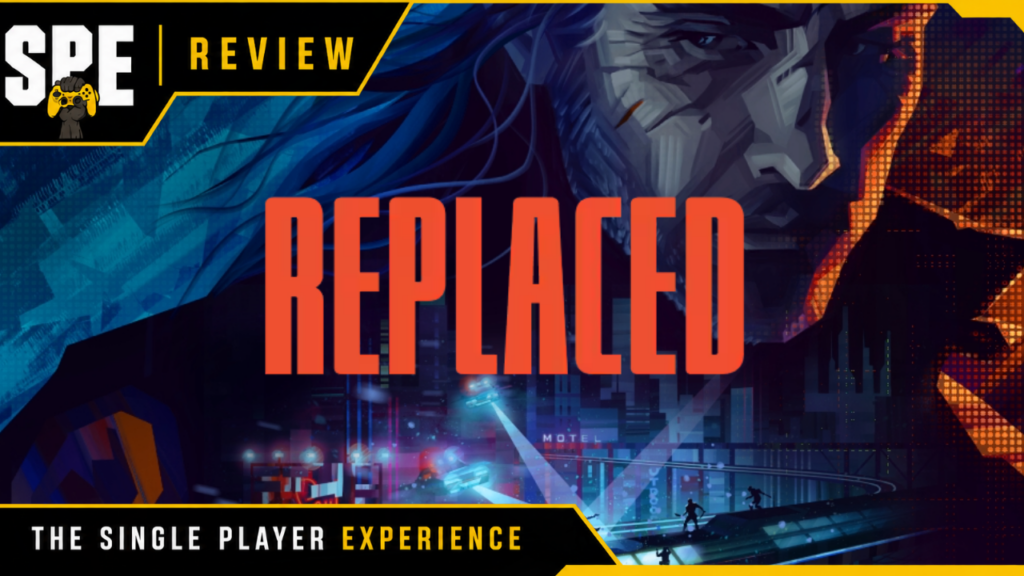
What if you took the dystopian atmosphere of The Last of Us, mixed it with the cyberpunk grime of Blade Runner and Judge Dredd, gave it the cinematic presentation of a modern prestige game, and then built an Arkham-style combat system into a 2D action-adventure? On paper, that combination sounds like it shouldn’t work. Somehow, REPLACED manages to make most of those ingredients fit together surprisingly well.
I’ve been looking forward to REPLACED for a while. I first discovered the game through a Steam Next Fest demo, and that demo immediately caught my attention. It wasn’t particularly long, but it gave me enough of a taste of the game’s visual presentation, combat, and atmosphere to convince me that this was going to be exactly the kind of strange cinematic indie game I enjoy.
After playing through the full game, I still think that first impression was largely correct. REPLACED is one of the most visually impressive indie games I’ve played this year, and its combat is easily my favorite part of the experience. At the same time, the game has a frustrating tendency to undermine its strongest qualities with platforming, puzzles, navigation, and stretches of story that slow down an otherwise compelling adventure.
That makes REPLACED an interesting game to evaluate because I found myself having two very different experiences depending on what the game was asking me to do. When I was fighting, exploring its dystopian world, or watching one of its beautifully constructed cinematic sequences, I was completely locked in. When the game asked me to figure out an obtuse puzzle or navigate a platforming section that I couldn’t properly read, that enthusiasm could disappear just as quickly.
A 2D Dystopian Thriller
The story takes place in a world shaped by an alternate version of history in which the United States dropped atomic bombs on its own soil during World War II. Phoenix Corporation eventually rises to power and controls Phoenix City, a sprawling metropolis enclosed behind an impenetrable wall.
You play as Warren Marsh, a scientist whose life has been defined by the loss of his research partner and best friend. Marsh’s work culminates in R.E.A.C.H., an artificial intelligence designed to match terminally ill patients with potential organ donors. The technology becomes far more ambitious than its original purpose, and Warren eventually becomes neurologically connected to the AI.
From there, the game becomes a journey outside the walls of Phoenix City as R.E.A.C.H. attempts to return to the laboratory and undo the process that put the AI inside Warren’s body. Along the way, the character begins to uncover more about Phoenix City, the corporation controlling it, and the world that exists beyond the walls.
The premise is interesting, and there are enough mysteries surrounding R.E.A.C.H. and Phoenix Corporation to keep the story moving. I just don’t think the narrative ultimately reaches the level that its premise promises.
There were stretches where I genuinely wanted to know what was going to happen next, but the game occasionally kills its own momentum by sending you into side objectives or stretches of gameplay that don’t feel particularly important to the larger story. I’ll find myself completely invested in what is happening, only for the narrative to suddenly slam on the brakes.
The result is a story that is good enough to keep you playing, but not one that I would consider one of the game’s defining strengths.
Gameplay: Batman Arkham in Two Dimensions
The combat is where REPLACED really won me over. If you’ve played the Batman: Arkham games, you’ll immediately understand what the developers are going for. You’re surrounded by enemies, you attack them, you counter incoming strikes, and you dodge attacks that can’t be countered. The similarities are obvious, but REPLACED adapts that formula surprisingly well to its 2D presentation.
Enemies telegraph their attacks with different indicators. Yellow signals indicate an attack that can be parried, while red indicates an unblockable attack that you need to dodge. Once you understand those visual cues, combat becomes a rhythm of attacking, countering, dodging, and repositioning yourself around the battlefield.
There is also a firearm that can be used to deal significant damage and create opportunities for devastating finishing moves. Those finishing moves are fantastic.
There’s a satisfying crunch to the combat that makes every successful attack feel impactful, and once you get into a rhythm and start chaining attacks together, REPLACED can produce that same kind of flow state that makes the Arkham combat system so addictive.
The character movement can sometimes feel slow and deliberate, but I actually think that works in the game’s favor during combat. There’s weight behind Warren’s attacks, and the slower movement makes every dodge, parry, and attack feel more deliberate.
The enemy variety also keeps things interesting. You’ll encounter shielded enemies that require you to strip away their defenses, agile opponents that force you to wait for an opening, and enemies armed with guns that change how you need to approach an encounter. The combat isn’t revolutionary, but it doesn’t need to be. It works. And when REPLACED gives you a large group of enemies and lets you work your way through them using everything you’ve learned, it can be an absolute blast.
I Just Wish There Was More Combat
This is where my frustration with REPLACED begins. I love the combat, but I don’t think the game gives it enough room to breathe.
There are boss fights scattered throughout the campaign, and when REPLACED gives you one, it tends to deliver. The fight against Uncle Ben is one of my favorites because it makes you feel like you’re in a genuinely dangerous confrontation while still requiring you to understand the game’s combat mechanics.
The Commissioner also gets a fantastic boss encounter that does a great job of changing things up and testing the tools you’ve developed throughout the campaign. The problem is that there simply aren’t enough of these moments. I found myself wishing the game would lean harder into its combat because the foundation is so good. The combat is the part of REPLACED where I felt the most consistently engaged, and the limited number of bosses made those encounters feel like rare events rather than a major pillar of the experience.
There is another issue that becomes particularly annoying when you die during a boss fight: the game makes you replay the preceding cinematic sequence before getting another attempt.
It’s a small thing, but when you’ve already seen the scene several times, forcing you to sit through it again creates unnecessary friction. Still, I rarely felt that combat deaths themselves were cheap. When I lost a fight, I generally knew why. I had missed a parry, mistimed a dodge, or made a mistake that cost me too much health. That made failure feel fair, which is always something I appreciate.
A World Worth Exploring
One thing I really enjoyed was how much optional information REPLACED puts throughout its world. You can discover items that increase your health, interview excerpts that provide additional context about the world, and scans that give you small pieces of lore. These collectibles aren’t necessary to understand the basic story, but they help flesh out Phoenix City and give players who want to dig deeper something to find.
I just wish the game did a better job of telling me where I was supposed to go next. For a game that is largely linear, I got lost an embarrassing number of times. There were moments where I genuinely sat there thinking, “Where the hell am I supposed to go?” An optional navigation prompt or button that could give me a subtle hint would have gone a long way toward solving this problem without completely removing exploration.
I don’t need the game to hold my hand. I just want a little nudge when I’ve been walking around the same area for five minutes wondering whether I’ve somehow missed the obvious path.
Pros
A World Worth Exploring
One thing I really enjoyed was how much optional information REPLACED puts throughout its world. You can discover items that increase your health, interview excerpts that provide additional context about the world, and scans that give you small pieces of lore. These collectibles aren’t necessary to understand the basic story, but they help flesh out Phoenix City and give players who want to dig deeper something to find.
I just wish the game did a better job of telling me where I was supposed to go next. For a game that is largely linear, I got lost an embarrassing number of times. There were moments where I genuinely sat there thinking, “Where the hell am I supposed to go?” An optional navigation prompt or button that could give me a subtle hint would have gone a long way toward solving this problem without completely removing exploration.
I don’t need the game to hold my hand. I just want a little nudge when I’ve been walking around the same area for five minutes wondering whether I’ve somehow missed the obvious path.
A Gorgeous Game on Steam Deck
REPLACED is another indie game that feels exceptionally well suited to the Steam Deck. The combination of its 2D presentation, relatively compact campaign, and cinematic structure makes it a natural handheld game. It looks fantastic on the Deck, and I spent a significant portion of my playthrough there.
I did experience a few crashes during my Steam Deck playthrough, although nothing that completely derailed my experience. It’s something prospective players should be aware of, but it wasn’t frequent enough to dramatically change my opinion of the game.
I will say, however, that REPLACED deserves to be experienced on a large television if you have the opportunity. The game’s use of widescreen presentation makes its cinematic qualities stand out even more. I wasn’t always a fan of widescreen presentation when I was younger, but games like Planet of Lana, Ghost of Yotei, and REPLACED have completely changed my mind about how effective it can be.
Those black bars and cinematic framing can make the world feel significantly larger than it actually is. There are several set pieces where REPLACED looks absolutely stunning on a big screen. At the same time, the larger display can make some of the platforming and environmental cues easier to see, which is another reason I’d recommend experiencing the game on a television at least once.
Cons
Unfortunately, I never developed the same appreciation for REPLACED’s platforming as I did the game’s combat. The platforming isn’t necessarily bad, but it often feels like the weakest link in the game’s overall design. A lot of the sequences are based around timing and precision rather than giving you much freedom to experiment. You’ll wait for a spotlight to move, jump between hazards, climb through an area, or navigate a sequence where the correct timing is more important than discovering an interesting solution.
The biggest problem I had was simply seeing what the game wanted me to do. The dark, grainy visual style that makes REPLACED look so incredible can also make some of its platforming elements difficult to distinguish. Sometimes I couldn’t immediately tell what was part of the background and what was an object I could interact with. There were also moments where I wasn’t sure whether I needed to jump toward something in front of me or move into a different layer of the environment.
Some of this is absolutely a “me” problem. I’m not exactly a platforming savant. There were plenty of moments where I eventually figured out what I’d done wrong, nailed the sequence on another attempt, and got that satisfying little “Oh, that’s what the game wanted me to do” feeling. Those moments were rewarding.
But there were also plenty of other times when I wasn’t struggling because the platforming was difficult. I was struggling because I couldn’t understand what I was supposed to interact with. That distinction matters.
The puzzles suffer from a similar issue. As the campaign progresses, REPLACED asks you to interact with more environmental puzzles and progression mechanics. The problem is that some of the early puzzles don’t communicate their rules particularly well.
I don’t mind a game making me think. In fact, I enjoy puzzles when they’re designed around a clear idea that forces me to look at a situation differently. But I don’t want to spend five minutes staring at a room because I don’t understand that I’m actually looking at a puzzle in the first place.
That’s where REPLACED occasionally loses me. I recently played Planet of Lana II, and one of the things I appreciated about its puzzles was the balance between being approachable and still making me think. REPLACED doesn’t always find that same balance. Some of its puzzles become easier to understand as you progress and learn the game’s visual language, but I found the early experience particularly frustrating.
The game does use visual cues to help. Certain interactable objects are highlighted in yellow, for example, which helps establish what you should be looking for. Unfortunately, even some of the climbing fixtures and environmental objects can be difficult to see against the game’s darker backgrounds. Again, the game’s greatest visual strength occasionally becomes one of its gameplay weaknesses.
Is This a Good Single Player Experience?
Yes, but with some caveats. REPLACED is an excellent recommendation for players who prioritize atmosphere, presentation, cinematic storytelling, and satisfying action combat. If you’re a fan of Batman: Arkham, cyberpunk dystopias, cinematic platformers, or games that tell stories through carefully constructed environments, there is a lot here to appreciate.
The combat alone is worth experiencing, particularly if you’re a fan of the Arkham formula. There is a genuine thrill that comes from entering a fight, reading enemy attacks, parrying incoming strikes, dodging unblockable attacks, and eventually finding yourself in that satisfying flow state where everything starts to click.
The platforming and puzzles are where I would temper my recommendation. Players who love precision platforming or enjoy being left to figure out environmental puzzles may have a better time with these sections than I did. Players like me, who want clear communication and aren’t naturally gifted at platforming, may occasionally find themselves frustrated.
Still, the overall package works. REPLACED is atmospheric, stylish, ambitious, and memorable, and it is difficult to argue with a game that kept me engaged all the way through its credits despite the things that frustrated me along the way.
Why This Passion Score?
My 78 Passion Score comes largely from how difficult it was for me to put REPLACED down despite having several legitimate complaints about it. I never reached a point where I thought I was done with the game. Even when I was frustrated by a platforming section, confused by a puzzle, or wandering around trying to figure out where the hell I was supposed to go, I still wanted to see what happened next. The game’s atmosphere kept pulling me forward, and the combat gave me enough satisfying moments that I was always willing to push through the weaker sections.
The aesthetic is probably the biggest reason the Passion Score is this high. REPLACED has an identity that immediately grabbed me. The combination of dystopian cyberpunk, cinematic framing, gorgeous lighting, 2D characters, 3D environments, and widescreen presentation creates a world that I genuinely wanted to spend time in. It reminded me of The Last of Us, Mad Max, Blade Runner, and Judge Dredd without feeling like a cheap imitation of any of them.
Then there is the combat, which scratches an itch I didn’t know I needed from a 2D game. As someone who loves the Batman: Arkham games, getting a version of that combat philosophy in this setting was one of the biggest highlights of my experience.
The reason this isn’t an even higher Passion Score is that I ultimately liked the game’s atmosphere and presentation more than I liked all of its gameplay. I wanted more combat and more boss fights, while the platforming and puzzles regularly tested my patience. The story also never quite delivered the emotional or narrative impact I thought it could have. But here’s the thing: I still finished it. I wanted to see those credits. For all of my complaints, REPLACED kept me engaged from beginning to end, and that counts for a lot.