
Set the Scene: One More Run, One More Drift
Full disclosure: I like racing games, but I’m not particularly good at them, and I’ve never been the kind of gamer who can spend hundreds of hours mastering every turn, perfecting every drift, and shaving milliseconds off a lap time. Racing games have a relatively short expiration date for me. I’ll jump in, enjoy the adrenaline rush, appreciate the spectacle of high-speed driving, and eventually find myself ready to move on to something else. I don’t hate the genre, but it has never been my first choice when I’m looking for a game to settle into for the long haul.
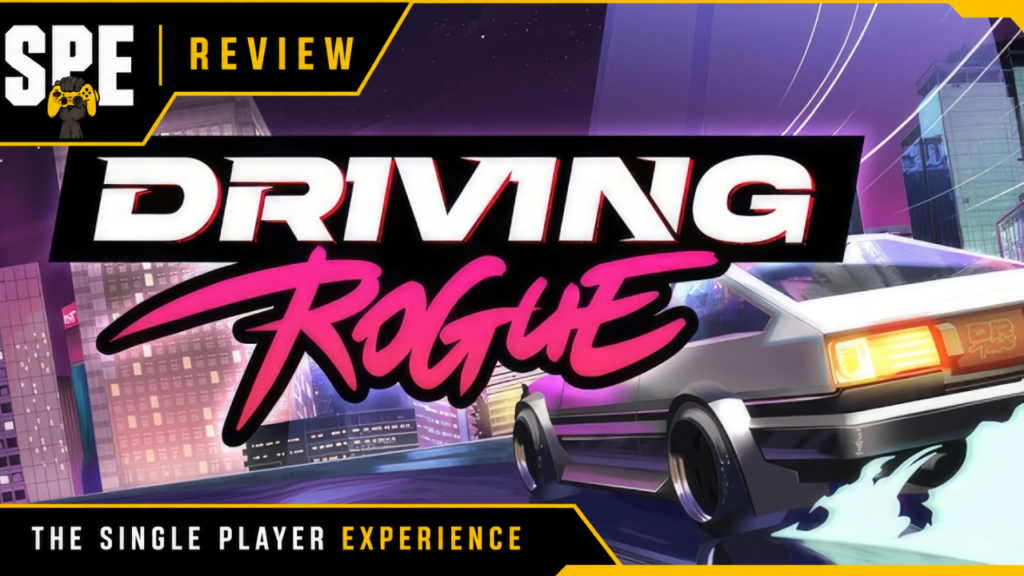
That hasn’t stopped me from checking out the occasional racer, especially when an indie developer puts an interesting spin on the formula. A few months ago, I stumbled across Driving Rogue while browsing Steam’s recently released games. The trailer immediately caught my attention with its combination of arcade racing, flashy visuals, and high-speed chaos. It reminded me of the old-school arcade racers I grew up seeing, with a little Crazy Taxi, a little Fast & Furious, and a healthy dose of Need for Speed Underground mixed into the presentation. The neon-soaked aesthetic, youthful attitude, and almost anime-inspired visual flair gave the game an identity that stood out among the other racing titles competing for my attention.
But there was one word that turned my curiosity into an immediate desire to play: roguelite. If you’ve listened to The Single Player Experience or read enough of my reviews, you already know that I’m a roguelike and roguelite sicko. Give me a gameplay loop built around repeatable runs, randomized upgrades, and the opportunity to make each attempt a little different, and I’m usually willing to give it a shot. Driving Rogue promised exactly that, combining high-speed racing with deck-building mechanics and arcade-style scoring. I had recently played Screamer, another racing game with an anime-inspired presentation, but this looked like a more arcade-focused experience with a different kind of replayability.
The game’s own pitch sums up the idea nicely: race through traffic, chase impossible gaps, and keep your combos alive while turning your vehicle into a high-speed monster. You can race solo or join friends in online co-op, with leaderboards providing another reason to push your skills further. I went into Driving Rogue hoping its roguelite systems would give me a reason to stick with a racing game longer than I usually do, and while it didn’t completely turn me into a racing enthusiast, it gave me a surprisingly enjoyable ride.
Gameplay: An Arcade Racer With a Roguelite Brain
The core premise of Driving Rogue is straightforward: complete races, earn points by driving with style, and survive long enough to reach the finish line before the timer expires. Speed matters, but simply holding down the accelerator and hoping for the best isn’t going to carry you very far. The game rewards players for combining different driving techniques, including drifting, slipstreaming behind other vehicles, and narrowly avoiding collisions. The more effectively you chain these actions together, the more impressive your score becomes, creating a system that encourages you to drive aggressively without losing control of your vehicle.
The tutorial does an excellent job of introducing these mechanics without overwhelming you. You’re taught how to accelerate, initiate and control a drift, exit a drift cleanly, and use the slipstream created by driving behind another car. You can also earn points for near misses, which reward you for threading your vehicle through dangerous gaps without actually making contact. Crashes, on the other hand, break your combo, damage your car, and cost you valuable momentum. If your vehicle’s health reaches zero, the run is over, so reckless driving can quickly turn a promising attempt into a complete disaster.
I appreciate how clearly the game communicates these systems from the beginning. A good tutorial can make or break the opening hours of a game, especially when it introduces mechanics that might be unfamiliar to players who don’t regularly play its genre. Driving Rogue gives you enough information to understand what it expects without burying you under a mountain of instructions. By the time I finished the introductory stages, I had a clear idea of how scoring worked, what I needed to do to survive, and why I couldn’t simply treat every race like a demolition derby.
Each race also provides a satisfying breakdown of your performance. You can see your top speed, drifting distance, slipstream usage, near misses, and overall time, alongside the points and currency earned through each category. At the end, the game assigns you a grade ranging from the lower ranks up to the coveted triple-S territory, giving you an immediate indication of how well you performed. Before starting another stage, you can see the score requirements for the different grades, which helps you understand exactly how much better you need to drive to meet the next challenge.
My first run ended around the fourth race, with a total score of 18,200 and a final-stage requirement that I failed to meet by a considerable margin. The game essentially told me that my score was a little light and that I needed to step up my game, which was a perfectly fair assessment of my driving ability at that point. I wasn’t being cheated by some arbitrary scoring system or punished by a mechanic I couldn’t understand; I simply hadn’t mastered the techniques needed to succeed. For someone who isn’t particularly skilled at racing games, I appreciated that distinction because it gave me a reason to improve rather than a reason to blame the game.
The Deck-Building Is the Secret Sauce
The biggest reason Driving Rogue caught my attention is that it doesn’t treat racing as the only system worth developing. Between races, you can spend the currency you’ve earned on cards that modify your vehicle, giving each run a progression system that feels familiar to anyone who enjoys roguelites and deck-builders. These cards can affect your car’s durability, acceleration, handling, and other characteristics, often providing a meaningful advantage in one area while introducing a drawback somewhere else. The result is a series of small decisions that gradually shape your vehicle into something better suited to the challenges ahead.
Take the Heavy Duty Body card, for example, which increases durability while reducing acceleration. It also helps you lose less speed and health through collisions, making it a potentially valuable choice if you expect to take a few knocks along the way. Expanding Plating offers another defensive option by increasing durability after every race, rewarding players who can survive long enough to benefit from its effect. These cards demonstrate how the upgrade system encourages you to think about your current weaknesses and what kind of driver you want to become during a run.
Other cards offer different forms of flexibility. Double Time allows you to restock consumable cards when the required shop slots are available, while Junkyard Sale gives you a random modification. The Mod Box provides a choice between three randomly generated mod cards, allowing you to select the option that best suits your current build. These decisions make the shop more than a place to spend whatever money you have left over. You’re actively trying to improve your odds of surviving future races, and every purchase can influence how your vehicle handles the next challenge.
I was pleasantly surprised by how much of an impact the cards had on the driving itself. An upgrade that changes durability or acceleration isn’t simply a number increasing on a menu; it can change how confident you feel pushing through traffic, how much punishment your vehicle can withstand, and how aggressively you can approach a difficult section of road. I initially wondered whether the deck-building concept might feel like a gimmick attached to a racing game, but the modifications have enough practical influence to make the system feel worthwhile. The cards genuinely matter, and that makes the progression between races satisfying.
However, I never quite reached the point where I developed a favorite build or became deeply invested in a particular combination of cards. In other roguelites and deck-builders, I often find myself chasing a specific strategy, hoping to discover the perfect synergy that turns a run into something special. With Driving Rogue, I was more likely to choose whichever cards I could afford and which ones appeared to offer the most straightforward benefit with the fewest drawbacks. That approach worked well enough, and I enjoyed seeing the upgrades change my car, but the system didn’t grab me as strongly as the best deck-building games have.
Even so, I consider the card system one of the game’s biggest strengths. It gives the racing a layer of strategy that helps distinguish Driving Rogue from a conventional arcade racer, and it creates a reason to care about how each race affects the rest of your run. The driving is the immediate attraction, but the upgrades give you something to think about when you’re not on the road.
Every Race Is a Test of Nerve
The scoring system becomes more demanding as you progress, and the game does a good job of introducing new obstacles and race types instead of simply asking you to repeat the same challenge indefinitely. Sprint races require you to reach the finish line before time runs out, while longer marathon-style events extend the journey and can provide opportunities to repair your vehicle along the way. The different formats help maintain the arcade momentum, giving you new circumstances to navigate as your run develops.
The road itself is designed to keep you alert. Other vehicles create moving obstacles, while hazards such as oil slicks, wet surfaces, and snow can make controlling your car more difficult. Low-traction conditions are especially dangerous because they can compromise your handling at exactly the moment you need to make a precise adjustment. These obstacles work well with the scoring system because they force you to balance risk and reward. You want to drift through narrow gaps and maintain a high-speed combo, but you also need to recognize when an aggressive maneuver could end your run.
Gas stations provide another important layer of strategy. Some stages feature a station that repairs your vehicle when you drive through it, giving you a chance to recover from damage before the next major challenge. I like that the game tells you when a gas station is expected to appear, allowing you to prepare for the possibility of healing instead of relying entirely on luck. It creates a small but useful decision point: you need to keep the station in mind while still driving well enough to meet the score requirements. Cards can also provide defensive or healing benefits, so survival is a combination of your driving ability and the build you’ve assembled.
One of my favorite moments came when I narrowly avoided a collision by slipping between two vehicles that were positioned just far enough apart to create an opening. I had been drifting, trying to maintain my combo, and suddenly found myself threading through a gap that I would normally have expected to crash into. Instead, I pulled it off, kept my run alive, and earned the points for the maneuver. It was one of those small gaming moments that makes you sit back and think, “Oh, yeah, I actually did that.” I’m not an especially accomplished racing player, so those moments of improvement felt particularly rewarding.
The boss encounters add another layer to the progression, testing your ability to perform under pressure while meeting the requirements needed to advance. I managed to defeat my first boss but still failed to earn enough style points to qualify for the next stage, which reinforced an important part of the game’s design: winning isn’t always enough. You have to drive well, maintain your combos, and meet the required score to keep moving forward. That approach fits the arcade philosophy, where performance matters just as much as reaching the finish line.
Naturally, I had a few rough runs along the way. I crashed, lost combos, misjudged drifts, and occasionally found myself struggling to meet a score requirement that seemed much easier when I watched the tutorial. But the game generally felt fair, and I rarely felt that a failure was the result of a cheap mechanic. My biggest obstacle was my own ability to drive consistently, which is exactly the kind of challenge a game like this should present. I wasn’t always successful, but I could usually understand what I needed to do differently the next time.
Neon Nights, Teenage Rebellion, and a Soundtrack That Absolutely Slaps
One of the first things that stood out to me about Driving Rogue was its visual identity. The neon colors, youthful attitude, and stylized presentation immediately reminded me of the era when Need for Speed Underground helped define the look and feel of street racing games. There’s an almost anime-inspired quality to the presentation, giving the game a heightened sense of speed and personality that separates it from more realistic racing simulators. It doesn’t try to convince you that you’re participating in a meticulously recreated motorsport event; it wants you to feel like you’re tearing through a stylized urban playground with the music turned up and your foot planted firmly on the accelerator.
That aesthetic is a big part of the game’s appeal. The visuals communicate the kind of arcade fantasy Driving Rogue is chasing, and they work particularly well alongside the game’s emphasis on drifting, near misses, and score-chasing. I would have liked more variation in the environments, but the overall presentation establishes a clear identity. For a game that relies heavily on repeated runs, having a strong visual personality matters, and the neon-soaked style helps make the experience feel more memorable than a generic collection of roads and cars.
But the real surprise was the soundtrack. As soon as I reached the main menu, I was greeted by trap drums that immediately grabbed my attention. Before I had even started a race, I was already nodding along to the music and thinking that the developers had put together something special. A good racing soundtrack should help establish the mood and keep your energy up, and Driving Rogue understands that assignment. The music is not simply background noise; it helps sell the fantasy of being a reckless street racer chasing one more high-speed run.
The soundtrack features a range of styles, including electronic influences, hip-hop, rock, and heavier percussion, giving the music enough variety to complement the racing. “UK Jungle” is an immediate head-banger, while “Read the Light Riot” blends rock and hip-hop in a way that feels tailor-made for an arcade racer from the golden age of the genre. “Saint Les” by Insomnia takes a more relaxed approach, mixing R&B and light rap elements into a track that offers a different atmosphere from the more aggressive songs. Those differences help the soundtrack feel like a curated collection rather than a series of interchangeable instrumentals.
“Super Heavy” by Felipe AGB is another standout, using heavy rock elements and pounding drums to give the racing an extra shot of adrenaline. Felipe AGB is one of the soundtrack’s MVPs, with a substantial collection of tracks that consistently fit the game’s personality. I appreciate when a developer takes the time to make music feel like an essential part of the experience rather than an afterthought, and the soundtrack elevates Driving Rogue in a way that is difficult to overstate. The music helps give the game its own identity, and I found myself enjoying the atmosphere even when my driving left a great deal to be desired.
Progression That Rewards You for Playing
Outside of the individual runs, Driving Rogue features a broader progression system that unlocks new content as you gain experience. There are 30 player levels to work through, with each level offering new cards, vehicles, upgrades, or other rewards that gradually expand the game. Early progression introduces additional modes and equipment, while later levels unlock features such as checkpoints that let you recover some of your progress after a failed run. This gives you reasons to keep playing beyond simply trying to achieve a higher score in your current session.
I particularly like that the game ties so much of its content to actual gameplay rather than relying on microtransactions. Vehicles, cosmetic options, and other unlockables are earned by completing challenges, defeating bosses, and reaching specific milestones. Different boss victories unlock different vehicles, while other accomplishments reward vinyl designs and customization options. You can also earn Street Credit by completing stages and achieving certain goals, giving you another reason to improve your performance as you work toward the content you want.
The vehicle customization is another welcome addition. You can unlock options for different parts of your car, including bumpers, vents, side skirts, rear bumpers, wings, and wheels, allowing you to make your ride feel more personal. The neon street-racing aesthetic lends itself naturally to customization, and I like that the game gives you goals to pursue instead of immediately putting every cosmetic option behind a paywall. There’s something satisfying about earning a new look because you completed a challenge or put in the time to improve your driving.
There is, however, one decision I don’t particularly care for. Unlocking a vinyl doesn’t necessarily mean you can immediately equip it without spending additional in-game currency. In practice, that can make the reward feel less generous than it initially appears, because the game has effectively unlocked the opportunity to purchase something rather than giving you the cosmetic outright. I would much rather earn a design through a challenge and then be free to apply it to my vehicle. It’s not a major problem, but it feels like an unnecessary extra hurdle in a progression system that otherwise does a good job of rewarding players for their effort.
I also appreciate that the tutorial remains accessible after the initial introduction. Being able to revisit the instructions is useful when you want to refresh your understanding of a mechanic or practice a technique that hasn’t quite clicked. The game is easy to pick up, but mastering its scoring system and driving mechanics takes more work, and giving players a way to review the basics helps make that learning process less intimidating. Between the level progression, vehicle unlocks, cards, and customization options, there is a steady stream of rewards to work toward.
Where the Experience Runs Out of Gas
For all the things I enjoyed about Driving Rogue, I never quite fell in love with it. Part of that comes down to my relationship with racing games in general. I can appreciate a good racer, enjoy the thrill of a particularly satisfying drift, and get invested in improving my performance, but I rarely want to spend as much time with the genre as I do with my favorite roguelikes or story-driven adventures. The roguelite structure gave me a reason to keep playing longer than I might have otherwise, but it couldn’t completely overcome the fact that racing simply isn’t my preferred genre.
I also found that the deck-building mechanics never became as personally compelling as I had hoped. The cards are effective, and I could feel the difference they made to my vehicle, but I didn’t develop the kind of attachment to a particular build that would have made me desperate to start another run. In my favorite roguelites, I often find myself chasing a specific strategy or hoping to combine a few key upgrades into something ridiculous. With Driving Rogue, I was generally more pragmatic, choosing whichever cards seemed useful and affordable rather than building toward a strategy that I was excited to see come together. The system works, but it didn’t become the main reason I wanted to keep playing.
The absence of a narrative is another missed opportunity for my personal tastes. I understand that this is an arcade racing game, and I don’t believe every game needs a sprawling story, emotional character arcs, or cinematic cutscenes to justify itself. Plenty of classic arcade games built their appeal around simple objectives and immediate gameplay, and Driving Rogue clearly understands that tradition. Still, I would have liked a little more context for the journey, whether that meant rival drivers, a loose campaign narrative, or some sense of the world and characters surrounding these races. A modest narrative thread could have given me another reason to care about progressing beyond unlocking the next vehicle or reaching the next stage.
That desire is admittedly personal. I tend to gravitate toward games that give me a narrative or a strong sense of character alongside their gameplay, and Driving Rogue is not really interested in providing either. Its progression is about getting better at the game, improving your car, and proving that you can handle increasingly demanding races. For players who enjoy that kind of straightforward arcade challenge, the lack of a story may be completely irrelevant. For me, it leaves the experience feeling a little less memorable than it could have been.
I also would have welcomed more environmental variety as the game progressed. The neon visuals and street-racing aesthetic are effective, but additional locations or more distinctive settings could have helped keep repeated runs feeling fresh. The procedural nature of the races and the different hazards already provide some variety, so this isn’t a complaint about the gameplay becoming identical from one stage to the next. Rather, it’s a feeling that the presentation could have gone further in supporting the game’s strong personality.
None of these shortcomings ruin the experience, and I want to be clear that I had a good time with Driving Rogue. The game is well structured, its core mechanics work, the soundtrack is excellent, and the roguelite systems give it a useful hook. But I never reached the point where I was ravenous for more, and I didn’t find the same level of personal attachment that keeps me returning to my favorite roguelikes. The game held my attention longer than most racers would, which is a genuine accomplishment, even if it didn’t turn a casual racing fan into a lifelong devotee.
Pros
Driving Rogue combines arcade racing with a satisfying roguelite and deck-building structure that gives each run a meaningful sense of progression. The scoring system rewards players for drifting, slipstreaming, and narrowly avoiding traffic, while the vehicle-modification cards have a noticeable impact on how each run plays. The neon-soaked, anime-inspired visuals establish a strong identity, and the soundtrack is a major highlight, mixing electronic music, hip-hop, and rock into a collection that perfectly matches the game’s high-speed energy. A clear tutorial, varied race challenges, unlockable vehicles, and progression that rewards gameplay rather than microtransactions round out an enjoyable package.
Cons
The deck-building system never quite develops into the kind of build-focused obsession that makes the best roguelites so difficult to put down, and the lack of a narrative leaves little to connect with beyond the racing itself. More environmental variety could have helped the presentation remain fresh across repeated runs, while the requirement to spend additional in-game currency on some unlocked cosmetics makes certain rewards feel less generous than they should. These are not fundamental problems with the game’s design, but they keep an otherwise strong arcade racer from becoming something I personally wanted to play indefinitely.
Is This a Good Single Player Experience?
Yes, particularly for players who enjoy arcade racing and want a roguelite structure that gives them a reason to return for another run. Driving Rogue does a good job of making each race feel like part of a larger progression system, with scoring challenges, vehicle upgrades, unlockable content, and increasingly demanding stages encouraging you to improve. The drifting and near-miss mechanics create an enjoyable risk-and-reward loop, while the deck-building cards provide meaningful adjustments to how your vehicle handles. The strong soundtrack and neon street-racing presentation also give the game a clear personality that helps it stand apart from more conventional racers.
The experience is best suited to players who enjoy chasing scores, mastering driving mechanics, and earning their rewards through repeated attempts. Its accessible tutorial makes it relatively easy to get started, but the scoring requirements and demanding later stages provide room for improvement as you become more comfortable with the handling. If you enjoy roguelites and racing games in equal measure, Driving Rogue offers an appealing combination of both genres.
Players looking for a substantial narrative, deep character development, or a roguelite built around elaborate synergies may find the experience less compelling. The card system is effective without necessarily becoming the centerpiece of an engrossing build-crafting experience, and the game relies heavily on the appeal of its racing loop. For me, that meant I enjoyed the ride without falling in love with it. For the right audience, however, Driving Rogue is a fun and well-constructed single-player experience that makes a convincing case for bringing roguelite progression into arcade racing.
Final Verdict:
Driving Rogue is a stylish, energetic arcade racer that combines drifting, score-chasing, and roguelite progression into an enjoyable package. Its deck-building system meaningfully changes how your car handles, the unlockable vehicles and customization options provide worthwhile goals, and the neon visuals and excellent soundtrack give the game a personality all its own. A stronger narrative, more environmental variety, and deeper personal engagement with the build system could have made it even better, but the core experience is already strong. I may not be the biggest racing fan in the world, but Driving Rogue gave me plenty of reasons to stay behind the wheel longer than I normally would.
Why This Passion Score?
My Passion Score of 80/100 reflects a game that I genuinely enjoyed without quite developing the attachment that would make me want to play it endlessly. The combination of arcade racing and roguelite progression immediately appealed to me, and I appreciate how much care went into making the systems work together. The cards have a real impact on the way your vehicle handles, the races reward you for taking calculated risks, and the progression system gives you a steady stream of unlockables to work toward. I also loved the neon, anime-inspired aesthetic and the soundtrack, which helped establish an atmosphere that made every race feel more energetic.
The biggest reason this game scored well with me is that the roguelite structure kept me engaged beyond the point where I might normally lose interest in a racing game. I’m not someone who typically spends an enormous amount of time with racers, but the opportunity to improve my car, experiment with cards, and push further into a run gave me reasons to keep playing. The moments when I successfully drifted through traffic or narrowly avoided a crash were genuinely satisfying, and the game’s scoring system made those small victories feel meaningful. I never felt that the game was unfairly punishing me for failing; more often, I knew that I needed to get better at the mechanics.
Still, there is a limit to how strongly I can connect with a game whose primary appeal is a genre that has never been my favorite. I didn’t become obsessed with the deck-building system, and I would have appreciated a little more narrative context to give the progression a stronger sense of purpose. Those are personal preferences rather than fundamental flaws, and I don’t think they should overshadow what Driving Rogue accomplishes. The game is fun, polished, and distinctive, and it held my attention longer than I expected. An 80/100 Passion Score reflects a strong positive experience without pretending that it became one of my all-time favorites.