
Introduction/Set the Scene
I’ve been a gamer all my life, and I’ve always had an appreciation for 3D platformers, even if I’ve never quite fallen in love with the genre. These games have never been my first choice, and as I’ve gotten older, I’ve found myself gravitating toward other kinds of experiences even more. Still, I make a point of giving the genre a chance whenever something catches my attention, hoping to find a game that finally convinces me to stick around. I’m not particularly good at 3D platformers, but I respect the creativity and mechanical precision that go into making a great one. Demon Tides is the kind of game that makes a compelling argument for the genre, even if it didn’t quite turn me into a convert.
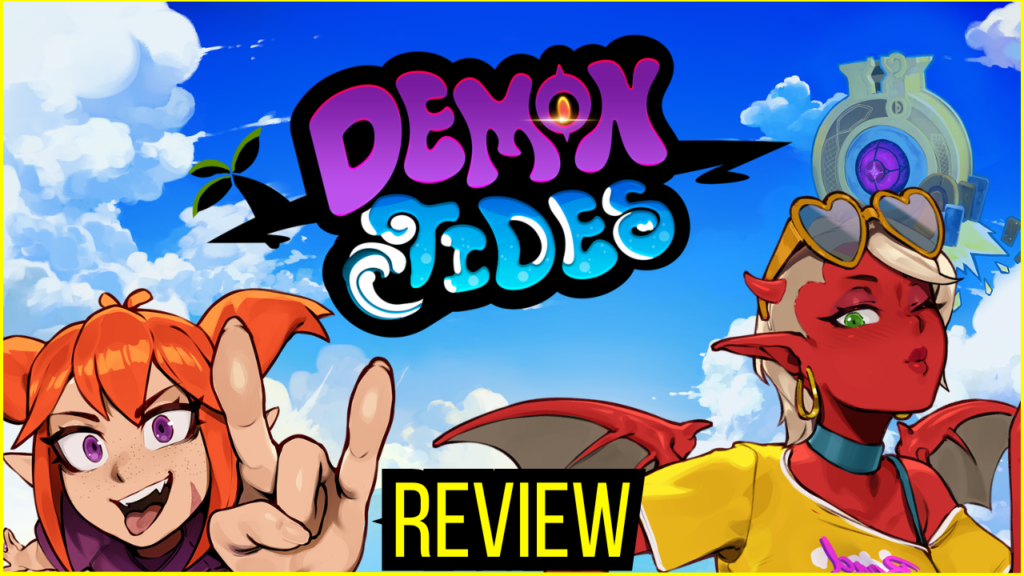
Developed and published by Fabraz, Demon Tides continues the story of Beebz, a shapeshifting demon teenager who dethroned the Demon King in Demon Turf and claimed the title of Queen of the Underworld. Now, Beebz and her motley crew of young misfits are heading into open waters to meet Ragnar, a man who claims to be her estranged father. What follows is an adventure across a collection of colorful islands, where platforming challenges, hidden collectibles, and an increasingly personal story give players plenty of reasons to keep exploring.
I came into Demon Tides without having played Demon Turf, so I was unfamiliar with the characters, the world, and the events that led Beebz to become queen. From what I gathered before playing, the original game built its identity around demanding precision platforming and a high degree of player expression. Thankfully, Demon Tides does a good job of bringing newcomers up to speed without making the previous game feel like required homework. The opening tutorial establishes the relevant history and gives you enough context to understand who Beebz is, what she has done, and why meeting Ragnar could change the way she sees herself.
Narrative
One of the things I appreciated most about Demon Tides is that its story feels like more than an excuse to send Beebz from one platforming challenge to the next. In plenty of 3D platformers, the narrative exists primarily to get you from the opening cutscene to the next batch of levels, with little interest in developing the characters beyond their basic personalities. Fabraz takes a more thoughtful approach here, using Beebz’s encounter with Ragnar to challenge her understanding of her family, her past, and the way she came to power.
Beebz’s actions in Demon Turf aren’t treated as inconsequential history simply because the sequel needs a new adventure. Her violent takeover of the Underworld has consequences, and Ragnar’s arrival gives her reasons to reconsider the choices that made her queen. That doesn’t mean the game suddenly turns into a heavy character drama, but it does give its protagonist a meaningful arc. Watching Beebz wrestle with her decisions and begin to recognize how they’ve affected the people around her adds a welcome layer of nuance to a genre that doesn’t always prioritize character development.
I particularly liked that the game allows Beebz to evolve rather than treating her previous accomplishments as proof that she has nothing left to learn. Her journey isn’t simply about becoming stronger or overcoming the next obstacle; it’s also about figuring out who she wants to be now that the consequences of her past are becoming harder to ignore. That personal dimension gave me a reason to care about the adventure beyond the satisfaction of clearing its platforming challenges, and it helped Demon Tides establish an identity that extends beyond its colorful presentation.
Shapeshifting Makes Every Jump Count
The foundation of Demon Tides is its movement, and Fabraz has put together a surprisingly versatile toolkit for getting Beebz through its many platforming challenges. The controls and overall approach to traversal should feel familiar to anyone who has played Super Mario Odyssey, with Beebz capable of chaining together jumps, triple jumps, side flips, and wall jumps to navigate the environment. She also has a dash attack that adds another option to her repertoire, giving players plenty of ways to approach the spaces in front of them.
Beebz’s three transformations are where things become especially interesting. The Bat Form functions as a double jump, giving her an additional burst of height when she transforms in midair. Spin Form, which resembles a spinning top, allows her to glide and squeeze a little more distance out of a jump. Snake Form is geared more toward speed, letting Beebz zip across the ground and water with a burst of momentum that can feel almost comically fast. The snake’s movement takes some getting used to because controlling it effectively depends on managing the camera, but once everything clicks, it gives the game another distinct way to approach traversal.
What makes these abilities work is that they aren’t just different animations attached to the same basic jump. Each transformation changes how you think about the environment, and learning when to switch between them becomes part of the fun. A gap that initially seems too wide might become manageable with a well-timed glide, while a stretch of water can turn into a high-speed route when you use Snake Form effectively. The game gives you a generous assortment of movement options, and its best platforming challenges encourage you to experiment with them rather than rely on a single solution.
That freedom was particularly valuable for someone like me, who can struggle with the precision required by 3D platformers. Demon Tides doesn’t force you to approach every challenge at the same pace, and I appreciated being able to slow down, assess my positioning, and work through obstacles in a way that suited me. The game still expects you to learn its mechanics and execute your jumps, but it offers enough flexibility that I rarely felt as though there was only one narrow way to make progress. For a genre that can sometimes feel punishing when you don’t have the necessary instincts, that flexibility goes a long way.
Talismans Give the Movement Real Personality
Talismans are one of my favorite parts of Demon Tides because they allow you to modify Beebz’s abilities in ways that can meaningfully change how you approach the game. These collectibles can add new movement options, enhance existing transformations, or introduce other effects that give your character a more personalized feel. Want to extend your reach with an additional jump in Bat Form, glide farther in Snake Form, or use Spin Form to generate a whirlwind that boosts you upward? There’s a Talisman for that, and equipping one can immediately change how you navigate the world.
The system also provides some much-needed flexibility for players who might be struggling with the platforming. One Talisman I kept equipped throughout much of my adventure allowed Beebz to create a bubble that suspended her in the air indefinitely. That might sound like a small addition, but it made a significant difference for me. Rather than feeling pressured to line up my next move while falling toward the ground, I could pause, assess the surrounding platforms, and take as much time as I needed to figure out my next step. It didn’t eliminate the challenge, but it gave me a way to work around one of the things I find most difficult about the genre.
Talismans also offer more playful options that go beyond straightforward mechanical upgrades. Some can alter Beebz’s appearance, while others change the way the world looks, including an effect that gives the game a pixel-art presentation. I love when a game allows players to customize an experience beyond simply increasing damage or improving a stat, and these options give Demon Tides an extra layer of personality. They aren’t necessary to finish the adventure, but they’re exactly the kind of feature that makes an already appealing game feel more generous. Between the practical upgrades and the cosmetic variations, Talismans give players a reason to keep exploring and make the movement system feel like something they can genuinely make their own.
An Open World That Rewards Curiosity
The world of Demon Tides is built around exploration, with Ragnar’s Rock divided into three regions filled with smaller islands to discover. Beebz’s immediate objective is to collect enough Golden Gears to power a cannon that will carry her ship into the next area, giving the adventure a clear sense of forward momentum without dictating every step along the way. Each island offers its own assortment of challenges, and players can decide which activities they want to tackle as they explore.
Some islands focus on straightforward platforming, while others introduce races, time trials, enemy arenas, or challenges that ask you to climb as high as possible in search of secrets. There are also lost little Kappas to reunite with their mother, alongside plenty of collectibles scattered throughout the environment. Golden Gears serve as the primary objective, but Talismans, outfits, and currency provide additional incentives for anyone who wants to investigate every corner of the world. There’s a satisfying variety to the activities, and the game does a good job of making exploration feel worthwhile rather than turning every island into a checklist of identical objectives.
I especially liked that the open structure gives you room to approach the adventure on your own terms. Instead of forcing you down a strictly linear path, Demon Tides encourages you to look around, spot something interesting in the distance, and decide whether you want to investigate it. That freedom pairs nicely with the movement system because discovering a new island or reaching a previously inaccessible area can feel like a reward in itself. The Golden Gears keep the main objective in view, but the optional challenges give you plenty of reasons to wander beyond the most obvious route.
This is also where the game’s generous collection of rewards works in its favor. Completing a challenge often gives you something tangible to work toward, whether that’s another piece of progression, a new Talisman, or currency to spend on other rewards. For players who enjoy squeezing every last secret out of a platformer, there’s a substantial amount of content here to dig into. I’m not someone who automatically needs to collect everything a game has to offer, but I appreciated that Demon Tides made its optional activities feel like meaningful extensions of the adventure rather than busywork.
A Colorful Throwback With a Few Rough Edges
Visually, Demon Tides has a vibrant, charming art style that gives its characters and environments plenty of personality. The character designs are expressive, the colorful islands are easy to appreciate, and the striking skyboxes help give the world a sense of scale. There’s a distinctly early-2000s video game aesthetic running through the presentation, and I mean that as a compliment. The game has a playful visual identity that feels comfortable embracing the traditions of 3D platformers without looking as though it’s simply trying to recreate an older game.
Unfortunately, the camera occasionally struggles to keep up with the environments. This was particularly noticeable when entering buildings or navigating tighter spaces, where the camera could clip through floors or hover awkwardly above characters during dialogue. Those moments aren’t disastrous on their own, but they can interrupt the otherwise charming presentation and make certain scenes feel less polished than the rest of the experience.
The camera also caused problems during some of the platforming itself. In more confined areas, such as narrow corridors or sections that required precise wall jumps, I sometimes found the camera sitting at an angle that made it harder to judge my positioning. That’s an especially frustrating issue in a game where movement is such a central part of the experience, because a difficult jump becomes even more demanding when you aren’t entirely confident about what you’re looking at. I’m already not the most capable 3D platformer player, so I don’t need much help making a jump more complicated than it has to be. Some of these moments may be less of a problem for experienced players, but the camera was a genuine annoyance during my time with the game.
Another unusual design decision involves checkpoints. Rather than automatically placing you at predetermined checkpoints throughout the world, Demon Tides lets you plant your own flag, which becomes your respawn point when you die. You can also hold up on the D-pad to teleport back to that flag whenever you want. It’s a straightforward system, and because you can use it without worrying about a limited number of attempts, it gives you control over where you want to return. The trade-off is that you have to remember to plant your flag before attempting a difficult challenge, because forgetting to do so can leave you with a longer recovery than you intended. I didn’t hate the system, but it does place a little more responsibility on the player than a traditional checkpoint structure would.
Playing Demon Tides on Steam Deck
I played Demon Tides on PC using the Steam Deck, and the overall experience was good enough that I was happy to keep playing on the handheld. The game didn’t consistently maintain the performance I wanted at higher graphical settings, and its dedicated Steam Deck preset didn’t completely resolve the issue. In my experience, the preset wasn’t making the most of the available GPU resources, which contributed to inconsistent performance and frame-rate fluctuations.
Dropping the game to a 40 FPS target made a noticeable difference, giving me a much more comfortable experience throughout my playthrough. It wasn’t a flawless technical showcase, but the performance was more than acceptable for my tastes once I found a configuration that worked. Considering how much of Demon Tides depends on responsive movement and carefully judged jumps, a stable frame rate was more important to me than pushing the visuals as high as possible. With that adjustment, the game felt good to play on the Steam Deck, and I had few reasons to abandon the handheld setup.
Is This a Good Single Player Experience?
Absolutely. Demon Tides brings together an expressive movement system, a world that rewards exploration, a generous assortment of optional challenges, and a story that gives its protagonist more depth than the genre typically demands. The transformations and Talismans provide meaningful ways to customize how you play, while the open structure lets you explore at your own pace. Its camera can occasionally make platforming more frustrating than it needs to be, but the game’s strengths consistently give you reasons to keep going.
What impressed me most is how complete the experience feels. The variety of activities, the freedom to experiment with Beebz’s abilities, and the attention given to the story all contribute to a game that feels thoughtfully designed. Demon Tides has the kind of quality and personality that could easily make someone a fan of 3D platformers, particularly if they enjoy the movement and open-ended exploration found in games like Super Mario Odyssey. It understands what makes the genre appealing and gives players plenty of opportunities to enjoy those strengths.
Why This Passion Score?
My feelings about Demon Tides ultimately come down to the difference between recognizing a game’s quality and personally connecting with what it offers. I had a solid time with it, and I can absolutely appreciate the amount of creativity and care that Fabraz put into the movement system, the world design, and the character writing. The Talismans were a particular highlight because they let me adapt the experience to my own limitations, while Beebz’s character arc gave the adventure more emotional substance than I usually expect from a 3D platformer.
At the same time, I never reached the point where I was completely absorbed by the experience. The camera occasionally made platforming more frustrating, and while the open world was rewarding to explore, the fundamental appeal of chaining together jumps and navigating increasingly demanding obstacles still isn’t what I naturally gravitate toward. That’s not necessarily a criticism of the game. In fact, I think Demon Tides does an excellent job of accommodating different play styles, and I never felt that my difficulty with the genre was entirely the game’s fault. I simply enjoyed it without developing the kind of attachment that would make it a personal favorite.
I also came away impressed by how much the game offers. There are plenty of challenges to complete, rewards to uncover, and abilities to experiment with, all wrapped in a colorful presentation that feels like a love letter to classic 3D platformers. If you’re already a fan of the genre, I can easily see Demon Tides becoming one of those games you spend hours exploring long after you’ve completed the main objectives. For me, though, it was a good experience rather than a transformative one. Fabraz gave me a strong reason to appreciate the genre, even if it didn’t convince me to fall in love with it.