
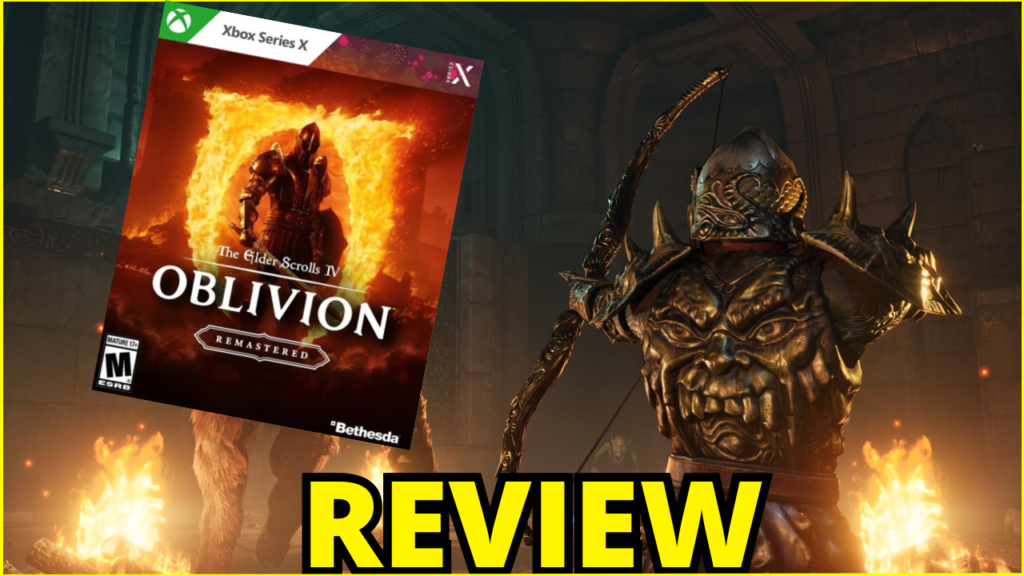
Intro/ Set The Scene
I’m not normally a gamer who goes back and replays older games. I’m not particularly fueled by nostalgia, and I generally prefer moving forward, experiencing something new, and seeing what developers are doing with the medium today. That’s not a knock against people who enjoy revisiting their favorite games, but I’ve always been more interested in what’s next than what I’ve already played. Every once in a while, though, something comes along that makes me reconsider that approach. A remake or remaster catches my attention, and suddenly I’m interested in revisiting a game that I haven’t thought about in years.
The Elder Scrolls IV: Oblivion Remastered was one of those games.
For me, Oblivion isn’t just another RPG from Bethesda’s catalog. This was my first Elder Scrolls game, my first real introduction to the Western RPG experience Bethesda would become so well known for, and the first game I ever unlocked every achievement in. I absolutely devoured this thing when I played it on Xbox 360 back in 2007. Teenage Sebastion was completely consumed by Cyrodiil, and I remember spending countless hours exploring its world, joining its factions, and getting lost in everything the game had to offer. It was one of those experiences that helped shape the kind of gamer I would eventually become.
I loved Oblivion so much that when The Elder Scrolls V: Skyrim eventually arrived, I was actually a little disappointed. I know that’s probably an unpopular opinion, but I felt like Bethesda had removed some of the things that made Oblivion special to me. The magic system wasn’t quite the same, spell creation was gone, and the main story and faction questlines didn’t hit me with the same impact. I thought Skyrim was a good game, but it never captured the same magic for me.
So when Xbox announced that Oblivion was getting a remaster, I knew I had to jump back in. This wasn’t just an opportunity to play an old RPG with prettier graphics. It was a chance to revisit a game that had been a significant part of my gaming history and see whether it still held up nearly two decades later.
And wouldn’t you know it? I ended up putting another 60 hours into this game.
What surprised me most wasn’t simply how much I still enjoyed it. It was how much I had forgotten about the actual experience of playing it. I remembered the guilds, the characters, and the general feeling of exploring Cyrodiil, but I had forgotten so much of the journey that got me there. Revisiting the game gave me an opportunity to experience many of those moments again, while also recognizing that the masterpiece I remembered wasn’t quite as flawless as teenage me had convinced himself it was. Oblivion Remastered is still a fantastic RPG, but it’s also a reminder that sometimes the games we remember most fondly have a few more rough edges than we care to admit.
Set the Scene
For those unfamiliar with Oblivion, this is an open-world RPG that originally released in 2006 and takes place in the province of Cyrodiil, part of the continent of Tamriel. You begin the adventure as a prisoner in the Imperial City’s prison, where an unexpected encounter with Emperor Uriel Septim sets you on a journey to prevent a catastrophic event from destroying the world. The Daedric Prince Mehrunes Dagon and his followers are threatening Tamriel, with portals to the realm of Oblivion opening across the land and unleashing increasingly dangerous creatures into the world.
However, one of the things I’ve always appreciated about Bethesda RPGs is that the main story is never the only reason to play them. You can spend dozens of hours pursuing the main quest, or you can completely ignore the fate of the world and go do whatever the hell you want. Join the Mages Guild, become an assassin, steal everything that isn’t nailed down, compete in the Imperial City’s arena, or wander into a random cave because you saw something interesting in the distance. The freedom to determine your own adventure is a huge part of what makes these games so appealing, and Oblivion still understands that better than many modern RPGs.
The remastered edition gives Cyrodiil a substantial visual overhaul, utilizing Unreal Engine 5 to breathe new life into the environments, characters, lighting, and overall presentation. The forests, towns, and landscapes look considerably more impressive than they did in the original release, and exploring the world feels like a much more visually rewarding experience. There are also some welcome gameplay adjustments, including sprinting, refinements to the leveling system, improved enemy scaling, updated combat feedback, and a redesigned user interface. These changes help make the experience more comfortable without completely abandoning the identity of the original game.
I played the remaster on both PC and Xbox Series X, and I was happy with the experience on both platforms. On Xbox, you have quality and performance options, including a 60 FPS performance mode, alongside settings for visual effects such as motion blur and screen-space reflections. The visual improvements are easily the biggest attraction, but I also want to give Bethesda credit for the improvements to loading times. Oblivion has plenty of loading screens as you move between buildings, dungeons, and different areas of the world, so having those transitions happen almost instantly makes a substantial difference. It’s one of those improvements that you might not appreciate until you return to the original and remember just how much time you spent staring at loading screens.
The user interface is another welcome improvement. The original menus had their own charm, but the updated presentation makes navigating your inventory, managing equipment, and keeping track of your character considerably more convenient. There are also changes to character leveling and enemy scaling that help address some of the original game’s more frustrating systems. The remaster doesn’t completely modernize Oblivion, nor should it necessarily try to. What it does is give players a more accessible way to experience a game that still has plenty of old-school design philosophies baked into it.
And yes, the NPC faces are still something else. They’re better than they were in 2006, but we’re not exactly escaping the uncanny valley here. Some of these characters still look like they were assembled in a laboratory, and I wouldn’t have it any other way.
Narrative
One of the biggest reasons Oblivion has remained so special to me is its storytelling. Bethesda has always been particularly good at creating worlds that encourage players to explore, but I think Oblivion is one of the studio’s strongest examples of building compelling stories within that world. What’s particularly interesting is that the main narrative doesn’t rely on making you the traditional chosen-one hero who is destined to save everyone. Instead, you’re essentially a prisoner who gets caught up in an extraordinary series of events and ends up helping the person who is actually supposed to fulfill that greater purpose.
Your relationship with Emperor Uriel Septim and the eventual discovery of Martin Septim give the story a different kind of foundation. You’re still involved in some incredibly important events, and you have plenty of opportunities to become the hero of the story, but there’s something refreshing about the idea that you’re helping someone else fulfill their destiny rather than having the entire universe revolve around your character. It’s a small distinction, but I think it gives the main quest a sense of purpose that makes it stand out among other fantasy RPGs.
The story revolves around the Oblivion Crisis, with the threat of Mehrunes Dagon and the opening of Oblivion Gates providing the central conflict. There are certainly moments when the main quest becomes repetitive, particularly when you’re tasked with entering another gate and completing what feels like a familiar objective. Those sequences can wear thin after you’ve done them several times. However, I still think the overarching narrative is one of Bethesda’s best. There’s a compelling sense of urgency behind the events, and the relationship between the player character and Martin gives the story an emotional foundation that I continue to appreciate.
But if we’re talking about the best storytelling in Oblivion, we have to talk about the faction questlines. This is where the game really shines, and it’s one of the reasons I think the title holds up so well today.
The Mages Guild was one of my favorite factions to revisit. I enjoy the magic systems in Oblivion, and the questline gives you a compelling reason to immerse yourself in that side of the world. There’s an interesting story involving ambition, power, and the responsibilities that come with wielding magic, and I found myself just as invested in it this time around as I was years ago. The Thieves Guild is another standout, largely because its missions require you to think about how you’re going to accomplish your objectives without getting caught. There’s something satisfying about being asked to steal an item, infiltrate a location, or complete a job while having to consider your approach instead of simply walking into a room and killing everything that moves.
The Dark Brotherhood, however, is still the crown jewel of the faction questlines. This is an organization built around murder and death, and joining it requires you to commit a killing before being welcomed into its ranks. From there, you’re brought into a league of assassins and tasked with carrying out a series of increasingly elaborate contracts. What makes these missions so memorable is that they often require more thought than simply approaching a target and stabbing them. The assassinations are creative, the characters are memorable, and the overarching storyline features some genuinely entertaining twists, betrayals, and an especially compelling antagonist. The rewards are also fantastic, giving you another reason to see the entire storyline through.
It’s a questline that I remembered fondly, but I was surprised by just how much I enjoyed it all over again. Even knowing some of the major developments, the characters and missions still managed to hold my attention. It’s a testament to how well Bethesda put this faction together that it remains one of the best questlines the studio has ever produced.
The Fighters Guild was considerably less exciting. I found much of its questline to be a collection of familiar dungeon-clearing and fetch-style objectives, and it didn’t have the same narrative appeal as the other factions. I also found it more cumbersome to keep track of where I needed to go to receive my next assignment. The quest givers are spread across different guild halls, which made progressing through the faction feel less straightforward than it did with the Mages Guild or Dark Brotherhood. It’s not necessarily terrible content, but it hasn’t aged as gracefully as the other guilds.
I also want to give the Arena some love. I genuinely think this is one of those features that should have been a staple in every Elder Scrolls game moving forward. There’s something wonderfully straightforward about entering a gladiatorial arena, fighting your way through increasingly difficult opponents, and earning recognition for your victories. It doesn’t have the narrative depth of the major guilds, but sometimes I don’t need a complicated story. Sometimes I just want to walk into an arena, beat the hell out of someone, and collect my reward. The Arena delivers exactly that.
And then there’s The Shivering Isles. This was my first time playing through the expansion, so it was one of the few major pieces of content in the remaster that I was experiencing completely fresh. The expansion takes you into the realm of Sheogorath, the Daedric Prince of Madness, and embraces a bizarre fantasy setting that feels like The Elder Scrolls collided with Alice in Wonderland. It’s certainly weird, sometimes to the point where I wasn’t entirely sold on its storytelling, but I appreciated having an entirely new world to explore after completing the main game and its faction questlines. The additional six to eight hours of content gave me something fresh to experience in a game I thought I already knew inside and out.
One of the things that struck me during this playthrough was just how much I appreciated the main quest in comparison to some of Bethesda’s more recent work. I’ve often felt that Starfield struggled to deliver a central narrative as compelling as the faction stories surrounding it. Oblivion, on the other hand, manages to give you a main story that can stand alongside its best guild questlines. That’s not to say every mission is exceptional, but there’s a clear sense of purpose behind the journey, and the overall narrative remains engaging enough to carry you through its weaker stretches.
Gameplay
One of the things I love about Oblivion is the freedom it gives you to build a character around the way you want to play. Your skills improve through use, meaning that swinging a sword increases your Blade skill, sneaking around improves your Sneak ability, and casting spells develops your different schools of magic. It’s a system that encourages experimentation and makes your character feel like they’re developing based on the actions you take throughout the world.
Of course, it can also be a little ridiculous. If you aren’t careful with how you level your character, enemies can become increasingly powerful at a pace that makes the world feel strangely unbalanced. There’s something particularly hilarious about encountering a roadside bandit who somehow manages to be equipped with an impressive collection of high-end armor while you’re still trying to make ends meet. The leveling system has its quirks, and the remaster makes some adjustments to improve the experience, but the underlying philosophy is still very much that of a game from another era.
For my playthrough, I created a Redguard. Part of that decision was because I liked the physical attributes associated with the race, particularly the benefits that suited a more physically oriented character. But I’ll be honest: I also picked Redguard because the character looked more like me. As a Black gamer, I gravitated toward that option years ago, and I wanted to carry that little tradition into my return to Cyrodiil. There are other races with some genuinely interesting abilities, particularly the Argonians and their ability to breathe underwater, but I was committed to my Redguard.
Initially, I leaned into hand-to-hand combat and swordplay, but I quickly realized that I wasn’t having as much fun with that approach. I’ve always enjoyed the magic in Oblivion, and I eventually shifted my attention toward developing my magical abilities. Restoration and Destruction became two of my more practical skills, but Conjuration was my personal favorite. There’s something incredibly entertaining about summoning some strange creature and watching it run toward an enemy to beat the absolute hell out of them.
Now, Conjuration isn’t necessarily the most effective skill when you’re starting out. Some of the creatures you can summon early in the game aren’t particularly impressive, and watching them get demolished by stronger enemies can be a little embarrassing. But I didn’t care. I enjoyed watching these little supernatural fighters get thrown into the middle of a battle, and eventually, as my abilities improved, they became considerably more useful. I found myself leaning into the magical side of the game far more than I originally intended, and that decision made the experience considerably more enjoyable.
Combat is still a mixed bag by modern standards. Melee encounters have more impact than they did in the original, thanks to updated animations, sound effects, and enemy reactions, but there’s only so much you can do with a combat system built around an older design philosophy. Some encounters can feel like you’re simply swinging a weapon back and forth until someone eventually falls over. The experience is at its best when you experiment with different abilities, use your surroundings, and take advantage of the freedom the game provides. Magic is particularly enjoyable, and I found that building my character around spellcasting gave me a much more entertaining experience than relying exclusively on swords and shields.
But there’s another side to my playthrough that I have to talk about, and it’s something that completely changed how I approached the game this time around.
I had the internet.
For context, I grew up in a rural part of East Texas, and back when I was playing Oblivion on the Xbox 360 in 2007 and 2008, my family didn’t have access to the kind of high-speed internet that would have made looking up guides, exploits, and community discoveries a regular part of my gaming experience. I played the game largely as intended, figured things out on my own, and spent a considerable amount of time grinding my character and trying to build up enough money to afford the equipment I wanted.
Nearly 20 years later, I decided I had already done that work once. This time, I wanted to see what kind of chaos I could get into.
And let me tell you, I discovered some things.
The duplication glitch was probably the biggest game-changer. By exploiting the inventory system, you can duplicate items and build up an enormous supply of just about anything you need. I started using it to multiply potion ingredients, then crafted ridiculous quantities of health and Magicka potions to level up my Alchemy skill. I also started selling all those duplicated items, which helped push my Mercantile skill through the roof and turned me into an absurdly wealthy adventurer.
That wealth opened up an entirely different side of the game. I started experimenting with custom weapons and enchantments, creating hammers and swords with combinations of elemental damage and other magical effects. One of my favorites was a hammer that dealt electrical damage while also shocking enemies within an area around the impact. Naturally, I had to create several copies of these weapons and store them in the various homes I purchased throughout Cyrodiil. I had gone from struggling to afford basic equipment during my original playthrough to being a ridiculously wealthy arms dealer with enough enchanted weapons to outfit an army.
But the real fun began when I discovered the infinite Magicka exploit.
By creating and repeatedly casting a custom spell that manipulates your character’s attributes and Magicka, you can essentially give yourself an enormous pool of magical energy. Once I figured that out, the possibilities became ridiculous. I started creating spells with area effects that could weaken enemy armor, drain fatigue, and strengthen my own defenses. I also created an extremely destructive fire spell that I affectionately named Fiendfire. It wasn’t quite the same as the devastating magical fire from Harry Potter, but it certainly got the job done.
There were times when I’d walk into the Imperial City, punch some random person, and wait for the guards to come running after me. Then I’d unleash my ridiculous spell and watch the entire area turn into a disaster zone. These were the same guards who had given teenage me so much trouble years ago, and now I was an unstoppable magical psychopath who could wipe out an entire squad before they had a chance to do anything about it.
Was this how the game was intended to be played? Absolutely not. Did I have a fantastic time doing it? You bet your ass I did.
I didn’t spend the entire game abusing these exploits because that would have made the experience far too easy and taken away some of the enjoyment of actually playing through the quests. Instead, I’d occasionally save my game, unleash some completely unnecessary destruction, and then reload my previous save once I was done causing trouble. It was a ridiculous way to revisit a game I already loved, but it gave me an entirely new kind of enjoyment that I never experienced during my original playthrough.
That’s one of the things I appreciate about Oblivion. It’s a game that gives you an enormous amount of freedom, and sometimes that freedom extends to breaking the entire experience in spectacular fashion. There’s a certain charm to a game that allows you to experiment with its systems, discover some ridiculous exploits, and become an overpowered demigod if that’s what you want to do. I had already played the game the traditional way years ago. This time, I wanted to have some fun.
Presentation and Technical Issues
Visually, Oblivion Remastered is a substantial improvement over the original. Cyrodiil has been given a new lease on life, and the updated environments make exploring the world considerably more enjoyable. The forests, towns, lighting, and environmental details all benefit from the visual overhaul, and it’s genuinely impressive to see how much more vibrant the world looks compared to what I remember from the Xbox 360. The character models have also been updated, although I don’t think we’re ever going to escape the strange faces that have become such a recognizable part of this game’s identity.
The improvements to loading times deserve another mention because they have such a meaningful impact on the overall experience. When you’re constantly traveling between locations, entering buildings, and exploring dungeons, those transitions add up. Having them happen almost instantly makes the game feel considerably more fluid. The updated user interface is another welcome addition, and the improvements to combat feedback make encounters feel a little more satisfying than they did in the original.
Unfortunately, the remaster still carries a fair amount of the technical jank that has become synonymous with Bethesda RPGs. I ran into several bugs throughout my playthrough, and some of them were more frustrating than others. There were instances where a quest required me to collect an item from a chest or retrieve something from an NPC, but even after interacting with the object, the item wouldn’t appear in my inventory. I also encountered situations where I paid off my bounty with the guards only to find that the game still recognized me as having an outstanding bounty afterward.
The Thieves Guild gave me another particularly annoying example. There were times when I visited Armand Christophe during his operating hours to clear my bounty or progress through a quest, but he wouldn’t provide the interaction I needed. It wasn’t always clear whether I was dealing with a bug or some other condition I hadn’t fulfilled, but it made the process more frustrating than it needed to be.
The Arena also gave me trouble on one occasion. I defeated my opponent, but the gates never opened and the announcer never acknowledged that the fight was over. I was effectively stuck inside the arena, with no way to continue the quest. I eventually had to reload a save from several minutes earlier to get past the problem.
These issues don’t completely derail the experience, but they’re worth mentioning because they can interrupt the flow of an otherwise enjoyable adventure. This is still very much a Bethesda RPG, and players should expect some strange behavior along the way. Even the Radiant AI system, which is designed to give NPCs their own schedules and routines, can produce some wonderfully bizarre moments. Sometimes it makes the world feel more alive, and sometimes it looks like the entire population of Cyrodiil is having a collective mental breakdown.
The leveling system can also be a source of frustration for players who don’t enjoy repetitive progression. Because skills improve through use, you’ll naturally find yourself repeating certain actions to develop your character. That might mean swinging your sword over and over again, sneaking around unnecessarily, or casting the same spell repeatedly to improve a particular magical discipline. Some people will appreciate that sense of progression, but others might find it tedious. The enemy scaling can compound the problem if you aren’t paying attention to how your character develops.
And while I enjoyed The Shivering Isles, I wasn’t completely sold on every aspect of the expansion. Its bizarre atmosphere and unusual setting are entertaining, but some of the missions lean a little too heavily on familiar fetch-quest structures. I still enjoyed the additional content, especially because it gave me something new to experience after all those years, but it wasn’t quite the revelation I had hoped it might be.
Pros
Oblivion Remastered succeeds because the original game’s greatest strengths remain intact. Cyrodiil is still an engaging world to explore, the freedom to build your character and approach quests however you want remains incredibly satisfying, and the faction questlines are some of Bethesda’s best work. The Dark Brotherhood, Mages Guild, and Thieves Guild are particularly memorable, while the main story provides a compelling alternative to the traditional chosen-one narrative. The visual overhaul, updated interface, improved combat feedback, and nearly instant loading times make returning to the game considerably more enjoyable. And whether you’re playing the game as intended or exploiting every glitch you can find to become an unstoppable magical menace, there’s an incredible amount of freedom and entertainment to be found here.
Cons
Despite the remaster, Oblivion still has plenty of technical issues and design quirks that can interrupt the experience. Quest progression bugs, bounty problems, and occasional situations that require reloading an earlier save are frustrating, particularly when you’re invested in a long questline. The melee combat and skill-based leveling system also show their age, with repetitive grinding and inconsistent enemy scaling potentially becoming a nuisance. The Fighters Guild doesn’t hold up as well as the other faction stories, and the Oblivion Gate sequences can become repetitive. The Shivering Isles expansion is a welcome addition, but some of its quests lack the narrative strength of the game’s best content.
Is This a Good Single Player Experience?
Absolutely. The Elder Scrolls IV: Oblivion Remastered is an excellent single-player RPG, particularly for anyone who enjoys Bethesda’s approach to open-world exploration, character progression, and player freedom. The main story remains one of my favorites in the developer’s catalog, and the faction questlines provide dozens of hours of additional content that are often just as compelling as the central narrative. You can spend your time becoming a powerful mage, joining an organization of assassins, building your reputation as a thief, or simply wandering around the world looking for something interesting to do. There’s a tremendous amount of content here, and the remaster makes it considerably more approachable for modern audiences. It isn’t without its frustrations, but if you enjoy getting lost in a sprawling RPG and making your own adventure, Cyrodiil is still well worth visiting.
Why This Passion Score?
A 75 Passion Score reflects how much Oblivion means to me as a gamer, versus how much of a buggy experience this remaster game is. I did genuinely enjoy revisiting it in 2025. This isn’t simply a case of me looking back at an old favorite and giving it a high score because of the memories attached to it. I spent another 60 hours in this world, completed the majority of the content I wanted to experience, and found myself enjoying the game in ways I hadn’t anticipated. The Mages Guild, Thieves Guild, and Dark Brotherhood were still fantastic, the main story held up remarkably well, and discovering all those exploits gave me an entirely different way to enjoy a game I’d already spent so much time with.
At the same time, revisiting Oblivion helped me recognize that I had probably romanticized certain aspects of the original game. It’s not quite the flawless masterpiece that teenage me remembered. The combat is dated, the leveling system can be frustrating, and the technical problems are sometimes difficult to overlook. There are also plenty of moments when the game reminds you that it was designed nearly 20 years ago. But none of that changes how much I appreciate what Bethesda accomplished here. The world has a personality, the stories are engaging, and the freedom to approach the experience on your own terms is something I still value enormously.
I also think there’s something special about returning to a game that played such a significant role in your history as a gamer and discovering that you still love it. I don’t need Oblivion to be perfect, and I don’t need to pretend that every aspect of it has aged gracefully. I just need it to give me a reason to spend another 60 hours exploring Cyrodiil, and it did exactly that. This is a game I’m going to cherish for the rest of my life, and revisiting it only reinforced why.