Set the Scene/Narrative
Sometimes, all it takes is a great trailer to convince me to give an indie game a chance. One of my favorite things about covering this corner of the gaming industry is discovering projects from smaller studios that might otherwise fly under my radar. I enjoy seeing developers take creative risks, put their own spin on familiar genres, and try to build something worth remembering. Supporting those projects has become a big part of what I enjoy about covering games, and Twilight Monk initially looked like exactly the kind of experience I wanted to champion.
I went into Twilight Monk knowing very little beyond what its trailer showed me. The hand-drawn art immediately caught my attention, and the combination of action-platforming, Metroidvania exploration, and light RPG mechanics seemed promising. I also discovered that the game is based on a graphic novel and book series of the same name, which made me curious about how much emphasis it would place on its world and characters. There was plenty here that appealed to me, but I also knew I was approaching the game with some reservations because Metroidvanias and I have a complicated relationship. I appreciate their emphasis on exploration and discovery, but I have never enjoyed getting lost in sprawling environments while trying to figure out where a game expects me to go next.
That tension ended up defining much of my experience with Twilight Monk. Aquatic Moon Games has created a beautiful adventure with enjoyable combat, varied environments, and a soundtrack that helps make its fantasy world feel larger than life. Unfortunately, some of the genre conventions I struggle with are also the ones that keep this game from becoming something I will remember for years to come.
A Beautiful World Worth Exploring
Set in the fantasy land of Asperia, Twilight Monk follows Raziel Tenza, the last descendant of an ancient order of Kung Fu warriors known as the Twilight Monks. Raziel must race against the exiled traitor Knox to recover the three Rings of the Triskelion before he unleashes a monstrous entity called the World Eater. It is a straightforward fantasy adventure premise, but it gives the game a clear central objective and an excuse to send its protagonist across a collection of distinct environments.
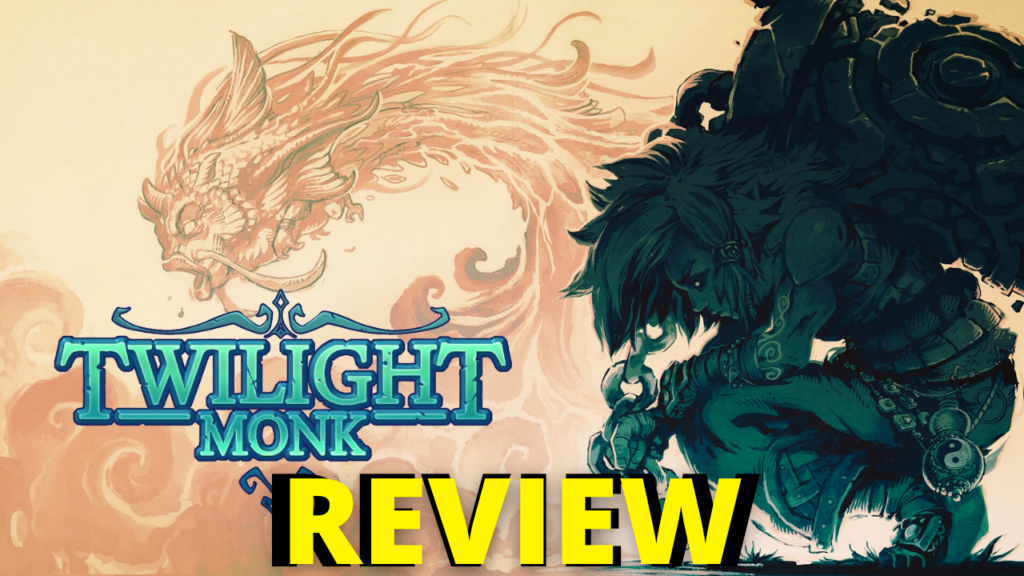
The first thing that struck me about Twilight Monk was how gorgeous it looks. The hand-drawn visuals are easily one of its greatest strengths, with expressive character designs, colorful backdrops, and environments that have their own distinct personalities. The game looks great on PC, but I was especially impressed with how well its art style came across on the Steam Deck. This is the kind of visual presentation that makes an indie game stand out without needing a massive budget or cutting-edge graphical technology. The artistry does the heavy lifting, and the results speak for themselves.
I particularly appreciated how much variety Aquatic Moon Games brought to the environments. One area, for example, resembles a sprawling graveyard, with bones scattered throughout the landscape and a vibrant green backdrop that gives the location an eerie atmosphere. Other areas establish their own identities through different color palettes, enemy designs, and environmental details. This variety matters in a game that asks you to spend so much time traversing connected spaces, and it helped keep the journey visually interesting even when the underlying exploration started to wear on me.
The soundtrack deserves similar praise. Rather than relying on a small handful of tracks that repeat throughout the adventure, Twilight Monk gives its different areas music that helps establish their individual identities. Some tracks are calm and soothing, while others lean into the sweeping, adventurous tone you would expect from a fantasy quest. The music works alongside the visuals to make the world feel inviting, and it often elevated moments that might otherwise have blended together. For an indie game, this is an impressive amount of attention paid to the overall presentation, and it is one of the clearest examples of the care that went into making this adventure feel like a complete experience.
A Story I Wanted to Connect With More
The fact that Twilight Monk is based on an existing graphic novel and book series made me curious about its narrative. I went in hoping that its connection to an established fictional world might lead to a stronger emphasis on storytelling and character development than I sometimes find in action-platformers. The premise involving Raziel, the three Rings of the Triskelion, Knox, and the threat of the World Eater gives the game a clear fantasy framework, and there is enough here to support an enjoyable adventure.
Unfortunately, I never developed much of a connection to the characters. The story is serviceable, and it provides a reason to keep moving through the world, but I did not find myself particularly invested in the people Raziel encounters or the outcome of his quest. I wanted the narrative to be one of the things that pulled me through the experience, especially given the game’s literary origins, but it rarely became a compelling reason to keep playing.
I also found it strange that the game includes occasional character noises, such as grunts and laughter, without fully committing to voice acting. These moments make the absence of spoken dialogue more noticeable, particularly during scenes that seem designed to give characters a little more personality. Full voice acting is not a requirement for an effective indie adventure, and plenty of games tell wonderful stories without it, but the way Twilight Monk handles these audio cues left me wishing it had taken a more consistent approach.
Ultimately, the narrative never became a major selling point for me. I did not dislike the story, but I also did not feel strongly enough about its characters or central conflict to overlook the exploration issues that continued to frustrate me. That disconnect is disappointing because the presentation and world design initially gave me reason to hope that I would find something more substantial beneath the surface.
Gameplay: Bosses and Combat
At its core, Twilight Monk combines the exploration and interconnected environments of a Metroidvania with the side-scrolling action of a platformer and an overworld map reminiscent of classic Japanese RPGs. Raziel’s primary weapon is a large, weighty staff-like pillar that serves several purposes throughout the adventure. You can use it to deliver melee attacks, throw it at enemies, plant it in the ground for cover, and interact with environmental mechanisms such as pressure plates. The pillar is central to the game’s identity, and its different uses give combat more variety than simply running up to an enemy and swinging until its health bar disappears.
There is a satisfying crunch to Raziel’s attacks that makes combat enjoyable from the beginning. His weapon feels substantial, and the animations do a good job of communicating the impact behind each strike. You can continue fighting with your hands and feet while the pillar is planted nearby, using it as a defensive tool while you attack from a different position. As you progress, the weapon becomes more powerful alongside the enemies you encounter, helping the combat maintain a reasonable sense of progression. It is not a revolutionary system, but it is a good foundation for an action-platformer, and I enjoyed the way the different uses of the pillar encouraged me to think about my positioning during encounters.
The game also gives you access to Mystic Arts powered by Amber, a resource replenished by breaking lanterns and defeating enemies. Talismans and other collectibles let you customize your build, while summons and upgrades provide additional ways to shape Raziel’s abilities. One of my favorite examples is the Talisman of the Stone Foot, which lets you plant the pillar on the ground and kick it toward enemies as a long-range projectile. Abilities like this help the combat feel more expressive as the game progresses, even if the overall system never quite reaches the level of depth or precision that would make it stand out among the genre’s best.
The platforming is similarly competent without being exceptional. Jumping and traversal feel good enough to support the adventure, although the controls do not always offer the precision I would like from a game built around navigating platforms and enemies in two dimensions. I also missed having a dedicated dodge roll. The game eventually gives Raziel a dash ability, which helps with movement and evasiveness, but I still felt that a proper dodge would have made combat more fluid, particularly during the early hours when defensive options are limited.
Another omission became increasingly noticeable as I played: the lack of dedicated upward and downward attacks. Plenty of modern action-platformers and Metroidvanias let you strike enemies above or below your character, making it easier to respond to opponents positioned on different platforms. Twilight Monk does not offer that same flexibility, and the absence feels especially strange in a genre where vertical combat has become such a familiar part of the experience. Neither issue ruins the combat, but both make the game feel less polished than it could have been.
Bosses and Enemies Keep Things Interesting
One of the strongest parts of Twilight Monk is its enemy variety. Phantom lanterns, cave bats, toxic slimes, lazy swordsmen, archers, mummies, and plenty of other opponents populate the world, giving each area its own assortment of threats. These enemies are not just visually different, either. Their attacks and behaviors encourage you to learn their patterns and adjust your approach, and their designs fit naturally into the environments they inhabit. That attention to detail helps the world feel more cohesive while keeping regular encounters from becoming completely monotonous.
The boss fights are another highlight. Each encounter has its own presentation, moveset, and attack patterns, giving the major battles a personality that distinguishes them from the standard enemies. They provide a satisfying test of the skills you have developed along the way, and I generally enjoyed learning their patterns and finding opportunities to attack. The bosses are not necessarily redefining action-platformer combat, but they are creative enough to make these encounters some of the most memorable parts of the game.
Unfortunately, the way Twilight Monk handles repeated boss attempts can make those otherwise enjoyable encounters frustrating. When you lose a fight, the game forces you to sit through the introductory dialogue again rather than giving you a straightforward way to skip it. That might not sound like a major problem, but repeating the same conversation every time you attempt a difficult boss quickly becomes tedious. When a game expects you to learn an enemy’s patterns through trial and error, it should not make you sit through the same cutscene before every rematch.
A Metroidvania That Actually Tells You Where to Go
Despite my reservations about the genre, I found some things to appreciate about how Twilight Monk approaches exploration. The game does a good job of teaching its systems through tutorials that are organized into readable scrolls, and I rarely felt confused about what a newly introduced mechanic was supposed to do. The game generally communicates its immediate objectives clearly, which is especially helpful when its environments begin to grow more complex.
I also appreciated that Twilight Monk provides guidance toward your next objective. Too many Metroidvanias expect players to rely almost entirely on discovery, leaving them to wander through previously explored areas until they stumble across the right path. I understand why that design appeals to people who love the genre, but it has never been one of my favorite approaches to progression. I would rather have a game communicate where I need to go while leaving optional secrets and collectibles for me to discover on my own. Twilight Monk makes an effort to strike that balance, and I wish more games in the genre would take a similar approach.
The game also includes small platforming challenges in its overworld. When enemies encounter Raziel, they can pull him into a contained platforming area where he must reach an exit to return to the main map. Some of these challenges are more demanding than others, but many provide a convenient opportunity to earn additional coins. Those coins can then be spent on accessories that help you during the adventure, giving these encounters a practical purpose beyond simply interrupting your journey.
Unfortunately, the game’s broader map design undermines some of the progress it makes in making exploration accessible. I have said many times that a map can make or break a Metroidvania for me, and Twilight Monk never quite gives me the information I want. Its maps do not provide the level of detail I would prefer when tracking down collectibles or figuring out which parts of an area I have fully explored. The game offers estimates of how many collectibles remain in a biome, which is better than providing no information at all, but it does not consistently show you where those items are located.
More frustratingly, the map highlights your current room without clearly displaying your precise position within it. That distinction becomes a problem when you are navigating a large area with multiple paths and interconnected spaces. I understand that some players enjoy piecing together a world through experimentation, but I find that kind of uncertainty more exhausting than rewarding. I want a map that helps me understand the space I am navigating, not one that leaves me second-guessing where I am or whether I have missed a path. The game makes a genuine effort to guide the player toward the main objective, but its map still leaves too much friction in the process.
An Old-School Save System With Modern-Day Frustrations
My other major complaint is the save system. Twilight Monk relies on designated save points where you can manually save your progress, restore your health, and replenish your projectile resources. There is no autosave system to protect your progress between these points, meaning that dying sends you back to your most recent manual save. Any progress you made after that save, including money earned while exploring the overworld, can be lost.
This is an old-school approach that I have not had to think about in quite some time. I had to get back into the habit of looking for save points and making sure I saved before venturing too far into an unfamiliar area. That might appeal to players who enjoy the tension of older adventure games, but the experience becomes much less appealing when save points feel too far apart. Losing a substantial stretch of progress because you died before reaching the next checkpoint can turn an otherwise enjoyable session into a frustrating exercise in repetition.
The problem is not simply that the game expects you to save manually. It is that the system combines infrequent save points with the possibility of losing meaningful progress, which makes exploration feel riskier than it needs to be. When I have already spent time navigating an area, fighting enemies, and figuring out where the game wants me to go, being forced to repeat those same steps does not make me more invested in the adventure. It makes me want to put the controller down.
These frustrations are made worse by the inability to skip certain dialogue sequences during repeated boss attempts. Both issues seem like the kinds of problems that could be addressed through patches or updates, although I cannot assume that the developers will make those changes. As the game stands, the save system and repeated dialogue are among the biggest obstacles to enjoying an otherwise solid action-adventure.
Pros
Twilight Monk makes a strong first impression with its beautiful hand-drawn art, varied environments, and soundtrack that gives each area its own personality. Combat feels weighty and satisfying, the pillar weapon offers several useful applications, and the boss fights provide some of the game’s most enjoyable encounters. Its tutorials are clear, its enemies are varied, and its objective guidance makes the main quest more approachable than many traditional Metroidvanias. There is a lot to appreciate here, particularly for players who enjoy action-platformers with light RPG customization.
Cons
The map does not provide enough useful information for players who want to navigate efficiently, and its room-based presentation can make it difficult to determine your precise location. The lack of autosaving and the distance between manual save points can also lead to lost progress and unnecessary repetition, while the inability to skip repeated boss dialogue makes difficult encounters more tedious than they should be. Combat is enjoyable but misses some expected defensive and directional attack options, and the narrative never gave me a strong enough connection to the characters to compensate for my frustrations with the exploration.
Is This a Good Single Player Experience?
I think that depends on how much you enjoy the genres Twilight Monk represents. If you are a fan of Metroidvanias and action-platformers, there is a good chance you will find something to enjoy in its combat, boss encounters, visual design, and interconnected fantasy world. It does not need to reinvent the genre to deliver a worthwhile adventure, and its combination of a distinctive weapon, varied enemies, and light RPG progression gives it a solid foundation. Players who appreciate a more traditional approach to exploration may be more forgiving of its map and save-system limitations than I was.
For me, however, the experience was more complicated. I enjoyed the combat and appreciated the artistry behind the game, but the navigation issues and repeated backtracking gradually wore me down. I finished the main story in roughly 10–11 hours without feeling particularly compelled to pursue most of the side quests or complete everything the world had to offer. Twilight Monk is a good single-player game for the right audience, but it is also a reminder that a game can execute its genre competently without necessarily being the right fit for every player.
Why This Passion Score?
My Passion Score of 61/100 reflects a game that I respected more than I personally loved. I went into Twilight Monk excited by its art style and intrigued by the idea of an action-platformer built around a distinctive weapon and a fantasy world adapted from an existing book series. Those elements delivered in several important ways. The visuals are gorgeous, the soundtrack is a highlight, and the combat has enough weight and variety to make fighting enemies enjoyable throughout the campaign.
The problem is that the aspects I struggled with are central to the experience rather than incidental features I could easily ignore. I have never been particularly fond of Metroidvania navigation, and while the game makes some welcome efforts to guide players toward their objectives, its map still leaves me wanting more. The lack of autosaving, infrequent save points, and repeated boss dialogue added frustration to a game that I already had trouble navigating. I also never developed the personal connection to the story that might have motivated me to push through those issues with greater enthusiasm.
I do not think Twilight Monk is a bad game, and I can absolutely see why someone who loves this genre would have a good time with it. My score simply reflects the difference between recognizing a game’s strengths and feeling genuinely attached to the experience. I appreciated what Aquatic Moon Games accomplished, but I was not left with the desire to return to its world once the credits rolled.